
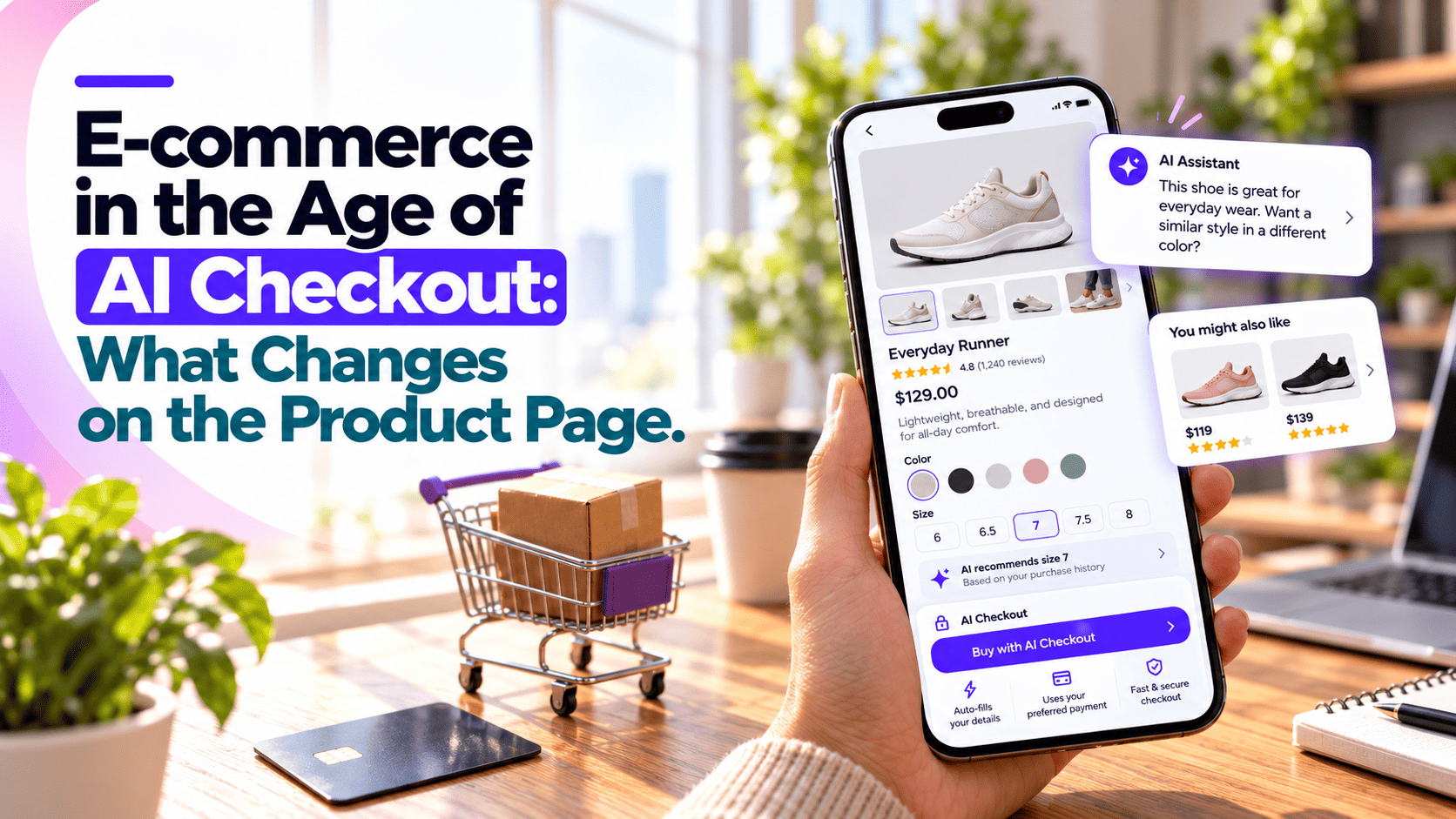
Suppose a customer is seeking a light laptop for travelling. Instead of browsing several shopping sites, they ask an AI assistant to find a laptop with long battery life, is compact and has good customer reviews.
The assistant can compare products, view their specifications and suggest appropriate products. The customer may never visit most of the product pages involved in that decision.
This changes what an e-commerce product page needs to accomplish.
In the past, online retailers focussed their product pages mostly on people and search engines. Today they have to take into account AI systems that gather, analyse and compare product information.
In the midst of this transformation, ecommerce AI checkout optimization is playing a crucial role. It's about ensuring that product data is precise, readable and uniform, to allow AI-powered shopping experiences to “understand” the information.
The goal is not simply to make products available, but to provide reliable information that helps AI systems evaluate them.
Traditional e-commerce journeys usually follow a familiar pattern:
AI-powered shopping can streamline a few of these steps.
An assistant can compare the details of a product at various stores before narrowing down the options to a short list. It can also assist customers in supporting shopping experiences to be closer to the checkout.
But AI discovery and AI purchasing are not the same. As of October 2026, shopping and checkout features depend on the provider, market, and merchant.
For retailers, the message is obvious: product information needs to be sensible even if a person doesn't read it all.
It is possible to create a page that looks great, but is hard for an automated system to understand.
Take a look at two product descriptions.
Product A: "Experience exceptional comfort with our premium everyday footwear."
Product B: "Men's Running Shoes with light weight, breathable mesh upper, rubber sole and soft insole."
The second description provides an AI system with more useful attributes to compare products.
This is not about the removal of persuasive language. It is to provide supporting facts to substantiate marketing statements.
|
Product page element |
What AI systems need to understand |
|
Product title |
Exact product identity and model |
|
Description |
Features, purpose, and limitations |
|
Specifications |
Comparable technical attributes |
|
Availability |
Current stock status |
|
Product images |
Accurate visual representation |
|
Reviews |
Genuine customer experiences |
|
Shipping information |
Delivery eligibility and conditions |
|
Return policy |
Clear purchase conditions |
These clues are used to alleviate uncertainty in the automated product comparison.
AI assistants may need specific product details to answer specific shopping queries.
A customer may want a waterproof backpack with a 15-inch laptop, as opposed to a backpack.
There are several important points to keep in mind when creating a useful product page:
Don't hide these details within lengthy sales paragraphs.
Product specifications should be readily available, well labeled and uniform throughout the site.
Envision an AI adviser suggesting a specific product that seems to be available.
The customer then visits the retailer's site, only to find that the variant the customer had chosen is not available.
That isn't a good idea because it causes a lot of friction.
Consistency in inventory data on product pages, structured data and supported product feeds is key for retailers.
This is particularly relevant when there are a variety of sizes, colours or configurations of the products.
One product variant may be available while another is out of stock. Each variation may result in inaccurate data.
Product descriptions can't always tell the story as well as customer reviews.
For instance, one retailer might refer to a travel bag as lightweight. A customer review may provide information on comfort in a lengthy commute.
Both are important, but they are for different reasons.
Provide genuine and specific feedback on:
The reviews should be honest and traceable. Artificial reviews or rating manipulation should be avoided by retailers as they could affect AI recommendations.
Valid review structured data may be helpful to search systems in understanding customer reviews, where supported.
Apply Structured Data to describe the information about the product.
Structured data provides a standardized interpretation to the search engines of information on a webpage.
Product and Offer schema can be used to provide information about a product's identity, availability, offers and ratings for e-commerce sites.
Google's merchant listing documentation provides information on what product markup is and how it can help improve the shopping visibility of products.
When mapping out their structured data needs, retailers can take a look at GBIM's Schema Creator.
Adding schema markup, however, doesn't mean it will be included in AI-based recommendations.
The information should also be correct and contain visible page content, which is available in the respective search or shopping system.
Product details may appear in several places:
There is uncertainty when there is conflicting information.
For example, one model of product could be called one thing on the website and have a different model number in the merchant feed.
These records could be different representations of the same product, which could be difficult for an AI system to identify.
Utilize consistent identifiers, brand names, product attributes and availability information wherever possible.
Let's say you own an online electronics company.
|
Existing product page |
Improved product page |
|
Generic product title |
Brand, model, and product type |
|
Promotional description |
Clear benefits and specifications |
|
Unclear variant information |
Separate attributes for each variant |
|
Outdated availability |
Synchronized inventory information |
|
Reviews without useful detail |
Authentic, descriptive feedback |
|
Missing product markup |
Valid Product structured data |
The improved product page serves two audiences.
The human shoppers will find it easier to make informed decisions and automated systems will get the information it needs to compare products.
That's where the old school e-commerce SEO and the AI-powered product discovery start to converge.
No. It alters some of the ways in which product information is sought and utilized.
There is still a place for traditional SEO in category visibility, product search, site architecture, inbound linking, and organic traffic.
There are extra considerations for product information quality and machine-readable data in AI shopping experiences.
For that reason, it is perfectly okay for retailers to think of ecommerce AI checkout optimization as a complement to their current SEO strategy and not something that can supplant it.
Retailers can overcome the challenge of product discoverability and contribute to better clarity and organisation of their online catalogues with a good e-commerce SEO strategy.
There is a significant technical difference, too.
Structured data is information presented on a web page. Product feeds deliver catalog content straight to the shopping systems that support them. A checkout integration also has an independent transactional functionality.
Each element supports a different part of the purchasing journey.
Before investing in new AI commerce integrations, retailers can evaluate their existing product pages.
Use the following questions as a starting point.
|
Audit question |
What to check |
|
Is the product clearly identified? |
Title, brand, model, and identifiers |
|
Can specifications be compared? |
Complete, standardized attributes |
|
Is inventory information reliable? |
Accurate variant-level availability |
|
Are reviews trustworthy? |
Genuine feedback and valid ratings |
|
Is structured data implemented? |
Relevant, valid product markup |
|
Do information sources agree? |
Website, feeds, and marketplace records |
|
Do they make sense when purchasing? |
Shipping, returns and eligibility |
Focus on pages that are more likely to be seen by searchers, are of high interest for your customers, or have frequent changes in inventory.
A smaller catalog with reliable information is easier to maintain than a large catalog containing partial information.
AI shopping is unlikely to eliminate the importance of product pages. It may make their underlying information more valuable.
Retailers still need appealing product images, compelling copy and seamless buying processes. But they also require information that can be understood by non-guessing automatic systems.
Use correct specifications. Ensure that stock levels are kept up to date. Listen to customers and act on their feedback. Maintain uniformity of product data throughout the channels.
At GBIM Technologies, we help e-commerce businesses strengthen their online stores' technical foundations and organic visibility. We can help you determine the gaps that exist with your product pages, and then provide a viable strategy to optimize them for both traditional search and newer AI shopping.
AI checkout refers to shopping experiences where an AI assistant helps customers select products and, in supported integrations, complete parts of the purchasing process. The level of automation depends on the provider and merchant capabilities.
AI shopping increases the importance of clear product attributes, accurate inventory information, structured data, and consistent catalog records. Traditional SEO practices remain important for search visibility and website usability.
Structured data helps supported systems interpret product information, but it is not a universal requirement for every AI shopping experience. Product feeds and other information sources may also contribute to discovery.
Yes. Smaller retailers can begin by improving product descriptions, organizing specifications, maintaining accurate inventory records, and implementing relevant structured data. These improvements are useful even without direct AI checkout integration.
There is no reliable basis for assuming that AI assistants will replace e-commerce websites entirely. Websites continue to support detailed product research, customer service, brand experiences, and merchant-controlled transactions.
Start with product identity, specifications, availability, and data consistency. These foundational improvements make product information easier for customers and automated shopping systems to interpret.
309, Rupa Solitaire,
Sector-1, Millennium Business Park,
Mahape, Navi Mumbai,
Maharashtra (400 710), INDIA.
Write to us at
hr@gbim.com