
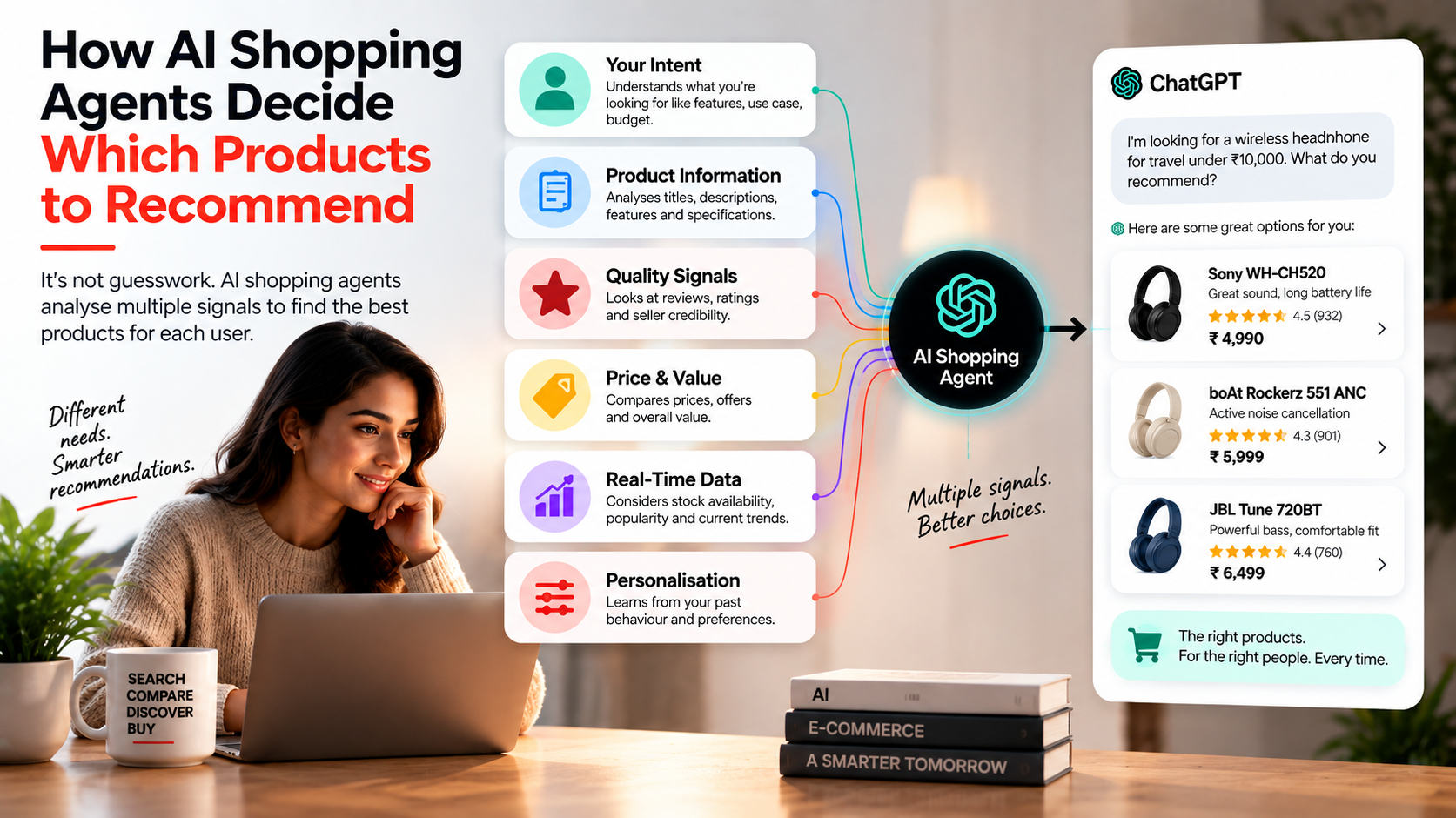
Imagine two online stores selling essentially the same product.
The first gives each product a clear name and identifier. Its sizes and colors are properly separated, availability is current, product descriptions match the actual item, and structured product information supports what shoppers see on the page.
The second store looks impressive to a human visitor, but its product information is inconsistent. Variants are difficult to distinguish, availability is outdated, and important details are missing or contradictory.
Which store can a machine understand more confidently?
That question gets to the heart of how AI shopping agents choose products. As shopping becomes more AI-assisted, retailers need to think beyond how attractive a product page looks. They also need to consider whether systems can accurately identify, interpret, compare, and retrieve their product information.
There is no secret piece of markup that guarantees a recommendation. The more useful way to approach the subject is to understand the signals that make products clearer to machines.
The first misconception worth clearing up is that "AI shopping agents" are one technology operating according to one ranking formula.
They aren't.
Shopping experiences can be built on different AI models, product catalogs, merchant integrations, search indexes, feeds, APIs, retailer data, and other information sources. The information available to one shopping assistant may not be identical to the information available to another.
That makes promises such as "do these five things and AI will recommend your product" unreliable.
Instead, businesses should concentrate on something they can control: making their product information accurate, complete, consistent, and understandable wherever it is supplied.
Rather than searching for an "AI optimization hack," consider the collection of information that describes a product.
Think of it as a signal stack.
Start with the basics.
A product should have a consistent identity across the systems where its information appears. Depending on the product and platform, useful identifiers and information may include:
These details help distinguish one product from another.
Google's merchant-listing documentation, for example, supports properties including brand, category and SKU within Product structured data.
A shopper doesn't simply want "a shirt." They may want a blue, medium-sized version of a particular shirt.
That distinction matters to machines as well.
Product attributes can include:
Google specifically recommends identifying product variants appropriately and using unique IDs for variants. Its documentation explains that ProductGroup and associated properties can help Google understand products that are variations of the same parent item.
Poorly separated variants can introduce ambiguity before recommendation is even part of the discussion.
A product may be relevant, but that is less useful if its underlying information no longer reflects what the customer will find on the page.
Availability and other offer information therefore need ongoing attention.
Google's merchant listing documentation, for instance, supports product information such as availability, shipping and return details in its merchant experiences.
The broader lesson is simple: product data is not a one-time SEO task. It needs to remain synchronized with the store.
A product feed turns a catalog into structured information that supported platforms can process systematically.
That makes feed quality important.
Missing attributes, inconsistent identifiers or stale information can create a different version of the product depending on which source a system reads.
For ecommerce teams, feed management should therefore be treated as part of product-data quality rather than merely a task completed when a store first connects to a shopping platform.
Structured data provides information about a page in a standardized format.
For ecommerce websites, Product markup can communicate information about products and offers in a form supported by search systems.
Google states that Product structured data can make pages eligible for product-related search experiences. Merchant listing markup can support information including availability and other product details.
Businesses implementing it can consult Google's Product structured data documentation for the current requirements.
But there is an important distinction:
Structured data helps describe a product. It does not guarantee that an AI assistant will recommend it.
Machine-readable information cannot compensate for a confusing underlying product page.
Suppose the visible page says a particular variant is unavailable while another data source says it is available. Or the feed uses one product identifier while the page uses another.
The issue isn't simply that one field is wrong. The system is receiving conflicting information.
This is why product-data consistency deserves as much attention as completeness.
When trying to understand how AI shopping agents choose products, it is easy to overestimate schema markup and treat it as a shortcut to AI visibility.
That's too strong.
What we can establish is narrower and more useful.
Google describes structured data as a standardized way to provide information about a page and classify its content. For products, supported markup can communicate details that Google uses for eligible product and merchant-listing experiences.
For an ecommerce business, that means structured data can reduce ambiguity around what a page represents.
It is better to think:
"Make our products easier for systems to understand."
Not:
"Add schema and AI will recommend us."
Those are very different claims.
Structured data exists on the website. Product feeds provide another structured source of catalog information to platforms that support them.
The same quality principles apply to both.
A feed should accurately represent what shoppers can actually find. Product names should be recognizable, identifiers should remain consistent, variants should be distinguishable, and frequently changing information should stay current.
The goal is not to stuff the feed with more information for its own sake.
It is to reduce uncertainty.
A retailer doesn't need to understand every AI model to identify weaknesses in its own product data.
Start with seven questions:
Our Schema Creator can help businesses create structured markup, while the Structured Data Testing Tool provides a way to validate markup and identify errors or warnings.
Validation still does not guarantee recommendation or visibility. It simply helps establish that the structured information has been implemented correctly.
You may encounter studies, presentations or marketing claims attaching a specific percentage increase in "AI selection likelihood" to schema implementation.
That deserves caution.
A percentage is only useful when we know what was tested: which AI system, which products, what dataset, how "selection" was defined, what the control group was, and whether other variables were held constant.
Without a verifiable original study establishing the relationship, such a statistic shouldn't be presented as a universal ecommerce benchmark.
What we can verify is Google's documentation showing that structured product information helps Google understand product details and can make qualifying pages eligible for supported product experiences.
That's already a practical reason to get product data right without inventing certainty about AI recommendations.
Understanding how AI shopping agents choose products is useful, but an e-commerce business has an even more practical question to answer:
How easy is our catalog for machines and customers to understand accurately?
Start there.
Clear product identities, well-defined variants, reliable attributes, synchronized feeds, valid structured data and consistent product pages create stronger digital foundations regardless of which AI shopping interfaces become dominant.
At GBIM, we approach this as part of the wider ecommerce visibility problem rather than treating "AI optimization" as an isolated trick. Our ecommerce SEO work looks at the technical, content and search foundations that help online stores make their products easier to discover and understand. As AI changes how people research products, we believe those foundations become more important, not less.
There is no single method used by every AI shopping system. Different platforms can rely on different models, catalogs, integrations, feeds and other information sources. Product relevance, available product information and the particular system's capabilities can all influence what a shopper sees.
No. Structured data helps machines understand information about a page, but valid schema does not guarantee an AI recommendation. Google similarly describes Product structured data in terms of understanding product information and eligibility for supported search experiences rather than guaranteed visibility.
Feeds give supported platforms structured catalog information. Accurate identifiers, attributes, variants and availability make product information easier to process consistently. Their exact role, however, depends on the shopping platform or AI system involved.
Yes. Structured data and customer-facing content perform different jobs. A product page still needs useful information that helps shoppers understand and evaluate an item, while structured data can communicate supported details in a standardized machine-readable format.
Businesses should pay particular attention to product names, identifiers, brands, variants, attributes, availability, images and other important catalog information. The relevant fields will vary by product category and platform.
Begin with product-data quality rather than chasing AI-specific shortcuts. Audit product pages, identifiers, variants, feeds and structured data for completeness and consistency. Keep changing information current, validate markup, and follow the documentation of the platforms where your products appear.
309, Rupa Solitaire,
Sector-1, Millennium Business Park,
Mahape, Navi Mumbai,
Maharashtra (400 710), INDIA.
Write to us at
hr@gbim.com