
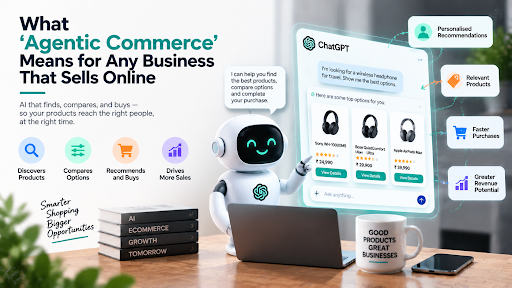
Imagine someone wants a new pair of running shoes.
The traditional journey is familiar. They search Google, open several product pages, compare reviews, check availability, maybe visit a marketplace, return to a brand website, and finally complete the purchase.
Now imagine an AI assistant helping with several of those steps in one conversation. The shopper describes what they need, the assistant narrows the options, compares products, answers follow-up questions, and, where supported, helps move the purchase toward checkout.
If you're wondering what is agentic commerce?, this shift offers the simplest explanation. It is not merely AI giving product recommendations. It is the move toward AI systems taking a more active role across the shopping journey, from discovery and comparison to permitted purchasing actions.
For businesses that sell online, that creates an important shift: your website is no longer the only place where customers may discover, evaluate, or even buy your products.
Agentic commerce refers to shopping experiences where AI agents can perform tasks on behalf of a user rather than simply answering questions.
Those tasks can include:
The important word is approved.
Current agentic commerce systems are not generally designed to make unrestricted purchases without the shopper's involvement. For example, OpenAI's Instant Checkout requires users to confirm the relevant purchase details, while Google's UCP-based commerce model is designed around systems exchanging information and carrying out commerce actions within supported merchant and payment environments.
So agentic commerce is better understood as delegated shopping assistance, with the level of automation depending on the platform, merchant integration, and user authorization.
The easiest way to see the difference is to compare the two journeys.
|
Traditional E-commerce Journey |
Agentic Commerce Journey |
|
Shopper searches manually |
Shopper describes the need conversationally |
|
Multiple pages or tabs are opened |
AI gathers and organizes relevant options |
|
Shopper compares products manually |
AI can summarize differences |
|
Customer checks availability |
Connected systems may retrieve availability data |
|
User visits a product page |
Product information may appear inside the AI experience |
|
Customer adds products to cart |
An AI-supported cart may be created |
|
Checkout happens on a website |
Checkout may occur within or through the AI interface |
|
Buyer manages each individual step |
Some approved actions can be delegated |
This does not mean conventional e-commerce websites are disappearing.
It means the customer journey is gaining another interface.
Consider how an agent-assisted purchase might work.
Instead of typing several short search queries, someone could simply say:
“I need lightweight running shoes for everyday road running, preferably with good cushioning.”
The starting point becomes a description of the desired outcome rather than a specific product name.
An AI system can break the request into attributes such as:
This is one reason accurate product information becomes increasingly important.
The system may use product feeds, merchant data, indexed web information, platform integrations, or other supported sources to find relevant products.
OpenAI, for example, introduced Instant Checkout as part of its move toward agentic commerce, allowing eligible products from participating merchants to be purchased from within ChatGPT.
Microsoft has taken a similar direction with Copilot Checkout, which enables supported shoppers to move from product discovery to purchase within Copilot while keeping the retailer as the merchant of record.
Instead of asking the customer to manually inspect several pages, the assistant can help compare characteristics that matter to the request.
This could shorten the path between initial interest and a buying decision.
The shopper still remains an important part of the process.
They may choose the product, confirm a recommendation, review the order, or authorize the next action.
Agentic does not automatically mean autonomous.
Where integrations exist, the AI experience can help carry the transaction forward.
Perplexity's Instant Buy, for example, currently allows eligible U.S. users to search for products and purchase from participating merchants directly through Perplexity's checkout workflow.
Google is also building agentic commerce infrastructure through the Universal Commerce Protocol, or UCP. Google describes UCP as an open standard designed to let AI agents, merchants, payment providers, and consumer platforms communicate across the shopping journey.
This is where the subject becomes more important than another AI trend.
Online retailers have traditionally optimized product pages primarily for two audiences:
people and search engines.
Agentic commerce adds another layer:
AI systems that need to interpret product information accurately enough to use it during a shopping task.
That changes the value of product data.
A product description is still important because a human may read it.
But the supporting information also needs to clearly communicate facts such as:
If this information is inconsistent across the website, feeds, and merchant platforms, it becomes harder for automated systems to confidently understand what is actually being sold.
For businesses working on e-commerce SEO, this means discoverability increasingly involves both the customer-facing page and the quality of the product data behind it.
A useful way to think about this shift is to separate human needs from machine needs.
A shopper still wants:
An AI system benefits from:
That does not mean retailers should write robotic product pages.
It means the underlying commerce data should be organized enough for machines to understand while the visible experience remains useful and convincing for people.
This distinction becomes especially important for businesses asking what is agentic commerce? and, more practically, what they need to do to prepare for it.
Structured data gives search engines and other compatible systems a standardized way to understand information on a webpage.
For e-commerce websites, product structured data can describe details such as product names, offers, ratings, availability, and other attributes.
Google states that adding structured data can help it understand page content and make product information eligible for richer search experiences. Google also recommends combining structured data with Merchant Center feeds where appropriate because the two sources can provide complementary product information.
Google's own introduction to structured data is a useful starting point for understanding how machine-readable information works.
Structured data should not be treated as a shortcut that guarantees a recommendation from an AI assistant.
Its value is more fundamental: it can make product information easier for supported systems to interpret correctly.
There is a tempting assumption that if AI begins choosing and comparing products, traditional marketing becomes less important.
The opposite may be closer to reality.
AI still needs products to discover. Customers still develop preferences. Brands still need demand. Merchants still need credible websites, good products, useful information, strong reviews, reliable availability, and clear positioning.
A shopper may ask an assistant:
“Find me a reliable coffee machine for a small apartment.”
But why certain brands are already known, reviewed, searched for, linked to, or trusted remains a marketing question.
Agentic commerce changes part of the interface between the customer and the business. It does not remove the need to become visible or desirable.
The channels feeding that demand may still include:
The buying path may become shorter, but the reasons a customer considers a brand do not suddenly disappear.
Paid discovery does not disappear either. Channels such as Google Ads can still introduce products and brands before an AI assistant becomes involved in the customer's shopping journey.
Agentic commerce is developing quickly, but businesses do not need to rebuild their entire e-commerce operation around every new AI announcement.
The more practical starting point is much less dramatic.
Make sure your product information is accurate.
Keep feeds updated.
Use consistent identifiers.
Maintain structured product data.
Make important policies easy to understand.
Ensure the website remains useful for customers who still prefer a conventional shopping journey.
At GBIM, we see this as part of a broader discoverability challenge rather than a standalone technology trend. We help businesses connect e-commerce SEO, product visibility, technical foundations, content, and digital marketing so that products remain easier to find and understand as customer journeys continue to change.
The businesses that prepare well are not necessarily those chasing every new AI feature first. They are the ones making their digital commerce information reliable enough to work across both today's channels and the emerging ones.
Agentic commerce is a form of online shopping where an AI assistant can help perform tasks for the customer, such as finding products, comparing choices, creating a cart, or supporting an approved purchase.
Traditional e-commerce normally requires the shopper to navigate websites and complete most actions manually. Agentic commerce allows an AI system to assist with or perform selected steps across the shopping journey.
That depends on the platform and authorization model. Current major implementations generally include user confirmation or permission before important transaction actions are completed.
Examples include OpenAI through Instant Checkout, Google through UCP-powered shopping experiences, Microsoft through Copilot Checkout, and Perplexity through Instant Buy. Availability varies by market, merchant, and platform.
AI systems need clear information to understand products accurately. Consistent titles, attributes, availability, identifiers, structured data, and product feeds can make product information easier for supported systems to interpret.
Businesses do not need to adopt every emerging platform immediately. However, improving product data, structured information, feeds, website usability, and overall discoverability can strengthen the business regardless of how quickly agentic commerce develops.
309, Rupa Solitaire,
Sector-1, Millennium Business Park,
Mahape, Navi Mumbai,
Maharashtra (400 710), INDIA.
Write to us at
hr@gbim.com