
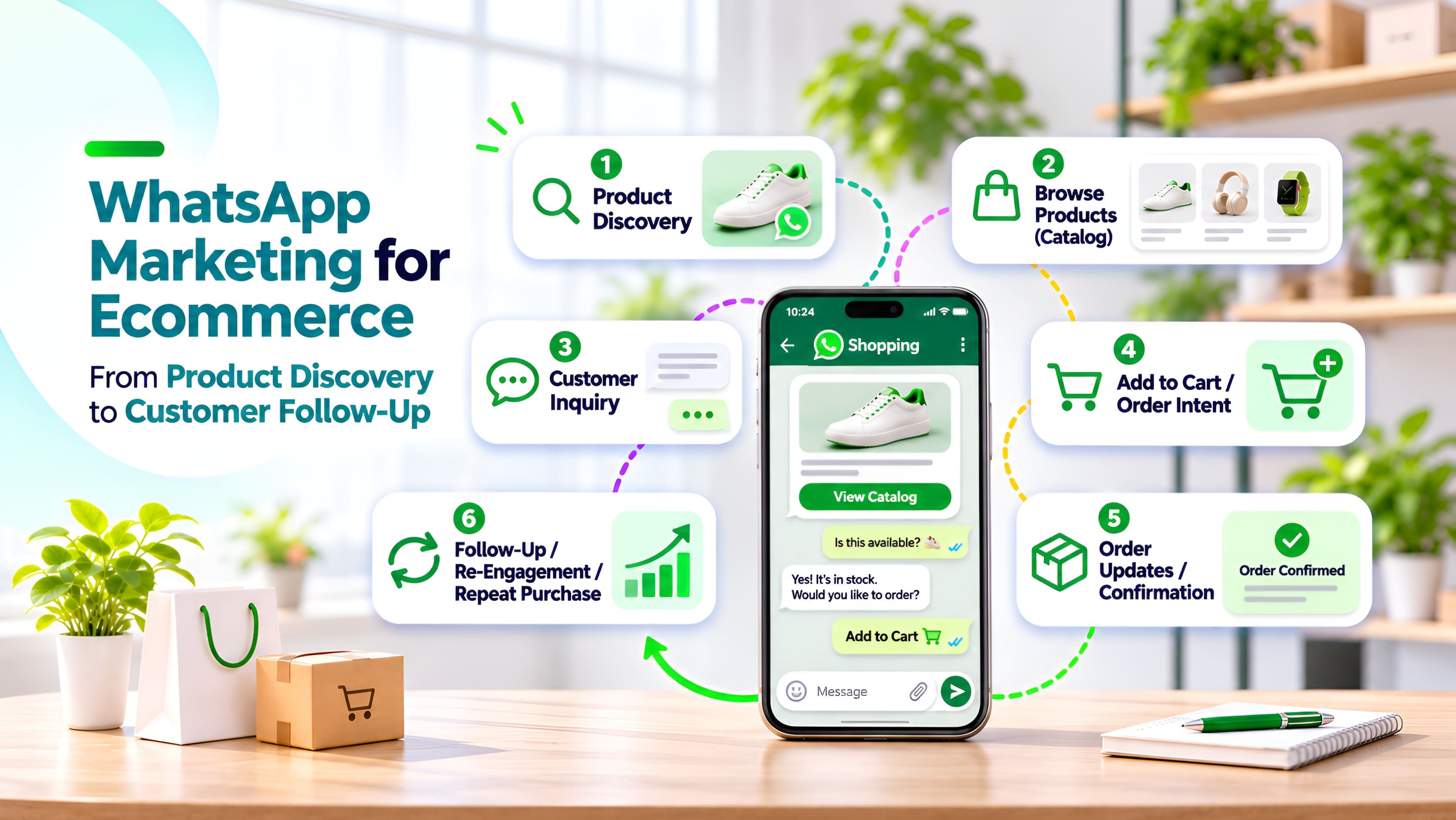
On Instagram, a customer discovers a pair of running shoes. The design is just right except that they don't know the size. No need for them to go through multiple layers of websites options and no need to ask questions, they simply tap on the WhatsApp icon and ask.
The store will offer a sizing guide and connect to the product. One customer sends a request and then another message of delivery status is sent to the customer via the same channel.
That's where it becomes possible with a few simple conversations to close the circle of the purchasing process for several points on the way with WhatsApp marketing for ecommerce.
Now, online retailers can no longer just be limited in responding to their customers' complaints via WhatsApp. It can assist in the discovery of products, decision making to purchase the products, communication with the order and even customer retention.
It should be useful, timely and relevant, but not be about sending more messages, it should be about each interaction.
While it may be convenient to shop online, sometimes you just aren't able to look at the product or meet the sales staff one-on-one.
They may want to know the size of the product, how it's available or when it is going to arrive, or the return terms.
If these questions remain unanswered, customers can delay their purchases or proceed to another store to make their purchases.
WhatsApp, a messaging service used for communication can be used by businesses to respond to the questions of customers and guide them to the right information.
Think about how conversations can help to meet the needs of customers:
|
Shopping stage |
Customer requirement |
WhatsApp opportunity |
|
Discovery |
Explore suitable products |
Share relevant catalogue information |
|
Consideration |
Compare features and options |
Answer product questions |
|
Purchase |
Resolve checkout doubts |
Provide assistance and links |
|
Order fulfilment |
Understand delivery progress |
Share permitted order updates |
|
After-sales |
Request help or guidance |
Offer customer support |
|
Retention |
Discover relevant products |
Send permission-based follow-ups |
Best suited in conjunction with an easily accessible site that can facilitate ecommerce.
The ecommerce brands are on Google Search, Instagram, Facebook, influencers and ads online.
As soon as they start to ask questions, to go beyond the browsing, then WhatsApp becomes useful.
Businesses may be able to leverage WhatsApp chats in proper customer engagement like:
For instance, when a furniture company asks customers about the size of sofas, the various types and colors of fabric and if they offer delivery service.
The message should give an overview of the services that customers can expect.
Depending on business accounts and features, retailers can post product photos, catalog listings, descriptions and links to websites.
If you sent out the full catalogue you would only confuse the person who wanted to know about one item in the catalogue.
The way to do this is to be aware of what they need and to provide some possibilities for this.
A fashion company gets an e-mail one day with the following message:
If you were in the cold winter would you wear this jacket?
It offers little chances of helping the customer if a generic answer is returned, simply with the return home page.
Answers should contain the description of the clothing, the size and purpose of the clothing based on the given information regarding the product.
Helpful answers can reduce uncertainty before purchasing.
They may be referred to human support for more detailed questions, but automated answers should be able to provide answers to more frequently asked questions.
Not every cart abandoner will buy the products that they have placed in their carts.
Some customers are reluctant due to the need for more information on delivery, payment options and product variations, or returns.
If the customers face such problems they will seek help, and WhatsApp can come to their rescue to ease worried feelings.
If a customer is interested in purchasing an appliance for use in the kitchen, he or she might request the appliance be delivered to his or her place.
The retailer can give information regarding its delivery policy and provide the right checkout link.
Recall of abandoned carts can also be a great tactic as long as the organization has the proper consent and adheres to WhatsApp texting rules.
Not being able to leave a cart abandoned doesn't mean a retailer has the right to send promotional WhatsApp messages.
Customers want to find out what happens after they place an order.
The right updates can eliminate uncertainty and help support to be more easily available.
The approved WhatsApp communication can be used by companies for:
The information should be accurate in regard to the order status.
On the WhatsApp Business Platform, businesses can generally send free-form replies within 24 hours of a customer's latest message. Outside this window, approved message templates are required. Business-initiated messages must also follow applicable opt-in requirements, WhatsApp policies and privacy laws.
Order updates need to be saved as an order update and not be camouflaged promotions.
An ecommerce brand and customer shouldn't end at the sale but they should be stronger after that.
Follow-up that is relevant can assist customers with their satisfaction and engagement in the future.
An online furniture company that specialises in wood furniture.
Once the product is delivered, the company can guide the product maintenance, or troubleshoot product assembly problems.
Other useful interactions: Requesting customer feedback, helping with returns, and making proper product suggestions (as appropriate and allowed by customers).
Importance of timing and reason of each message.
Another ad for a refrigerator may be less helpful to a customer than an installation guide for a newly-purchased refrigerator.
The aim of a successful WhatsApp marketing for ecommerce strategy should be to link the messaging efforts to meaningful customer results.
One of the indicators is volume of messages; whether purchases are made or customers are satisfied as a result of the messages.
|
Performance indicator |
What it reveals |
|
Conversations initiated |
Customer interest in contacting the business |
|
Response time |
Efficiency of customer assistance |
|
Qualified enquiries |
Relevance of customer conversations |
|
Conversation-to-purchase rate |
Purchases associated with messaging interactions |
|
Support resolution rate |
Effectiveness of customer service |
|
Opt-out rate |
Possible dissatisfaction with communication |
For example, if there are particular links that the business has provided for the campaigns, then they will be able to track traffic from WhatsApp discussion and differentiate it from the other traffic. All these, if collected with the compliant CRM records and orders, can be helpful to the retailer to evaluate the questions and the repeat customers' actions.
It's important to note here, however, that simply having a conversation with a customer on WhatsApp does not mean that the purchasing of said product or service, for example, is WhatsApp's responsibility.
Customers may have interacted with several marketing channels before purchasing.
Without an understanding of the importance of communication, companies may miss the mark on communicating effectively.
Some of the common mistakes are sending repetitive promotions, providing outdated product information, automating but not having any human touch, and responding too late.
Additionally, companies must stop collecting any additional customer information or making any other promotional communications after an opt-out.
These rules apply to the templates and outbound messages that are sent as part of a promotion, and the WhatsApp messaging policy requires the appropriate permission.
Any good approach can function with customers' preferences without impacting the product information.
When using WhatsApp for ecommerce, consider it as a component of the customer journey rather than a marketing tool or medium.
Conversations can enable customers to locate products, address buying problems etc. and can be used to provide post-purchase customer service.
At GBIM, we help ecommerce brands to see the link between digital ad/marketing and customer engagement and conversions. We want to establish a real relationship with our customers and as well create measurable business growth and long-term customer relationships.
Helpful conversations matter beyond the purchase.
WhatsApp marketing involves using WhatsApp to communicate with online shoppers throughout their buying journey. Businesses can answer product questions, provide purchase assistance, share permitted order updates and maintain customer relationships through relevant conversations.
WhatsApp can support sales by addressing customer questions, reducing purchase uncertainty and helping shoppers find suitable products. However, results depend on product relevance, response quality, customer intent and the overall shopping experience.
Businesses can use Click-to-WhatsApp advertisements, website contact buttons and social media links to encourage interested customers to begin conversations. These interactions can help retailers understand requirements and recommend relevant products.
Yes, where permitted. Businesses must obtain appropriate customer permission and follow WhatsApp's messaging policies. For the WhatsApp Business Platform, outbound reminders outside the customer service window require approved message templates.
Automation can help manage routine enquiries, acknowledge messages and provide relevant order information. However, customers should have access to human assistance when their questions require individual attention or more detailed support.
Businesses should monitor conversation volume, response times, qualified enquiries, purchases associated with messaging, support resolution and opt-out rates. Reviewing these indicators alongside website and sales data provides a clearer understanding of campaign effectiveness.
309, Rupa Solitaire,
Sector-1, Millennium Business Park,
Mahape, Navi Mumbai,
Maharashtra (400 710), INDIA.
Write to us at
hr@gbim.com