
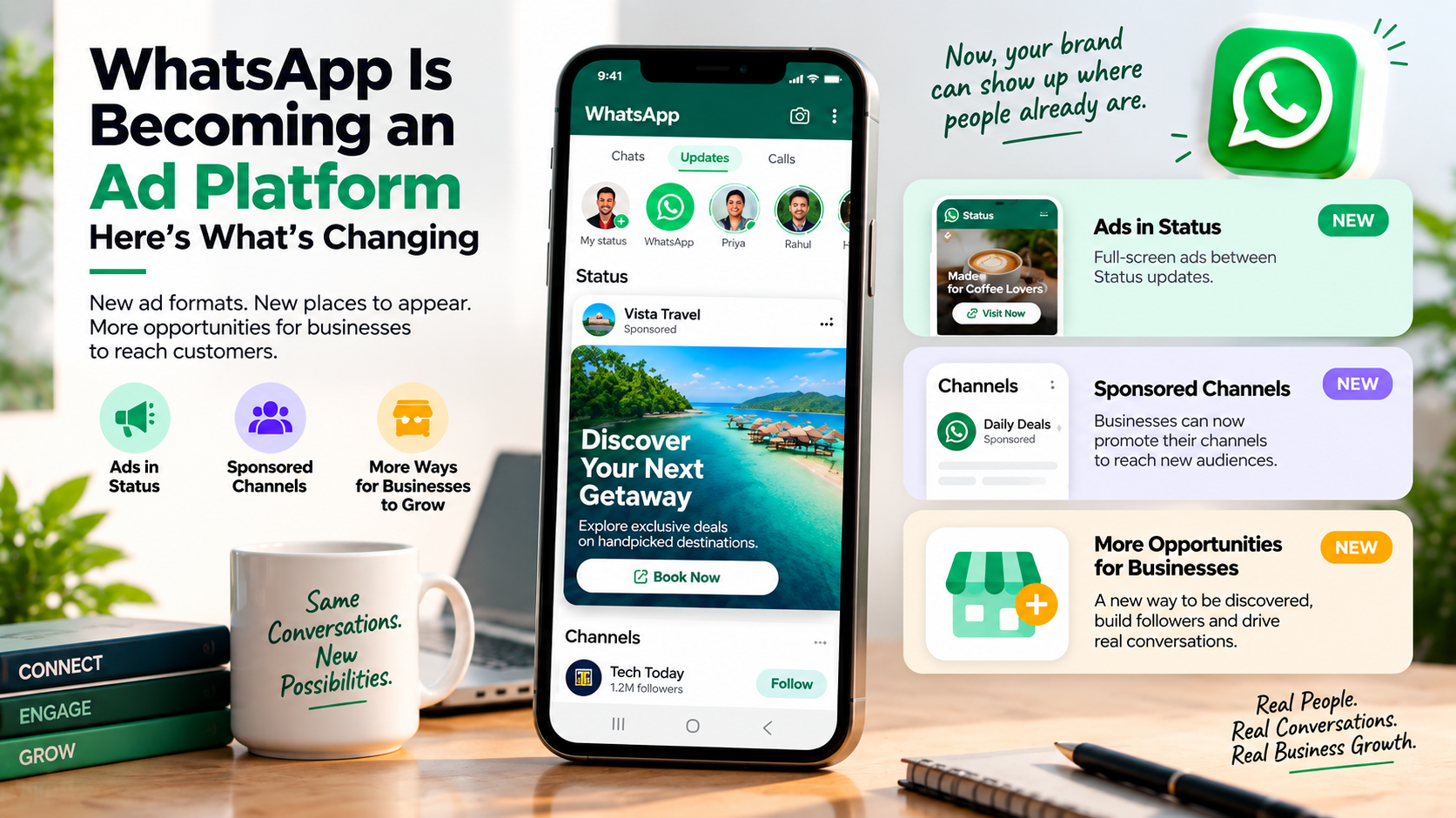
“Ads on WhatsApp” can sound more intrusive than the reality. It is easy to imagine sponsored messages appearing between conversations with family, colleagues, or customers. That is not how WhatsApp has designed its advertising experience.
The change is happening primarily inside the Updates tab, where people already view Status updates and follow Channels. Personal chats remain separate. The latest WhatsApp Status ads in India rollout is important for businesses because advertising is entering selected discovery surfaces without changing the private nature of personal chats.
Instead, Meta is opening selected parts of WhatsApp to commercial discovery while keeping personal communication separate from those placements. Ads in Status, promoted Channels, and related features are gradually creating a new marketing surface inside an app that many Indian consumers already use every day.
The simplest way to understand the change is to look at WhatsApp as two different environments.
There is the private communication side:
Then there is the Updates side:
Advertising is being introduced into the second environment.
WhatsApp says ads may appear while people are viewing Status, while promoted Channels can receive additional visibility in the Channels area. Status ads are labeled as advertising rather than being presented as ordinary updates.
That difference is fundamental. The advertising opportunity comes from the discovery layer of WhatsApp, not from inserting commercial messages into someone's private conversations.
There are three developments businesses should separate rather than treating them as one feature.
WhatsApp Status already works as a temporary content stream where people share photos, videos, text, and updates.
Businesses can now potentially appear within that viewing experience through ads in Status.
That moves WhatsApp closer to being a paid discovery channel rather than only a place where a customer arrives after discovering a brand somewhere else.
A person might be moving through Status updates and encounter a clearly labeled advertisement from a business without first opening a conversation with it.
WhatsApp Channels allow organizations, creators, publishers, and businesses to broadcast updates to followers.
Promoted Channels add a paid discovery layer.
Instead of relying entirely on people finding a Channel organically, eligible Channel administrators can potentially promote it within WhatsApp's discovery environment. WhatsApp is still rolling these capabilities out gradually, so availability can differ across markets and accounts.
Historically, many businesses treated WhatsApp as the destination rather than the discovery channel.
A customer might:
or:
Status advertising potentially changes that sequence.
WhatsApp itself can now become part of the discovery stage rather than serving only as the communication tool at the end.
This is arguably more important than what is changing.
Personal messages are not becoming normal advertising inventory.
WhatsApp says personal messages, calls, and Status content remain end-to-end encrypted. It also states that personal messages, calls, and the groups someone belongs to are not used to determine the advertisements that person sees.
So this is not a scenario where a private conversation about buying a sofa suddenly causes a sofa advertisement to appear because WhatsApp read that conversation.
WhatsApp also states that it does not sell or share people's phone numbers with advertisers.
That separation matters for both users and advertisers.
Businesses should understand that WhatsApp advertising creates a new placement opportunity. It does not provide unrestricted access to private user conversations.
India is particularly important because WhatsApp already plays a significant role in communication between consumers and businesses.
Meta previously confirmed that businesses including Maruti Suzuki, Air India, and Flipkart were using ads in Status as the company began bringing the experience to people in India. The company described the introduction as a gradual rollout rather than an instant nationwide switch.
As the WhatsApp Status ads in India rollout develops, businesses should remember that availability is expanding gradually rather than appearing for every user at once.
A feature being officially announced does not necessarily mean every advertiser or every user sees exactly the same functionality immediately.
WhatsApp's own help documentation continues to state that Status and Channel ads are being introduced progressively and may not yet be available in every region or to every user.
For businesses, availability should therefore be checked directly rather than assumed from headlines.
Another common misunderstanding is that WhatsApp would need to read private conversations to decide which advertisements to display.
Meta says the advertising system instead uses a more limited set of information.
That may include:
For people who have chosen to connect WhatsApp with Meta's Accounts Center, advertising preferences and information from their other Meta accounts may also contribute to personalization.
This creates some familiar targeting characteristics without making private messages the targeting source.
It is also useful to separate ad targeting from Channel recommendations. WhatsApp says Channel recommendations can consider signals such as general location, language preference, Channel activity, popularity, reactions, and the kinds of Channels people interact with.
For marketers, the lesson is straightforward: WhatsApp discovery has its own context and signals. It should not automatically be treated as another copy of Facebook or Instagram targeting.
The most interesting change may not be the ad format itself. It may be WhatsApp's position in the customer journey.
For years, a typical path looked like this:
WhatsApp usually appeared once some level of intent already existed.
The emerging journey can look different:
This gives marketers another potential entry point into the journey.
It also means businesses exploring social media advertising with GBIM may eventually need to think about WhatsApp not merely as a response channel but as part of the broader paid-media mix.
Not quite.
There are obvious similarities.
Both can now contain:
But the environments are still different.
Instagram was designed around public and semi-public content discovery. WhatsApp's core identity remains communication, while the Updates tab provides a separate space for broader discovery.
That difference affects user expectations.
Someone scrolling Instagram expects to encounter brands frequently. A WhatsApp user may approach the app with a much stronger expectation of utility, communication, and personal relevance.
Businesses therefore should not simply copy an Instagram campaign into WhatsApp and assume the context is identical.
The creative, message, and action need to fit the environment.
Following every new advertising format immediately is rarely a strategy.
Businesses following WhatsApp Status ads in India developments should focus on audience behavior and campaign suitability rather than treating the new placement as an automatic advertising opportunity.
High WhatsApp usage alone is not enough.
The advertising experience exists in Status and Channels, so behavior within those areas matters more than simply having WhatsApp installed.
Decide whether the objective is:
A channel without a defined role becomes another place to spend attention without knowing what success means.
Status is a fast-moving viewing environment.
Creative should communicate its purpose quickly rather than assuming people will stop for a long explanation.
The interesting advantage of WhatsApp may be what happens after discovery.
If someone encounters a business through Status, consider how easily that person can continue toward product research, a website visit, or a meaningful conversation.
WhatsApp should compete for marketing attention based on performance and customer behavior, not novelty.
Brands already managing several paid channels may benefit from reviewing the wider strategy through GBIM's social media marketing capabilities rather than evaluating each emerging placement in isolation.
WhatsApp becoming an advertising environment is significant, but the important question for businesses is not simply, “Can we advertise there?”
It is:
What problem would advertising there solve?
For some brands, Status could create another useful discovery point. For others, existing search, social, retail, or remarketing channels may still deserve greater attention.
At GBIM, we prefer to look at that wider journey before treating any new placement as a must-use channel. We examine where audiences discover a brand, where consideration happens, where people drop out, and where another advertising surface could genuinely improve the path to action.
That business-first approach is also how we think about broader digital marketing in Mumbai: the value of a channel comes from the role it plays in growth, not simply from being new.
No. WhatsApp says ads are being introduced in Status and Channels within the Updates area, separate from personal chats and calls. Personal messages remain end-to-end encrypted and are not used to determine the ads people see.
The rollout is gradual. Meta has confirmed that Status advertising is being introduced in India, but WhatsApp notes that availability can vary by account and region while the feature continues to expand.
Meta says limited information such as country or city, language, followed Channels, and interactions with ads can help determine relevant advertising. Additional Meta advertising information may be used when a person has connected WhatsApp to Accounts Center.
They share some surface similarities because both appear around vertical, temporary content. However, WhatsApp and Instagram have different user environments and expectations, so businesses should not assume the same campaign approach will perform identically.
Businesses interested in advertising and customer communication should review the tools available through WhatsApp's business ecosystem and Meta Ads Manager. Feature availability can differ as the rollout develops.
No. Suitability depends on where the target audience spends attention, how customers discover the business, the campaign objective, creative suitability, and how WhatsApp fits alongside existing marketing channels. A new advertising placement is useful only when it has a clear role in the customer journey.
309, Rupa Solitaire,
Sector-1, Millennium Business Park,
Mahape, Navi Mumbai,
Maharashtra (400 710), INDIA.
Write to us at
hr@gbim.com