
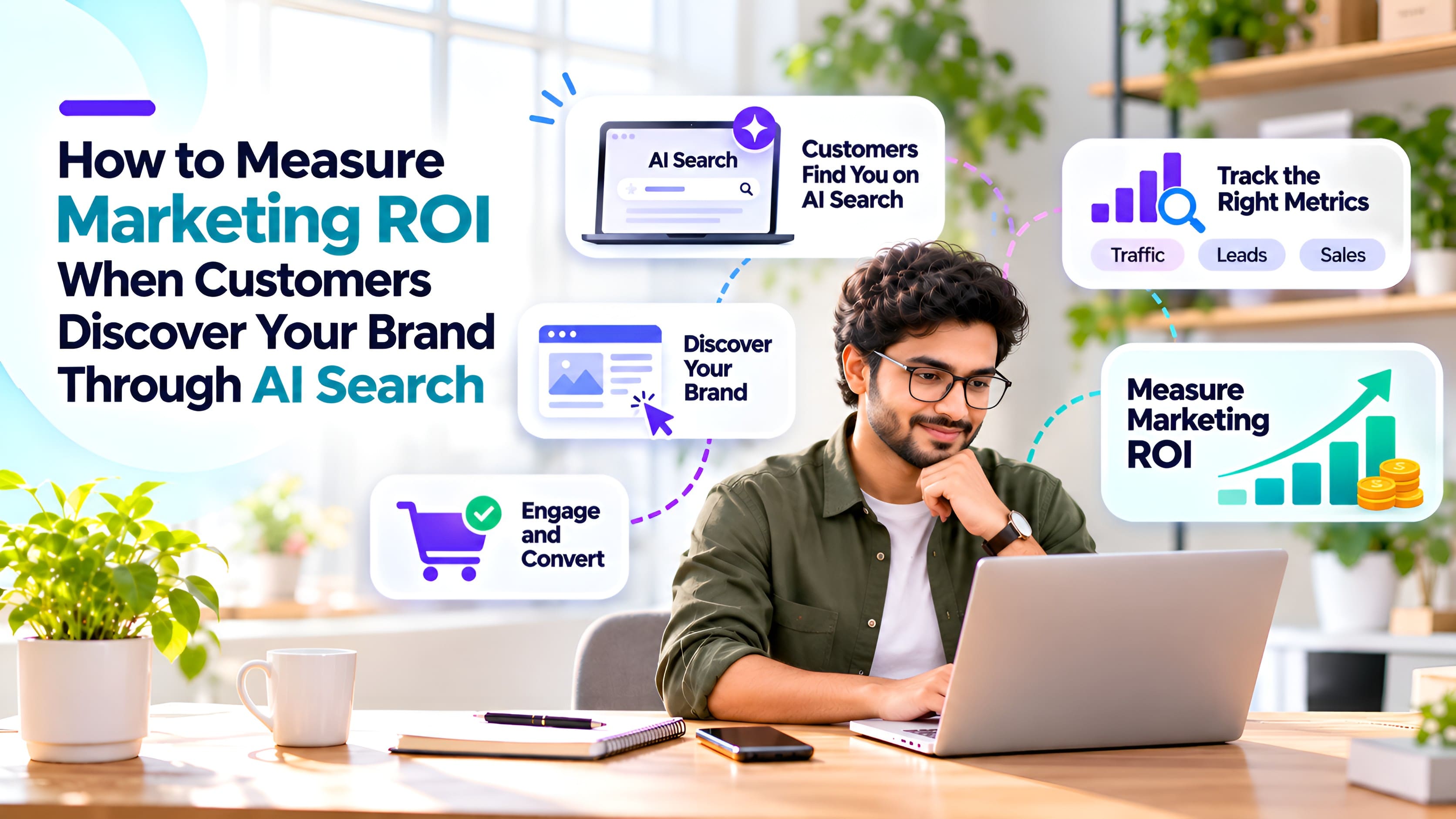
A new business enquiry is seen on your marketing dashboard from Google. They checked out your site, took a look at your services and booked a consultation.
As you're talking with the salesperson, though, you find something interesting. Your company is recommended by an AI assistant as a prospect's first introduction.
But which channel can take the credit?
This is the challenge of measuring AI search marketing ROI. Commercial impact of AI-powered discovery is hard to measure, as it can impact customer decisions on their way to a website.
If your business already invests in SEO, continue using analytics alongside newer AI visibility indicators. It is to blend AI visibility data, customer behaviour and business outcomes to comprehend the whole journey.
The classic marketing reports focus on measurable interactions such as visits to a site, clicks on ads and the conversion of those clicks.
There is another layer with AI-assisted discovery.
Customers may have the capability to ask AI-based assistants to match service providers, suggest products or clarify business solutions. They might find a brand in an answer, and go to its website at a later time.
If you are a marketing manager looking for digital agencies, think about it.
AI may have influenced discovery, while analytics records the visit as organic search.
Google Analytics 4 offers various attribution models, such as data-driven attribution. But this type of model can't automatically detect a previous AI interaction where there was no website activity.
This is important in measuring marketing performance.
When businesses are able to distinguish between visibility, engagement, and commercial results, the path of AI discovery measurement is made more clear.
|
Measurement area |
Useful indicators |
Main limitation |
|
AI visibility |
Brand mentions, citations, AI search impressions |
Exposure does not prove customer interest |
|
Website engagement |
AI referrals, engaged sessions, branded searches |
Some discovery journeys remain unidentified |
|
Lead generation |
Enquiries, qualified leads, consultation requests |
Other channels may influence conversions |
|
Business outcomes |
Customers acquired, revenue, customer-reported discovery |
Attribution may remain incomplete |
There is no single indicator that captures all the steps along the way.
You could see your company appearing in the AI suggestions more often and start to gain brand awareness without any immediate leads.
Likewise, when there are more branded searches, there might be more advertising, or social media and offline activity as well — not just AI.
If the referral information is provided, Google Analytics 4 can track visits from AI platforms.
Review traffic sources, landing pages, engagement and completed business actions.
Be extra cautious of visitors who have made enquiries or requested a consultation.
Customers who discover your brand through AI and then go straight to your site, however, might not be able to be recognized as an AI-driven visitor.
Google launched a new feature for performance reporting of Generative AI in Search Console for the year 2026.
These reports enable website owners to analyze impressions and the pages that are included in Google's generative AI experiences, such as AI Overviews and AI Mode.
Can be helpful for visibility, but never as sales or financial returns.
Also, Google's report isn't comprehensive of all AI assistants or discovery platforms.
Businesses can test their customer questions on relevant AI assistants on a regular basis.
A B2B organization, for instance, could look at answers to questions regarding service providers in a particular sector.
Note if the brand is mentioned and how well it is described, and if it is mentioned by competitors.
Establish regular prompts and reporting times.
The observations are of sampled visibility, not audience exposure, and AI answers can vary depending on context, location and time.
Google Search Console can help businesses examine searches containing their brand name.
If there was an increase in branded impressions, it could indicate rising awareness.
Marketers should, however, contrast these changes with advertising campaigns, public relations activity and other promotional activity.
Branded search growth is a complementing indicator, not a direct measure of the impact of AI.
Customer feedback can provide data that analytics can't capture.
Include an "optional" question on enquiry forms:
How did you find out about our business?
Incorporate AI assistants with search engines, social media, recommendations and others.
Discovery sources can also be added to the CRM notes of sales teams.
Customer-reported data is not 100% accurate, but it can be useful and when used alongside digital data, gives more context.
For companies considering AI search marketing ROI, it's crucial to separate out tangible economic benefits from the overall impact on marketing.
ROI is the ratio of the value of business generated to the investment required.
The question is, how much commercial benefit can be reasonably linked to discovery using AI?
There are three categories that a practical reporting framework can utilize:
The first two categories are more indicative of commercial contribution, but can overlap.
Directional indicators need to stay away from confirmed business returns.
Don't use them all and lump them together into a single financial ROI number if there is no defensible attribution method.
Any method of measurement is reliable that starts with a baseline.
Note the current level of visibility, referral, branded search and qualified enquiry and before making any significant changes to content.
Next, set up reporting schedules and link the information you have from Search Console, GA4, CRM records and customer feedback.
If your business cycle is longer, look at the steps that leads need to take to become customers, instead of focusing on the leads that come in.
Last, but not least, tie AI metrics to broader marketing efforts.
Investigate the relationship when AI mentions and qualified enquiries both go up. Don't presume that one was the direct cause of the other.
There are three assumptions that can undermine reporting:
Every AI mentioned creates value: Being visible is good but it doesn't equal meaningful customer action.
Every branded search comes from AI: Multiple channels influence brand awareness.
More AI referrals automatically mean better ROI: Quality of traffic, conversions and business outcomes are more significant than the number of visitors.
The other thing businesses shouldn't do is advertise exact attributions if there's missing information.
While AI search is a valuable tool for customer discovery, it's not a replacement for the importance of SEO or website analytics or customer research.
The most important measurement method is to use the information that is available on visibility with qualified leads, customer feedback and measurable business outcomes.
At GBIM, we can assist businesses to tie their SEO, content strategy and digital marketing performance back to their broader growth goals. We are committed to reporting that brings value to the brand, helping them understand their customers' actions and make informed marketing decisions.
The aim is not just to be in more answers from AI. It is to determine the impact of that visibility on the improvement of business relationships and sustainable growth.
It measures the business return associated with marketing activities that support discovery through AI-powered search experiences. A reliable assessment requires commercial outcomes, relevant marketing investment and defensible attribution rather than visibility metrics alone.
Yes, GA4 can identify some visits from AI platforms when referral information is available. However, it cannot reliably detect every earlier AI interaction that influenced a customer before they visited the website.
Yes. Google's Generative AI performance reports provide visibility information for supported AI experiences within Google Search and Discover. They do not measure all AI platforms or establish the financial value of impressions.
Businesses can combine identifiable AI referrals, optional customer discovery questions and CRM records. This helps reveal some AI-influenced enquiries, although not every customer journey can be reconstructed accurately.
No. Brand mentions indicate visibility, not confirmed financial returns. Businesses need reliable information about resulting customer activity, attributable business value and relevant marketing investment before calculating ROI.
Monthly reviews can reveal directional changes in visibility, referrals and enquiries. Businesses with longer sales cycles should also examine broader reporting periods to understand how AI-influenced leads progress towards actual customers.
309, Rupa Solitaire,
Sector-1, Millennium Business Park,
Mahape, Navi Mumbai,
Maharashtra (400 710), INDIA.
Write to us at
hr@gbim.com