
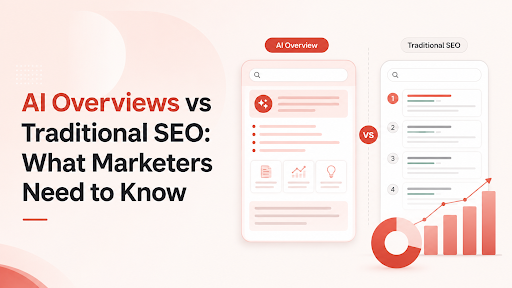
If you are noticing a sudden shift in your organic website traffic, you are likely trying to understand what are Google AI Overviews and how they impact your digital footprint. These AI-generated answer blocks sit right at the top of the search results page, giving users immediate answers using advanced Gemini models. Written specifically for digital marketers and business owners, this guide breaks down how AI search shifts clicks and how you can adapt. You are in the exact right place to learn how to future-proof your visibility and turn these search changes into a massive competitive advantage.
For more than twenty years, search engine optimization followed a very clear rule: you found relevant keywords, wrote solid content, optimized your pages, and fought for a spot in the top ten blue links. If your snippet looked good, a user clicked through to your website. The relationship was transactional and predictable.
AI search completely redefines this experience. With the rollout of advanced Gemini reasoning models running natively in Google's search infrastructure, the engine no longer acts as a simple index of links. Instead, it reads hundreds of resources simultaneously, pulls out the core facts, and writes a fully synthesized answer right on the page before a user ever scrolls down to see standard organic listings.
This creates a fundamental split in modern SEO strategy:
focuses on getting individual URLs indexed, optimizing for specific keywords, and driving traffic directly to a site via traditional listings.
focuses on data accessibility, conversational depth, and earning direct citations or source buttons inside the AI-generated answer snapshot itself.
You are no longer just competing with other businesses for the number one spot in a list. You are competing to become the primary resource that the AI trusts, quotes, and highlights for the consumer.
Because the AI summary provides instant, highly accurate answers, consumer behavior is shifting rapidly. A user searching for a quick breakdown or comparison no longer needs to click through to a blog post; they read the summary box and leave. This has caused a significant rise in zero-click searches, particularly for informational queries.
Data across competitive industries shows that informational keywords are experiencing an organic click-through rate decline of up to 60 percent. Websites that rely heavily on top-of-funnel blog posts to generate massive brand awareness are seeing their search sessions soften.
However, this does not mean organic traffic is losing its value. Instead, the nature of that traffic is changing. While casual, informational clicks are dropping, the visitors who do click through from an AI overview citation show significantly higher intent. They have already read the summary, they know your brand is a trusted source, and they are landing on your site to take a specific action or dive much deeper into your offerings.
Google does not pull its overview citations out of thin air. When a user type or speaks a complex question, the search engine runs a "query fan-out" process. It essentially breaks down the query into smaller intent paths, checks its internal Knowledge Graph, and scans the web for the most reliable documents.
The algorithm uses specific parameters to choose which sites get highlighted:
To make sure your content doesn't lose its footprint, you need to adapt your production workflow with AI optimization to fit how search engines extract data today.
Review your existing pages. If your content simply repeats what the top five results already say, it fails the information gain test. Add original data, real client examples, or distinct professional perspectives.
Structure your writing so that a clear, plain-language answer appears right at the top of the page or directly under a major section heading. Keep this block to two or three sentences long to allow easy AI extraction.
Add advanced structured data to your website backend. Utilize FAQ schema, Product markup, and Author blueprints to tell search bots exactly who you are and what your content means.
Instead of targeting isolated keywords, build interconnected hubs of pages that cover an entire category thoroughly. Link these pages internally to signal complete topical authority to the algorithm.
With AI boxes shifting traditional links down the screen, old reporting metrics like tracking exact keyword positions can lead to inaccurate conclusions. A site might technically rank in position two, but if a massive AI overview sits above it, the expected traffic will drop.
Marketers must look to modern toolsets, including the dedicated AI Performance reports inside Google Search Console. These tools allow you to measure your direct impressions inside AI Overviews and AI Mode separate from traditional web search. Focus on tracking citation frequency, branded search volume increases, and overall conversion actions on your key landing pages rather than chasing superficial click volume alone.
Navigating a massive structural shift in search technology requires deep engineering insight, continuous data testing, and an agile strategy. We at GBIM bring over twenty-one years of direct optimization experience to your marketing team. We have guided brands through every major algorithm shift, and we build systems that protect your digital assets over the long haul.
Our team helps you dissect technical crawl barriers, restructure your content layout for automated extraction, and run advanced entity mapping programs. We focus completely on building real authority and maximizing hard conversions, ensuring your brand stays highly visible exactly where your customers are searching.
Our services support businesses ready to move past generic keywords and embrace true search authority. Let’s sit down, audit your current organic visibility, and design a customized roadmap that secures your digital growth through 2026 and beyond.
What are Google AI Overviews exactly?
They are automated snapshots powered by generative AI that synthesize data from multiple web pages to answer search queries directly at the very top of the screen.
Does the rise of AI search mean regular SEO is dead?
No, traditional SEO remains highly critical because generative models rely on crawled, well-structured, and fully indexed web pages to gather their facts.
How do AI Overviews affect overall website traffic?
They generally cause a drop in top-of-funnel clicks for simple factual questions, but they drive highly qualified visitors with strong buying intent via source citations.
What is the difference between AEO and traditional SEO?
Traditional SEO focuses on optimizing your site to rank in a vertical list of links, while Answer Engine Optimization (AEO) shapes text to be extracted as a direct answer within AI boxes.
How do I get my website cited inside the AI summary box?
You must format your pages with clear, direct answer blocks near the top, use comprehensive schema markup, and provide unique, data-rich insights.
How can I track if my website is appearing in AI Overviews?
You can use the new Search Generative AI performance reports inside Google Search Console to monitor impressions and pages appearing within AI features.
Can I prevent Google's AI from scraping my content?
Yes, you can apply standard crawl blocks or snippet restrictions in your robots code, but doing so will usually lower your visibility in regular organic search results as well.
309, Rupa Solitaire,
Sector-1, Millennium Business Park,
Mahape, Navi Mumbai,
Maharashtra (400 710), INDIA.
Write to us at
hr@gbim.com