
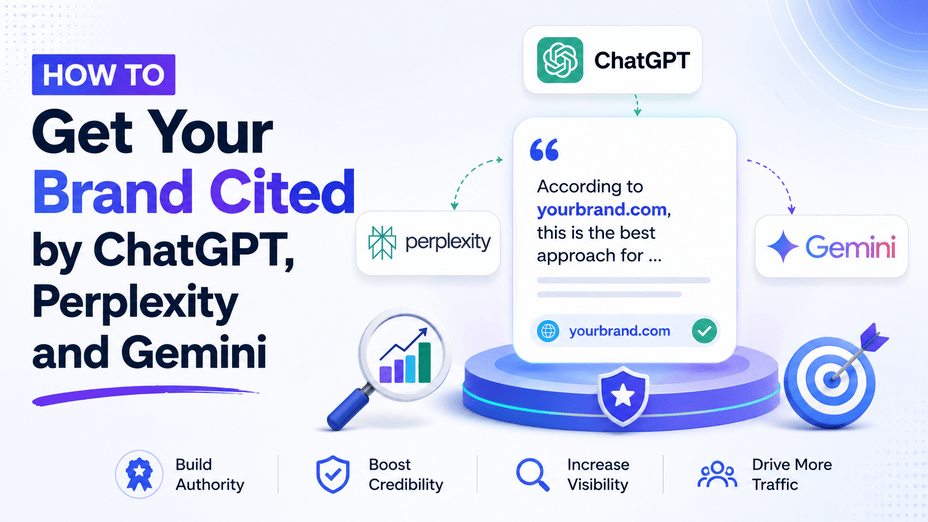
If you're searching for how to get mentioned by ChatGPT, you're probably noticing a shift in how people discover businesses online. Instead of clicking through search results, users are asking AI assistants for recommendations, product comparisons, and service providers. If your brand isn't being cited, you're missing valuable visibility. This guide explains how AI platforms like ChatGPT, Perplexity, and Gemini choose sources, why some brands appear consistently while others don't, and what you can do to increase your chances of being referenced naturally.
For years, businesses focused on appearing on the first page of Google.
That is still important, but AI-powered search is changing how people find information.
Someone looking for an SEO agency today might ask:
Instead of showing ten websites, AI platforms generate a direct answer based on information they trust.
If your business becomes part of that answer, your brand gains visibility before a user even visits a search engine results page.
Being cited by AI platforms builds:
AI models do not randomly recommend businesses.
They analyse thousands of trusted sources before generating an answer.
Rather than relying on a single webpage, they compare information across multiple platforms to identify consistent signals.
These signals include:
When multiple trustworthy sources describe your business in the same way, AI becomes far more confident about mentioning your brand.
Consistency matters more than volume.
Think of AI as a researcher rather than a search engine.
Before recommending a business, it asks several questions internally.
Many websites fail here.
Instead of saying:
We deliver innovative digital excellence.
Say exactly what your business offers.
For example:
We provide SEO services for Australian businesses looking to increase organic traffic and improve AI search visibility.
Clear descriptions reduce ambiguity.
If your website says you specialise in local SEO, but every external website describes you as a web design agency, AI receives mixed signals.
That inconsistency lowers confidence.
Your messaging should remain consistent across:
AI models favour brands that consistently publish useful, experience-driven content.
That includes:
Publishing one high-quality article every few months is often more valuable than publishing dozens of generic blogs.
One of the biggest reasons brands fail to appear in AI responses is because their content is difficult to extract.
Large language models process webpages in smaller sections rather than reading the entire page at once.
Every section should answer one clear question.
For example:
SEO has become increasingly important over the years because businesses continue investing in digital marketing and online growth strategies.
SEO helps businesses increase organic visibility by improving how search engines understand and rank their webpages.
The second version is factual, complete and easy to cite.
AI assistants are designed to answer questions.
Your content should reflect that.
Instead of creating vague service pages, build content around the questions your customers actually ask.
Examples include:
Each question becomes an opportunity for AI to extract a direct answer.
Publishing isolated articles is no longer enough.
AI platforms evaluate whether your website demonstrates expertise across an entire subject.
For example, if you want to become recognised for AI search optimisation, your website should include content covering:
Together, these pages establish topical authority.
The stronger your topical coverage, the more likely AI is to trust your content.
Your website is only one part of your digital footprint.
AI systems compare information across the web.
Useful places to build authority include:
Every credible mention reinforces your expertise.
Small technical improvements often make a significant difference.
Review your website and ensure it includes:
Technical clarity improves how AI systems interpret your content.
Many businesses produce quality services but remain invisible because of avoidable issues.
Common problems include:
Marketing language without clear facts gives AI very little to reference.
Short pages rarely provide enough context for AI to understand expertise.
If nobody else talks about your business, AI has fewer trust signals.
Large paragraphs without headings make extraction difficult.
Publishing random blogs does not establish authority in a specific subject.
One of the simplest audits takes less than five minutes.
Ask ChatGPT, Gemini or Perplexity questions like:
Compare the answers with how you want your business to be positioned.
If important details are missing or incorrect, those gaps indicate opportunities to improve your website and wider digital presence.
Getting your brand cited by AI platforms requires more than adding a few keywords.
It involves improving technical SEO, strengthening topical authority, building trusted digital signals and publishing content that AI systems can confidently understand.
We at GBIM help businesses prepare for this new generation of search by combining proven SEO strategies with practical AI optimisation techniques.
Our team analyses how search engines and AI platforms interpret your website, identifies content gaps, improves website architecture, strengthens entity signals and develops content designed for both human readers and AI systems.
The goal is simple.
Create digital assets that remain visible wherever your customers choose to search, whether that is Google, ChatGPT, Perplexity, Gemini or the next generation of AI-powered search platforms.
Create trustworthy, well-structured content and build consistent authority across reputable websites so AI models have confidence in citing your brand.
Rankings help, but AI also considers content quality, authority, consistency and trusted third-party references.
Yes. Schema markup helps AI understand your website more accurately and strengthens contextual signals.
Perplexity favours sources that provide clear, factual and well-organised information with strong authority.
There is no fixed timeline. It depends on content quality, technical optimisation, authority and how frequently AI systems refresh their knowledge sources.
Absolutely. Strong SEO remains the foundation. Answer Engine Optimisation (AEO) builds on that foundation to improve visibility across AI-powered search experiences.
Yes. We help businesses strengthen technical SEO, topical authority, content strategy and digital trust signals so their websites are better positioned for both traditional search engines and AI-powered platforms.
309, Rupa Solitaire,
Sector-1, Millennium Business Park,
Mahape, Navi Mumbai,
Maharashtra (400 710), INDIA.
Write to us at
hr@gbim.com