
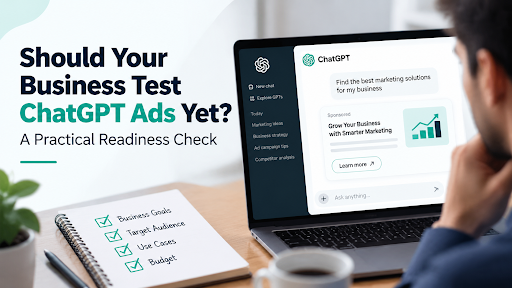
New advertising channels have a habit of creating urgency before they create clarity. A platform launches something new, marketers begin discussing first-mover advantage, and businesses start wondering whether they are already behind.
ChatGPT Ads deserves more careful thinking.
As of September 2026, businesses in India can access ChatGPT Ads through OpenAI's Ads Manager. The advertising environment is built around conversations in which people may be researching products, comparing alternatives, weighing tradeoffs, or trying to make a decision. OpenAI also states that ads are clearly labeled and remain separate from ChatGPT's answers.
That makes the channel interesting. It does not automatically make it right for every advertiser.
If the question on your mind is, should I advertise on ChatGPT?, don't start with how new or popular the platform is. Start with whether the way people use ChatGPT overlaps with the way customers evaluate what your business sells.
That requires a readiness check.
Audience size alone tells you very little about advertising fit.
A potential customer simply using ChatGPT is different from that customer using ChatGPT while researching a problem your business can solve.
Consider the difference:
OpenAI says its ad system considers signals including the context and intent of the current conversation, along with information from the ad and landing page. Advertisers can also provide contextual hints about topics or conversations where an offering may be relevant.
That means the strongest opportunity may not simply be "reach."
It may be relevance during research and decision-making.
Rather than asking whether every business should enter the channel, evaluate these five areas first.
Start with customer behavior.
Do buyers need to compare options, understand features, solve problems, research providers, or evaluate alternatives before acting?
ChatGPT Ads may deserve greater attention when the buying process involves questions such as:
These are naturally conversational research behaviors.
A business whose customers rarely research before purchasing may have a weaker immediate case.
Not every transaction has the same customer journey.
A complex B2B service might involve several research sessions, internal discussions, comparisons, and demonstrations. A considered consumer purchase could involve reviews, specifications, alternatives, and recommendations.
Those environments potentially create more opportunities for conversational advertising.
The question is not simply whether your product can be advertised.
Ask:
Does conversation meaningfully contribute to how customers make the decision?
If it does, the platform becomes more strategically interesting.
New channels can become a distraction when established ones are still poorly managed.
Suppose a business has:
Adding another platform will not repair those problems.
It may simply create another source of traffic that the business cannot evaluate properly.
This is where broader marketing strategy matters more than platform enthusiasm.
Before expanding, businesses should understand what is already generating demand, where customers drop out of the journey, and which channels are underperforming.
An emerging channel should be treated as an experiment with measurable questions.
For example:
OpenAI's current Ads Manager includes campaign measurement for metrics such as impressions, clicks, and conversions, while its advertising system continues to evolve.
Businesses therefore need to define success before launching rather than deciding afterward whether the numbers "look good."
Early adoption and immediate scale are not the same thing.
A business testing a developing advertising environment should be comfortable learning:
If management expects a new channel to immediately become a major source of leads or sales, the experiment starts with the wrong expectations.
|
Situation |
What It Suggests |
|
Customers conduct substantial research before purchasing |
Worth investigating |
|
Buyers use AI tools to compare solutions |
Stronger testing case |
|
Existing paid channels are measured well |
Easier to evaluate incremental value |
|
Core marketing performance is unclear |
Strengthen foundations first |
|
Conversion tracking is limited |
Testing may produce ambiguous results |
|
Business expects instant large-scale volume |
Expectations should be reset |
|
Team can run controlled experiments |
Better environment for early testing |
The point of this matrix is not to produce a universal yes or no.
It is to separate channel curiosity from channel readiness.
Sometimes the most useful marketing recommendation is to wait.
If the business cannot confidently explain which existing campaigns create qualified leads or meaningful conversions, expanding into another platform may create additional confusion.
Fix measurement first.
A platform may have enormous usage without being closely connected to how your customers evaluate your category.
Presence does not automatically equal intent.
New advertising environments generally require testing and learning.
Businesses that need a mature, predictable acquisition engine may still rely more heavily on established channels while monitoring how ChatGPT advertising develops.
There is nothing strategically conservative about refusing to chase every new channel. Sometimes discipline creates the better marketing decision.
The opposite case also exists.
Testing becomes more reasonable when several conditions overlap.
You may have a stronger case if:
For businesses in this position, asking should I advertise on ChatGPT? becomes less about following a trend and more about testing whether a new decision-making environment can contribute incremental value.
OpenAI's own positioning emphasizes reaching people while they explore options, compare alternatives, and make decisions rather than treating the product as another conventional keyword-ad platform.
That distinction matters.
A campaign is not a strategy simply because it runs on a new platform.
Good advertising decisions still begin with familiar questions:
Those questions apply to search, social, retail media, programmatic advertising, and conversational advertising alike.
The platform changes.
The need for disciplined decision-making does not.
Businesses do not need to participate in every emerging advertising format. They need to participate where customer behavior, commercial intent, measurement capability, and marketing readiness overlap.
At GBIM, we prefer to look at emerging channels in that wider context. Our approach to digital advertising is not simply to add another platform because it is available, but to understand where it fits within the broader discovery, consideration, and conversion journey.
For some businesses, ChatGPT Ads may already justify a controlled test. For others, improving search, paid media, conversion tracking, landing pages, or measurement may deliver more immediate value.
Ultimately, should I advertise on ChatGPT? is a business-readiness question rather than simply a technology question.
Yes. OpenAI announced direct Ads Manager availability across India on August 31, 2026, and its current availability documentation lists India as supporting self-service access.
OpenAI states that advertising does not influence ChatGPT's answers. Ads are presented separately and are clearly identified as advertising.
Businesses with research-heavy or comparison-heavy customer journeys may have a stronger reason to investigate the channel. This can include companies selling complex services, technology, considered consumer products, or solutions where customers commonly evaluate several options before deciding.
They should not automatically be treated as a replacement. Search advertising and conversational advertising operate in different environments and may serve different moments in the customer journey. Businesses should evaluate the incremental role of each channel rather than assume that one must replace the other.
Start with a defined objective and track metrics connected to it. Depending on the campaign, that could include qualified visits, engagement, conversion actions, lead quality, or assisted conversions. Avoid judging an experiment only by traffic volume.
Early testing can help a business learn how its messaging performs in conversational environments before the channel becomes more established. However, that advantage matters only when the audience fit, measurement setup, landing experience, and broader marketing foundations are strong enough to produce useful learning.
309, Rupa Solitaire,
Sector-1, Millennium Business Park,
Mahape, Navi Mumbai,
Maharashtra (400 710), INDIA.
Write to us at
hr@gbim.com