
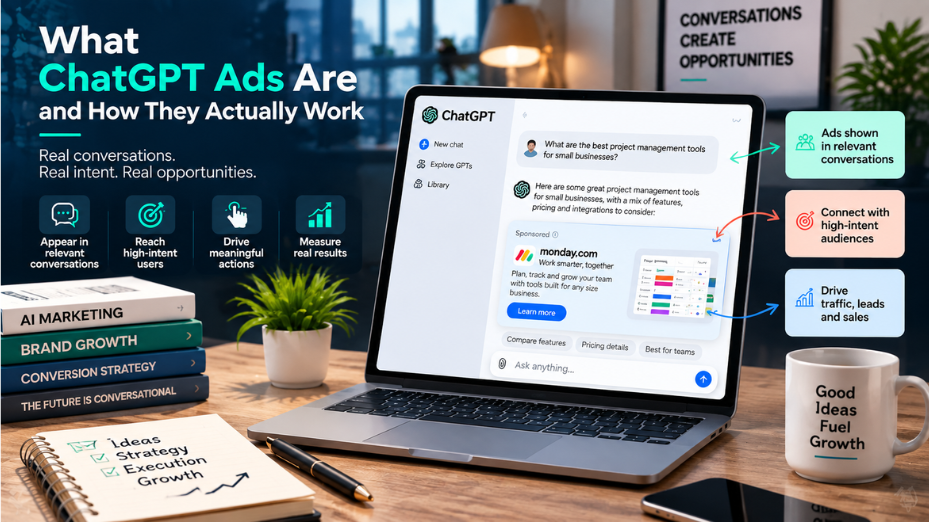
For years, marketers mostly discussed ChatGPT as a new discovery environment: a place where people asked questions, compared options, researched products, and worked through decisions in conversation. Advertising changes that equation.
Businesses can now appear through clearly identified sponsored placements within ChatGPT, creating a new paid-media surface alongside established search, social, retail, and display channels.
With ChatGPT Ads explained in practical terms, the key distinction is simple: an advertisement can appear alongside a ChatGPT experience, but it does not buy control over what ChatGPT says.
The advertising program began as a limited U.S. test in February 2026 and has developed quickly since then. OpenAI introduced additional buying options in May and expanded direct Ads Manager access to India and other markets at the end of August 2026.
ChatGPT Ads are sponsored placements that can appear below a ChatGPT response when the system determines that an eligible advertisement is relevant to the conversation.
The current ad format can include:
The important word here is sponsored.
Ads are visually identified and separated from the main ChatGPT response. OpenAI states that advertising does not influence the answers generated by ChatGPT.
So if someone asks ChatGPT to compare several software platforms, an advertiser cannot simply pay to have ChatGPT describe its product as the best option.
That separation matters because conversational advertising works very differently from simply purchasing visibility inside a traditional search-results page.
Rather than treating ChatGPT advertising as one sudden launch, it is more useful to see how the platform has developed.
OpenAI started testing advertising in the United States among logged-in adult users on its Free and Go plans.
The initial test deliberately kept advertisements separate from generated answers. Paid ChatGPT tiers such as Plus and Pro were excluded from the ad experience.
Pilot testing
The next major change was on the advertiser side.
OpenAI introduced a beta self-serve Ads Manager and added cost-per-click bidding alongside its earlier CPM buying model.
That gave marketers another way to think about campaign objectives:
CPM: pay around impressions and reach
CPC: pay when someone clicks
This was an important move because it shifted ChatGPT Ads from a small managed experiment toward something more recognizable as an advertising platform.
Advertiser access expands
OpenAI announced that advertisers could purchase ChatGPT ads directly through Ads Manager across India, Europe, the Middle East, and North Africa.
By this point, the platform had moved well beyond its original U.S.-only pilot.
India enters the direct-buying footprint
ChatGPT Ads remains an evolving advertising system rather than a finished, mature ecosystem.
OpenAI has continued adding targeting, measurement, conversion optimization, creative tools, and newer ad experiences. In September, it also announced experiments involving Sponsored Agents that can allow users to begin interacting with business-sponsored agents after clicking an advertisement.
That pace of change is precisely why businesses should evaluate the platform based on what exists now rather than assumptions formed at the beginning of 2026.
The wider discovery landscape is changing at the same time. Marketers can also follow Google's Search Central Blog for updates on how search experiences and AI-assisted discovery continue to evolve.
At its simplest, the advertising journey can be understood like this:
This sequence matters.
The advertisement is not inserted into the reasoning of the response as though the advertiser had purchased editorial influence.
Imagine someone asks:
“What should I consider when choosing accounting software for a growing business?”
ChatGPT may provide an independent explanation covering features such as integrations, reporting, scalability, or ease of use.
A relevant software company might then appear in a clearly marked advertisement beneath that answer.
The two pieces of content serve different purposes:
The response answers the question.
The advertisement provides a commercial option.
That is the basic mechanism marketers need to understand.
The mechanics are also becoming more familiar to marketers who already manage paid campaigns.
OpenAI currently supports CPM and CPC buying, while eligible advertisers can also run conversion-optimized campaigns. Advertisers can set maximum bids, and OpenAI describes its ad-selection system as a relevance-weighted, second-price auction.
The practical implication is that buying visibility is not simply about submitting the highest possible bid.
Relevance also matters.
An eligible advertisement needs to make sense in the context where it could appear.
Businesses already familiar with Google Ads will recognize several advertising concepts, but the environment is fundamentally different.
|
Traditional Search Advertising |
ChatGPT Advertising |
|
Built around a search-results environment |
Built around a conversational environment |
|
Often strongly keyword-led |
Can use conversational context and other permitted signals |
|
Ads appear around search results |
Ads appear separately below ChatGPT responses |
|
Highly mature advertising ecosystem |
Newer and still developing ecosystem |
|
Long-established optimization practices |
Emerging optimization practices |
That last distinction is important.
Marketers should resist copying a mature Google Ads strategy into ChatGPT and assuming the same behavior will follow.
Getting ChatGPT Ads explained clearly also means separating how the advertising model actually works from several common misconceptions.
An advertiser cannot simply purchase a favorable ChatGPT answer.
OpenAI says answers remain independent from advertising.
Sponsored content is presented separately and labeled accordingly.
That visual separation is important both for user trust and for marketers evaluating the channel.
A conversation being commercially relevant does not mean every advertiser in that category automatically appears.
Eligibility, context, auction dynamics, targeting, relevance, campaign settings, and other platform controls can affect delivery.
So marketers should think about ChatGPT advertising as a media system, not as paid product placement inside AI-generated answers.
The interesting part of ChatGPT advertising is not simply that another platform now sells ads.
It is where the user may be mentally when an ad appears.
People often use conversational AI while they are:
Those behaviors can occur closer to active consideration than passive media consumption.
That does not automatically make ChatGPT better than search, social, or retail media. It simply means the platform can add another commercially relevant moment to the customer journey.
And that moment deserves to be measured rather than assumed.
ChatGPT Ads should not immediately be viewed as a replacement for Google Ads, paid social, programmatic advertising, or retail media.
A better question is:
What job could this channel perform within the existing media mix?
For one business, that could mean reaching users during early research.
For another, it may mean appearing when prospective buyers compare alternatives.
For some businesses, the audience or buying journey may not justify testing the channel yet.
That is why a broader paid advertising strategy still matters. A new platform has value only when its role connects logically with the audience, funnel, measurement system, and business objective.
Adding another media channel without answering those questions simply creates another dashboard to manage.
New advertising environments tend to produce two extreme reactions.
One group rushes in because the platform is new.
Another ignores it until every question about targeting, attribution, scale, and performance has already been answered.
Neither approach is particularly useful.
The better approach is to watch how the channel develops, understand how customers actually use ChatGPT, and test it when there is a clear reason to do so.
That is how we approach emerging channels at GBIM. We look at where a platform fits into the wider customer journey before treating it as another advertising checkbox. Search, AI discovery, paid media, content, and conversion behavior increasingly overlap, so the real question is not whether a platform is fashionable. It is whether it helps solve a genuine growth problem.
Businesses exploring the wider role of conversational AI can also use our ChatGPT resources to better understand how the technology fits into the changing digital landscape.
With ChatGPT Ads explained from both a buying and user-experience perspective, businesses can evaluate the channel based on how it actually works rather than the hype surrounding it. The opportunity is not to buy influence over AI. It is to earn relevant visibility alongside conversations where people are already exploring, comparing, and deciding.
ChatGPT ads can appear below ChatGPT responses as clearly labeled sponsored placements. They are visually separated from the AI-generated answer and may include an advertiser name, headline, description, image, and landing-page link.
No. OpenAI states that advertising does not influence ChatGPT's answers. An advertiser may appear through a sponsored placement, but buying an advertisement does not allow the advertiser to purchase a favorable organic answer or recommendation.
OpenAI currently supports multiple buying approaches, including CPM and CPC. Eligible advertisers can also use conversion-optimized campaign objectives. The available options continue to develop as the advertising platform expands.
Yes. On August 31, 2026, OpenAI announced direct Ads Manager availability for advertisers across India along with Europe, the Middle East, and North Africa.
No. Google Search advertising operates primarily within a search-results environment, while ChatGPT advertising appears within a conversational AI experience. Some auction and campaign concepts may feel familiar, but user behavior, context, placement, and optimization can differ significantly.
OpenAI's Ads Manager currently reports metrics including impressions, clicks, click-through rate, average CPC, average CPM, spend, and conversions. Advertisers can also use conversion measurement and tracking parameters to analyze traffic and campaign outcomes.
309, Rupa Solitaire,
Sector-1, Millennium Business Park,
Mahape, Navi Mumbai,
Maharashtra (400 710), INDIA.
Write to us at
hr@gbim.com