
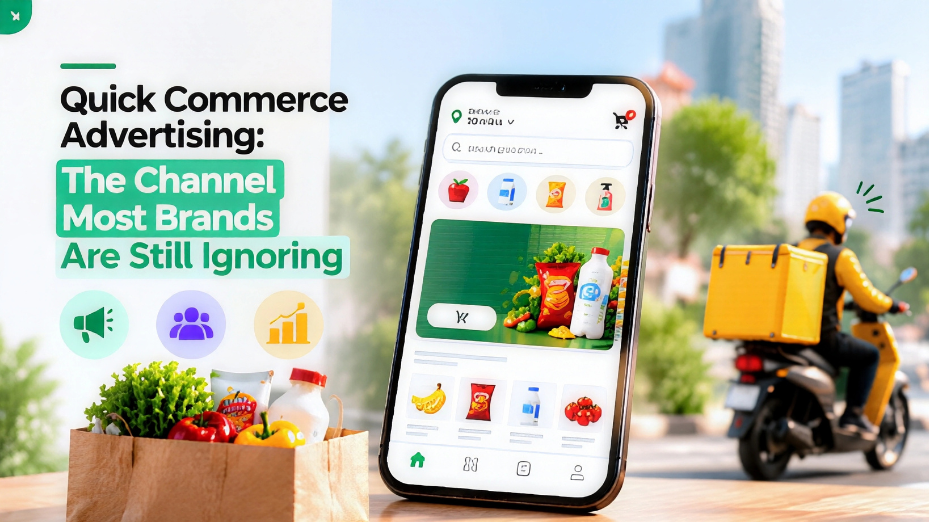
When someone runs out of milk or coffee at eight in the morning, they do not open Google to read buying guides. They tap open a delivery app, type the item into the search bar, and buy whatever appears in the top two or three slots. The entire transaction takes less than a minute.
If your product does not show up on that initial screen, you miss the sale entirely. That immediate point of purchase is why quick commerce advertising in India has turned into such an active channel over the past two years. Even so, many consumer brands still treat these rapid delivery apps purely as distribution channels rather than paid media platforms.
Understanding how in-app placements work, what they cost, and where their operational limits lie is essential before shifting budget away from conventional digital channels.
Quick commerce platforms operate digital storefronts that function like concentrated retail media networks. Because user sessions on these apps are short and intent is high, ad formats are designed to prompt immediate cart additions rather than leisurely product browsing.
The main ad units available across major platforms include:
Ad management varies across platforms. Some have rolled out self-serve consoles with automated bidding, while others still require direct coordination with category managers to lock in banner dates and search tenures.
The psychology of a quick commerce buyer is simple: they want their items immediately, and they rarely scroll past the first few rows of products.
On a traditional marketplace, shoppers often compare dozens of reviews, check multiple sellers, and wait days for delivery. On a ten-minute delivery app, convenience overrides deep comparison. If a preferred brand is out of stock or buried on page three, the buyer will almost always pick an alternative rather than close the app empty-handed.
This dynamic makes search placement on quick commerce apps far more decisive than on traditional websites. The consumer is already holding their payment method and waiting at the digital checkout. That proximity to purchase is the core appeal of retail media advertising within fast delivery environments.
Not every business belongs on a ten-minute delivery platform. Quick commerce ad spend produces the clearest returns for high-frequency, impulse-driven, or daily household goods:
High-ticket products or items that require detailed specifications, custom sizing, or extensive research tend to struggle. If a consumer needs twenty minutes to think about the purchase, placing a sponsored banner on an app built for five-minute transactions is rarely an efficient use of budget.
To decide where this inventory fits in your media mix, consider how it differs from your existing paid channels.
|
Channel |
User Intent |
Time to Purchase |
Primary Attribution Metric |
Main Operational Risk |
|
Quick commerce ads |
Immediate need |
Minutes |
Direct in-app sales, ROAS |
Dark store stockouts kill campaign efficiency |
|
Search ads (Google) |
Research or high intent |
Hours to days |
Conversions, cost per lead |
Broad query waste, landing page drop-offs |
|
Social ads (Meta) |
Passive discovery |
Days to weeks |
Engagement, CAC, ROAS |
Creative fatigue, lower purchase intent |
|
Marketplace ads |
Deliberate shopping |
Hours to days |
ACoS, organic ranking uplift |
Heavy price competition, multi-day delivery lag |
Each channel solves a different problem. Social ads generate demand, search ads capture research intent, and quick commerce advertising captures immediate transactions at the final hurdle.
Jumping into quick commerce campaigns without operational coordination usually leads to wasted budget. A structured rollout keeps spend focused on products that can actually convert.
Tracking performance on quick commerce apps requires some realism. Most platforms provide standard metrics such as impressions, clicks, cost per click, and return on ad spend (ROAS). However, the reporting infrastructure is not as open or granular as mature advertising networks.
Attribution windows are short, and cross-platform tracking is limited. If a user sees your social media ad on Monday and buys your product on a delivery app on Wednesday, connecting those two touchpoints is difficult without complex third-party attribution models.
Furthermore, keeping an eye on organic placement remains essential. Relying entirely on paid bids to stay visible quickly erodes product margins. Building strong brand search volume and supporting your broader organic visibility through sound e-commerce SEO ensures your brand maintains discoverability across search engines and online channels without depending entirely on paid placements.
Before committing a large percentage of your marketing budget, keep these regular pain points in mind:
Quick commerce is no longer just an experiment for novelty brands. It is a working retail media environment that captures consumers at the exact moment of purchase. For FMCG, personal care, and household brands selling in urban India, testing this channel is becoming a practical necessity.
Success comes down to treating it as an operational discipline rather than an isolated ad platform. When your stock distribution, keyword selection, and broader digital marketing work together, quick commerce advertising in India can deliver dependable volume where traditional channels stall.
At GBIM, we help businesses evaluate emerging retail channels and build data-led media strategies that protect margins while driving measurable revenue. With over 21 years of digital marketing and performance experience, our team can help you audit your category opportunities, set up practical campaign frameworks, and integrate retail media into your wider growth plan.
What is the minimum budget needed for quick commerce advertising in India?
Budgets vary by platform. Some self-serve tools allow initial testing with modest daily budgets of a few thousand rupees, while managed brand days or top-tier category takeovers require larger, fixed financial commitments.
How does quick commerce advertising affect organic product rank?
Higher sales velocity from sponsored ads can improve a product's organic positioning on the platform's algorithm, provided stock levels remain consistent and customer reviews are positive.
Can D2C brands compete with established FMCG companies on these apps?
Yes, particularly in niche subcategories like organic snacks, premium coffee, or specialized skincare where targeted keyword bidding allows smaller brands to appear alongside market leaders.
Why did my ad run when my product was out of stock?
Because inventory is tracked at individual micro-warehouses (dark stores), an ad campaign set at a city level may remain active even if specific local dark stores run out of your SKU. Constant inventory sync is essential.
What is a healthy ROAS for quick commerce campaigns?
Target returns depend on product margins and category competition. High-margin personal care products might aim for a 3x to 5x ROAS, while everyday grocery staples with tighter margins often operate between 1.5x and 2.5x.
309, Rupa Solitaire,
Sector-1, Millennium Business Park,
Mahape, Navi Mumbai,
Maharashtra (400 710), INDIA.
Write to us at
hr@gbim.com