
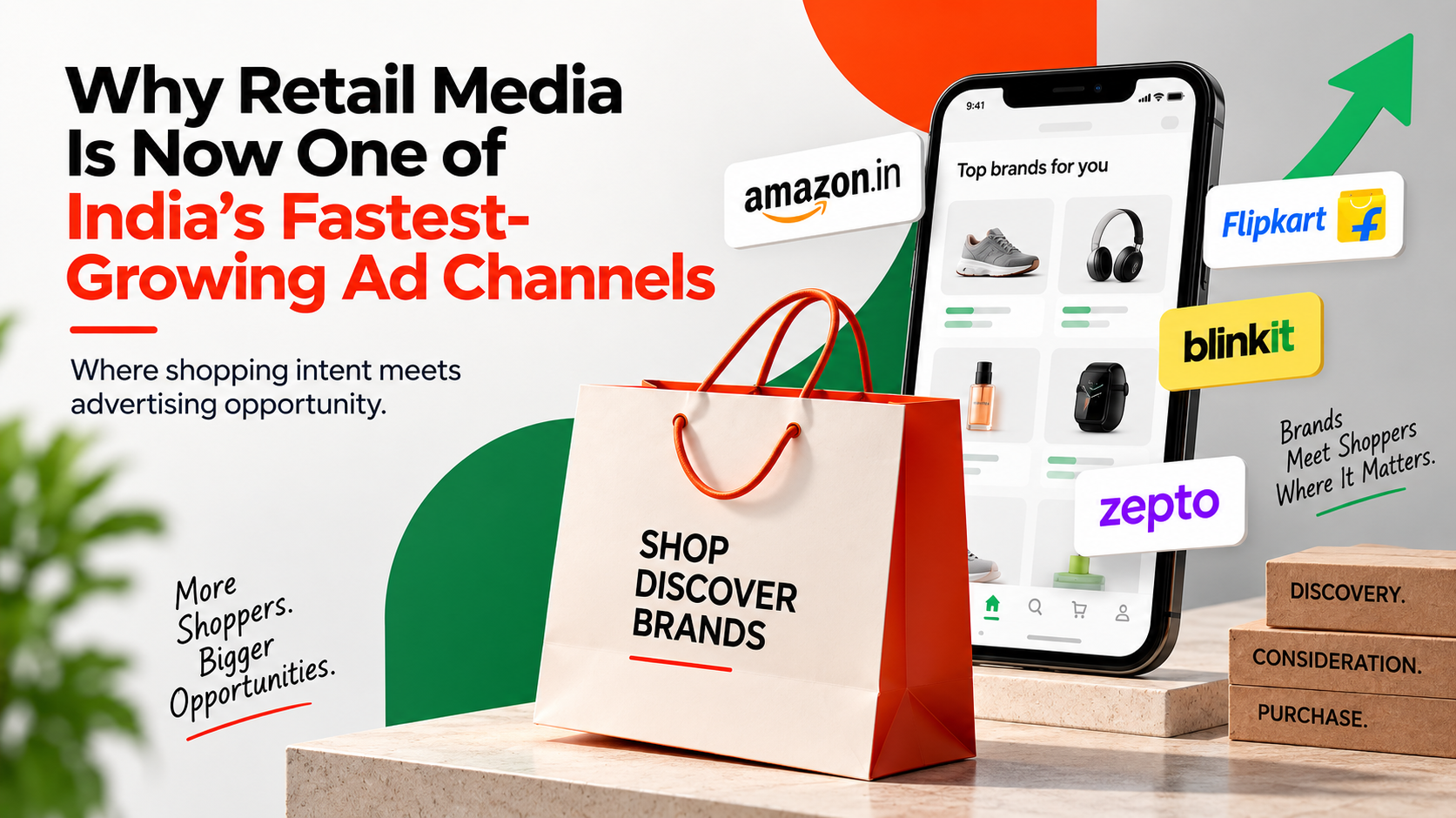
India's advertising landscape is shifting closer to the point where people actually shop.
Advertising spend on e-retail platforms reached ₹17,601 crore in 2025, growing 55.86% year over year, according to the dentsu–e4m Digital Advertising Report 2026. E-retail advertising also accounted for 24.58% of India's total digital media spend during the year.
The growth recorded across retail media in India in 2025 shows how quickly advertising investment is moving closer to commerce environments.
But the growth figure alone does not explain the change.
Why are businesses directing more advertising attention toward retailers and marketplaces when search engines and social platforms already offer enormous reach?
The answer lies partly in context. Retail media can reach consumers while they are already browsing, comparing or preparing to buy.
Retail media is advertising that appears across the digital or physical environments controlled by retailers, marketplaces and commerce platforms.
Consider a simple example.
Someone opens an online marketplace looking for shampoo. They type the product category into the search box and see:
Those placements are forms of retail media.
The concept can extend beyond marketplace search results. Retail media networks may include display placements, sponsored listings, video, off-site advertising and other formats built around a retailer's audience and commerce data.
This matters because the advertiser is reaching someone in a very different setting from a person casually scrolling through an entertainment feed.
The shopper may already be thinking about a purchase.
Traditional marketing funnels are usually described as a progression:
Retail media becomes particularly interesting near the lower half of this journey because the advertising environment and the shopping environment can overlap.
However, it would be a mistake to describe retail media only as a conversion tool.
Retail platforms are increasingly adding formats designed for discovery and brand storytelling as well. The dentsu–e4m report describes e-retail environments as evolving beyond lower-funnel conversion toward broader full-funnel advertising ecosystems.
That means the role of retail media is expanding.
A consumer may discover a product, learn about it, compare alternatives and buy it without leaving the same broad commerce environment.
India provides particularly strong conditions for commerce-led advertising.
E-commerce, marketplaces and quick-commerce platforms have become important parts of the way many consumers discover and purchase products. At the same time, these platforms have been developing their own advertising inventories.
The 55.86% increase recorded during 2025 was more than twice the 23.43% growth reported for e-retail advertising in 2024.
There are signs that the expansion is continuing. WPP Media's 2026 India advertising outlook projects retail media at approximately ₹30,555 crore in 2026, although that figure uses its own market methodology and should not be treated as directly interchangeable with every other industry estimate.
For marketers tracking retail media in India trends, the important story is not one isolated growth percentage but the broader movement of advertising toward commerce environments.
Retail media is sometimes discussed as though it is about to replace conventional digital channels. That oversimplifies what each channel does.
|
Question |
Search |
Social |
Retail Media |
|
Typical user context |
Looking for information or solutions |
Browsing, consuming and discovering |
Often browsing or shopping for products |
|
Primary strength |
Capturing expressed intent |
Discovery, attention and reach |
Proximity to commerce |
|
Typical environment |
Search engine |
Social platform |
Retailer or marketplace |
|
Role in the funnel |
Broad |
Broad |
Often mid/lower funnel, but expanding upward |
|
Common signal |
Search behavior and intent |
Interests and engagement |
Shopping and commerce behavior |
None is automatically better.
A person who discovers a product through social media may later research it on Google and eventually buy it through a marketplace.
Those channels have participated in the same customer journey, not necessarily competed for ownership of it.
That is also why a broader digital advertising strategy should look at how channels work together rather than evaluating each one in isolation.
Retailers often have something highly valuable to advertisers: direct signals about shopping behavior within their own environments.
Depending on the platform and its privacy framework, these signals may include behaviors such as:
That is different from simply knowing that someone belongs to a broad demographic or has shown an interest in a general topic.
A retailer may understand what happens much closer to the transaction.
This can make retail environments useful for advertising relevance and measurement.
It can also create what marketers often call a closed-loop measurement opportunity: the ability to connect advertising exposure or interaction with commerce activity occurring inside the retailer's ecosystem.
Still, marketers should be careful with the word "attribution." Seeing a sale after an ad does not automatically prove that the advertising caused the sale.
That distinction becomes important as retail media grows.
Fast growth does not remove basic media-planning problems.
In fact, retail media introduces several of its own.
Different retailers can operate separate advertising systems, reporting standards, formats and audience tools.
A brand working across several platforms may therefore have to reconcile multiple sets of data.
A conversion reported by one retail platform may not use exactly the same attribution window or methodology as another platform.
Comparing headline performance figures without understanding those differences can produce misleading conclusions.
Suppose someone regularly buys the same household product every month.
They see a sponsored listing and make their usual purchase.
Did the ad generate an additional sale, or would that customer have bought the product anyway?
That is an incrementality question and it matters.
Search, social, influencer activity, organic visibility and retail advertising may all influence the same purchase.
Assigning the entire result to the final platform interaction can undervalue what happened earlier.
A strong reported return can look attractive, but businesses should also ask whether advertising is bringing in additional customers, additional purchases or stronger brand preference.
That is a more demanding question than simply asking whether an ad appeared before a transaction.
Retail media growth should not automatically lead a business to remove investment from every other channel.
Search still captures people actively expressing questions and needs. Social can create discovery before a consumer even starts shopping. Content can establish trust. Organic visibility can keep a brand discoverable over longer periods.
Retail media performs a different role.
For an e-commerce business, for example, marketplace visibility may work alongside a strong e-commerce SEO strategy, product-page optimization and search advertising rather than replacing them.
Even within Google's commerce ecosystem, accurate product information remains important. Google's own Merchant Center guidance explains how product data can be submitted and used across relevant Google experiences through product feeds and related systems. Businesses working with shopping feeds can refer directly to Google Merchant Center guidance.
The practical question is not:
"Which channel wins?"
It is:
"What job does each channel perform in our customer's journey?"
The rise of retail media reflects a larger change in digital marketing: media and commerce are moving closer together.
For some businesses, that may make retailer and marketplace advertising increasingly important. For others, search, social, content or broader brand activity may continue to do more of the heavy lifting.
The answer depends on where customers discover the brand, how they evaluate alternatives and where transactions actually happen.
At GBIM, we prefer to start with that journey rather than the popularity of a channel. We look at how search, commerce, paid media and other digital touchpoints contribute to the wider growth picture before deciding where a new advertising environment belongs.
As retail media in India continues to expand, its role is also moving beyond narrowly focused performance advertising toward a broader place in the digital marketing ecosystem.
Retail media is advertising delivered through a retailer's or marketplace's digital and physical environments. Examples can include sponsored product listings, display ads, video placements and other promotions shown to people using a shopping platform.
Growth is being supported by expanding e-commerce and quick-commerce usage, larger advertising inventories on retail platforms, access to commerce-related first-party signals and advertiser interest in reaching consumers closer to purchase. E-retail advertising spend in India grew 55.86% year over year in 2025, according to the dentsu–e4m Digital Advertising Report 2026.
Common examples include sponsored product results on marketplaces, promoted brand placements within shopping apps, display advertising on retailer websites and certain off-site campaigns that use a retailer's advertising network or audience signals.
No. Search advertising usually reaches people based on search activity across a search engine, while retail media operates within or around a retailer's commerce ecosystem. Both can capture intent, but the context and available data can differ.
It is particularly relevant to businesses whose products are sold through marketplaces, retailers or commerce platforms. Its usefulness depends on where a company's customers shop, how its products are distributed and which retail advertising opportunities are available.
Businesses should look beyond platform-reported sales alone. Useful measures may include incremental sales, new-customer acquisition, product visibility, conversion behavior and the relationship between retail media and other channels. Attribution methods and reporting definitions should also be checked before comparing performance across platforms.
309, Rupa Solitaire,
Sector-1, Millennium Business Park,
Mahape, Navi Mumbai,
Maharashtra (400 710), INDIA.
Write to us at
hr@gbim.com