
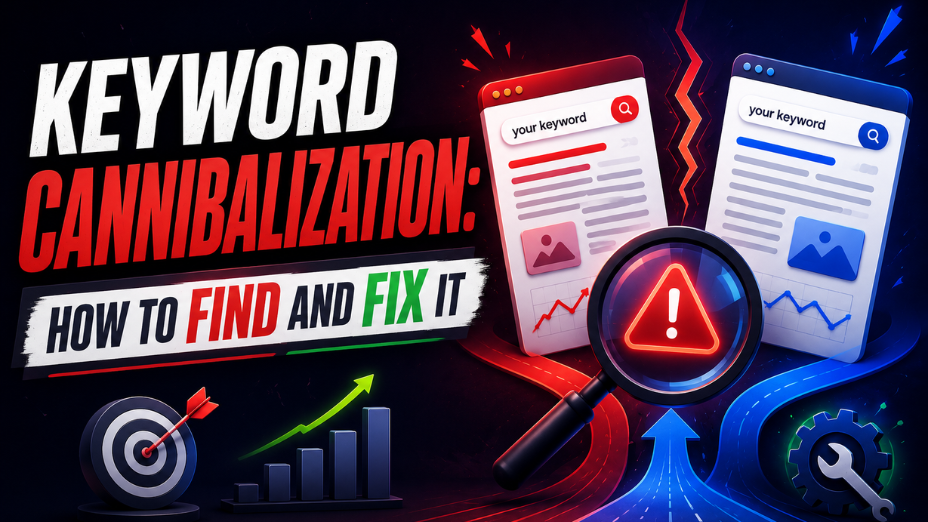
If you are staring at your analytics dashboard asking, "why is my page not ranking despite publishing fresh content?", keyword cannibalization is likely the hidden culprit. Keyword cannibalization happens when multiple pages on your website target the exact same search intent, forcing search engine algorithms to choose between them and splitting your authority.
This guide is built for business owners, marketing teams, and content strategists who want to audit internal keyword conflicts and reclaim lost search visibility. By the end of this article, you will know exactly how to identify competing URLs, resolve cannibalization issues, and secure lasting Google Page 1 rankings.
A common SEO misconception is that creating several articles on the same topic gives you more chances to rank. In reality, the opposite occurs. When you publish multiple landing pages or blog posts that compete for identical terms, you create self-inflicted internal competition.
Search engine algorithms look for a single, definitive URL on your domain to answer a user search query. When presented with three or four overlapping pages, search crawlers struggle to pick a clear winner. Instead of elevating one URL to the top spot, Google often dilutes the ranking strength across all competing pages or constantly rotates them in search results.
If you suspect internal competition is holding back your site performance, look out for these warning signs during your next content review:
Locating overlapping content requires a systematic audit process. Here are three straightforward methods our team uses to uncover keyword conflicts.
The quickest way to check how Google categorizes your content is by using a search operator.
Type the following query into Google:
site:yourdomain.com "target keyword"
Review the list of returned URLs. If you see multiple pages with almost identical title tags and headers competing for that exact query, you have found potential cannibalization.
Google Search Console provides direct data on how search crawlers treat your site architecture.
If multiple URLs earn impressions and clicks for that same query, your site is splitting search visibility across competing pages.
For larger websites, export your published URLs along with their target keywords into a spreadsheet. Grouping URLs by core topic helps reveal intent overlap and structural duplication across your domain.
Fixing cannibalization does not mean deleting content randomly. It involves consolidating authority so every page fulfills a distinct purpose.
When you have multiple short or outdated posts covering thin variations of a topic, combine them into one comprehensive master guide. Extract the strongest points, data, and visual elements from each page.
Publish the updated master guide, then implement permanent 301 redirects from the old competing URLs to the master URL. This transfers built-up link equity straight to your primary page.
Some pages ought to coexist, but their target intent needs clear separation.
For instance, a transactional landing page should focus on hiring or purchasing, while an informational post should focus on educational guides. Adjust title tags, headings, and meta descriptions so each page targets a unique angle without overlapping.
In e-commerce, product filters and variations frequently generate similar URLs. In these scenarios, add canonical tags (rel="canonical") pointing back to the primary category or product page. This tells search engines which URL to index and rank.
Your internal links act as roadmap markers for search engines. Audit your site and adjust anchor text so keyword-rich links point strictly to your main pillar resource rather than secondary posts.
When clients consult us asking, "why is my page not ranking after months of publishing content?", keyword cannibalization is frequently the root cause. Clearing up internal content friction remains one of the fastest ways to recover lost rankings and boost traffic.
We at GBIM bring a data-driven approach to technical optimization and site architecture. Our team conducts detailed audits to map out search intent across every URL on your site. Through our specialized SEO consulting services and targeted local SEO solutions, our team helps businesses consolidate link authority, eliminate keyword overlap, and achieve sustained visibility on search engines.
Our services support companies in building clean content hierarchies that drive real traffic and measurable business growth.
Duplicate content involves identical text across multiple URLs, whereas keyword cannibalization occurs when distinct pages target the same search query and intent.
No, as long as each page serves a unique search intent or subtopic without directly competing for the exact same primary keyword.
Most sites experience ranking improvements within 2 to 6 weeks after setting up 301 redirects, consolidating content, and allowing search engines to re-crawl the updated structure.
Instead of deleting old pages, set up permanent 301 redirects to your main resource so you preserve all accumulated backlink equity.
Yes, using exact-match keyword anchor text to link to different internal pages confuses search crawlers about which URL represents your main authoritative source.
Maintain a centralized content map and perform thorough keyword research before writing to ensure every new page targets a distinct primary keyword.
309, Rupa Solitaire,
Sector-1, Millennium Business Park,
Mahape, Navi Mumbai,
Maharashtra (400 710), INDIA.
Write to us at
hr@gbim.com