
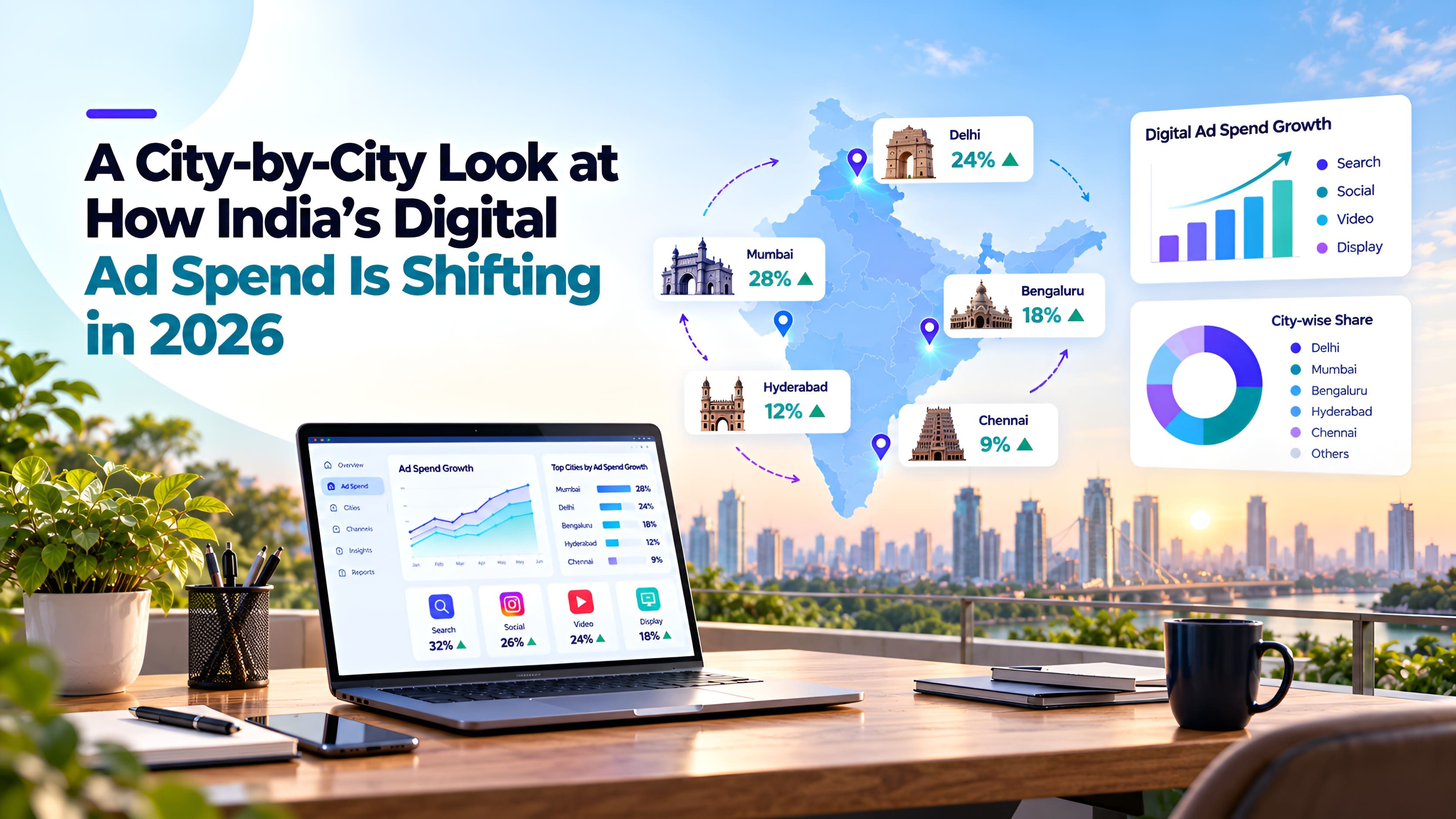
What works well in Mumbai may not work as effectively in Pune. That campaign could work differently if it were shifted to Bengaluru. The platform can be the same. The creative may not be altered. But the outcomes can differ as customers in each city in India find their products, make comparisons and make their purchases differently.
In this regard, that geographical difference is becoming increasingly important as the advertising industry in India is moving towards the digital space.
According to the Dentsu Digital Advertising Report 2026, digital advertising spend to be around 59% of the overall advertising spending, totaling to approximately ₹71,621 crore in 2025.
But national growth data does not tell the whole story.
To understand India’s digital advertising trends by city, businesses must look beyond national spending figures but also how the local industry, consumer habits, regional content and consumption of media impacts on advertising decision making.
Today, India's advertising and communication environment is past the era of national advertising through television and newspapers.
Now companies spread their marketing efforts over search engines, social media, online videos, connected television (CTV), and retail sites.
The Dentsu report highlights a number of interesting trends:
These are national figures and NOT estimates of expenditure per city. The commercial characteristics and channel opportunities are discussed at the city level in the sections below. They are not to be construed as advertising spend rankings.
For advertisers, the challenge is understanding how these national trends affect individual Indian markets.
As a major financial and commercial hub, Mumbai supports advertising across diverse industries.
Competing for attention from consumers and businesses are financial services, retail, entertainment, real estate and professional services.
This poses a number of strategic issues for advertisers.
When individuals are looking for financial products, professional services, or local businesses, they typically have a particular requirement.
Brands can connect with these users when they show interest in a particular search.
But that is not enough to get conversions. Relevance, messaging and audience targeting of landing pages are still critical.
Instagram Reels and YouTube can be leveraged to introduce products by consumer brands, and retail media placements can be used to target shoppers who are already on the marketplaces.
The distinction matters. Based on the two channels, one could establish awareness, and the other could collect purchase intentions.
Organic visibility can also be used to complement paid campaigns, so businesses considering the competition in their area can check out how it can work in SEO services in Mumbai.
The city's technology ecosystem makes it an important software market, and also a place to launch startups, provide education and training services, and sell professional brands.
However, it's not just about technology when it comes to advertising opportunities.
Local brands and consumer services and retail businesses are also on the scene.
Let's take two companies based in Bengaluru.
A software company that caters to enterprise decision makers can leverage:
Instead, a consumer lifestyle brand might focus on Instagram, creator collaborations and product-centric videos.
Both approaches are not a ‘Bengaluru formula'.
This is based on the audience, the product and the buying process.
For enterprises looking to establish a more robust local footprint, SEO services in Bangalore can be a valuable addition to advertising to boost organic search visibility.
Pune is a city with a wide variety of businesses due to education, manufacturing, information technology, and growing suburbanization.
This diversity makes generalisations about local advertising behaviour difficult to make.
An educational institution could have to contact students and parents for a number of weeks of research. A manufacturing supplier can aim a procurement professional who has already a basic knowledge of the product category.
A local consumer business may rely more on search intent that is immediate rather than longer term.
|
Business category |
Channels worth evaluating |
Main objective |
|
Educational institutions |
Google Search, YouTube |
Generate qualified inquiries |
|
Manufacturing suppliers |
Search, LinkedIn |
Reach business buyers |
|
Local services |
Google Search, Maps |
Capture nearby demand |
|
Consumer brands |
Instagram, YouTube |
Build awareness and interest |
The following are strategic starting points and not the measured channel rankings for Pune.
Use local campaign data to validate them for advertisers.
SEO services in Pune can also help customers who look for businesses prior to calling.
Delhi NCR tells us that at times, city-level planning should go beyond the city and become neighbourhood-level planning.
Though the region of Delhi, Gurugram, Noida and its environs is an integrated economic region, it isn't a single audience.
Each business district, residential area, industrial area and retail area may have different customer profiles.
For instance, a corporate campaign in Gurugram may require different messaging from a home improvement campaign in Noida.
Advertisers should consider:
The bottom line is that the geographic scope of the lesson should match the business's real geographic scope of service.
The industrial and manufacturing activity of Vadodara provides an advertising context that is unique to the area.
Instead of reaching a large audience of consumers, it can be more beneficial for many B2B businesses to reach a smaller audience of relevant decision makers.
Search campaigns focused on selected industrial products, services or supplier needs may be helpful to get started.
But consumer businesses can have their own need for localised search visibility, regional-language creative and social media campaigns.
A content strategy for a manufacturing company will differ from that of a restaurant looking to entice walk-in customers.
Within the same city, winning the battle in marketing is about matching up the message with the buying situation.
Businesses can strengthen their organic visibility through SEO services in Vadodara, helping potential customers find relevant suppliers and services online.
Small towns and cities need to be considered, but not necessarily as cheaper alternatives to metropolitan advertising markets.
Their opportunities will rely upon local need, Internet utilization, dispersion systems and consumer inclinations.
Brands can reach specific audiences more effectively through the use of regional-language content. Use short-form video to introduce products, and search advertising to engage people who are already searching for solutions.
Furthermore, Connected TV (CTV) is spreading beyond the country's major metros.
Ormax Media's 2025 OTT audience research showed that some 75.8 million CTV viewers were in towns of less than one million people and rural areas.
This finding challenges the assumption that connected TV advertising is relevant only to metropolitan audiences.
Growth, however, doesn't mean that CTV advertising is as effective for all of the smaller cities or business categories.
Brands can reach consumers while they are shopping for products in the e-commerce and quick-commerce platforms.
This opens doors for companies that sell their goods on these channels.
But the performance of retail media is subject to product availability, competition from the product category and the quality of product information.
Connected television enables advertisers to target audiences who are viewing streaming television on connected TV.
Some CTV campaigns can take advantage of audience and geographic targeting, unlike traditional TV buying.
Before reallocating investment, brands need to make sure that the targeting, measurement, and audience reach that they have available meets their needs.
Instagram isn't going anywhere when it comes to product discovery, creator collaborations, and short-form storytelling.
However, the successful creative concept should not be reproduced in different cities without taking linguistic and cultural differences, as well as the expectations of the audiences into account.
Localizing an ad, rather than merely translating it, is more beneficial in terms of relevance.
The most useful approach to india digital advertising trends by city is to combine national market research with evidence from individual locations.
Before entering a new market, advertisers should examine:
A limited, measurable campaign can reveal more about a particular city than national advertising forecasts alone.
Businesses should compare lead quality, conversion rates, customer acquisition performance, and actual sales outcomes before expanding.
The rapidly expanding digital advertising market in India presents opportunities in emerging markets as well as metros.
However, higher national advertising expenditure does not necessarily translate into stronger local campaign performance.
There are different commercial environments in Mumbai, Bengaluru, Pune, Delhi NCR and Vadodara. Within these cities, there are alternative audience behaviors depending on needs and situations.
At GBIM, we assist businesses in establishing a link between their digital marketing decisions and their real growth goals. Our search marketing, audience research and performance-based tactics help us uncover opportunities that are operating according to market conditions, not just what we try to do.
Advertising in more cities isn't the objective. It is an understanding of where the right customers are and how to best communicate with them.
Mumbai, Delhi NCR, Bengaluru, Pune, Hyderabad, and Chennai are important commercial markets. However, the best city for a campaign depends on the business category, target customers, and available demand. National reports do not establish one universal city ranking.
Digital media consumption is expanding beyond major metropolitan areas. Growth in connected television audiences and regional digital content indicates broader opportunities, although actual advertising demand and performance vary by city.
Google Search and Maps can help capture existing local demand, while Instagram and YouTube may support awareness and product discovery. The right combination depends on customer behavior, competition, and the business's objectives.
Connected TV gives advertisers another way to reach streaming audiences on larger screens. Its growing reach across urban and smaller markets creates opportunities for video campaigns, although targeting options and measurable results vary by provider.
City-level analysis helps identify differences in customer demand, lead quality, competition, and conversion behavior. It also helps businesses avoid assuming that a successful campaign in one location will perform equally well elsewhere.
Start with existing customer locations, search demand, competitive research, and operational coverage. Then test the most relevant channels in a clearly defined geographic area. Expand only when the campaign produces useful evidence of customer interest and business results.
309, Rupa Solitaire,
Sector-1, Millennium Business Park,
Mahape, Navi Mumbai,
Maharashtra (400 710), INDIA.
Write to us at
hr@gbim.com