
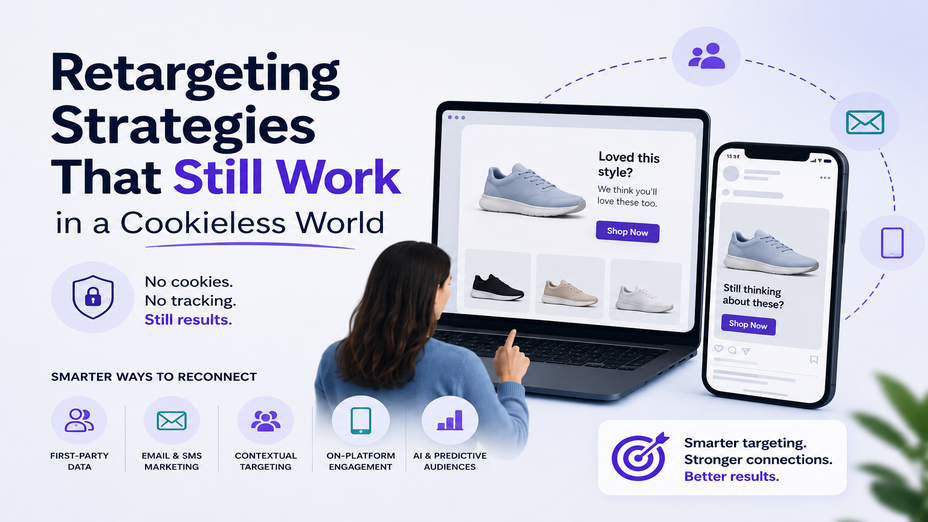
If you are finding that your ad campaigns yield lower returns as browsers block third-party cookies, you are not alone. Building retargeting ads that work requires replacing legacy cross-site tracking with privacy-compliant, first-party frameworks. This guide is built for performance marketers, e-commerce owners, and B2B growth leads who need to re-engage warm website visitors and increase return on ad spend (ROAS). Below, you will discover the exact cookieless targeting frameworks, server-side data setups, and publisher-led strategies that turn lost website traffic into qualified leads and sales without violating user privacy.
For over two decades, digital advertising relied heavily on third-party cookies. A user would visit your site, a tracking snippet would drop a cookie in their browser, and ad networks would follow that user across the web showing dynamic product ads.
That model is officially broken.
Apple's Safari introduced Intelligent Tracking Prevention (ITP), Mozilla Firefox enabled Enhanced Tracking Protection (ETP), and Google Chrome continues to restrict cross-site tracking through Privacy Sandbox initiatives. Compounded by mobile privacy updates like iOS App Tracking Transparency (ATT) and global regulations such as GDPR, CCPA, and India's DPDP Act, traditional client-side pixels now miss between 40% and 60% of user touchpoints.
When browser tracking breaks:
To maintain profitable acquisition channels, businesses must pivot from rented third-party tracking to owned first-party data infrastructure.
To build high-converting ad campaigns today, it helps to understand how data classification has evolved across modern acquisition channels.
|
Data Type |
Source & Collection Method |
Privacy Risk |
Longevity & Control |
|
Zero-Party Data |
Explicitly given by users via quizzes, preference centers, and forms |
Very Low |
High (Fully Owned) |
|
First-Party Data |
Collected directly from user activity on your owned website/app |
Low |
High (Fully Owned) |
|
Second-Party Data |
First-party data shared through trusted brand partnerships |
Moderate |
Medium (Partner Dependent) |
|
Third-Party Data |
Aggregated from external sources and cross-site browser tracking |
Critical (Phaseout) |
Expired / Non-Reliable |
Relying on third-party data leaves your business vulnerable to browser restrictions and policy changes. Direct consumer relationships, built through zero-party data (information explicitly shared by users) and first-party data (behaviours collected on your owned properties), form the foundation of sustainable ad performance.
Transitioning away from third-party tracking does not mean abandoning retargeting. It means using smarter, more resilient strategies that respect user privacy while delivering high conversion rates.
One of the most effective ways to run retargeting ads that work without third-party cookies is through direct identity matching. Instead of relying on a browser pixel to remember a visitor, you capture consented user identifiers (such as email addresses or phone numbers) and securely sync them with ad platforms.
Major advertising networks offer dedicated tools for this purpose:
Because these platforms use hashed, privacy-compliant user data, match rates remain high regardless of browser cookie policies.
Traditional client-side tracking relies on the user's browser to send event data (such as page views, add-to-cart events, or form submissions) to ad platforms. Ad blockers, network drops, and browser privacy tools frequently block these requests.
Server-side tracking solves this problem by routing event data from your website server directly to the ad network's server via API.
[User Browser] ---> [Your Web Server] ---> [Server-Side GTM] ---> [Meta / Google Conversions API]
Implementing Server-Side Google Tag Manager (sGTM) alongside platform-specific APIs like Meta Conversions API or Google Ads Offline Conversions provides significant advantages:
When persistent cross-site tracking is unavailable, contextual relevance becomes your primary lever for conversion. Contextual retargeting focuses on where your target audience is spending time online rather than tracking their individual movements across unrelated sites.
Instead of showing generic retargeting ads to every past visitor, structure your campaigns based on content depth and engagement intent:
Platforms like Google, Meta, Amazon, and TikTok operate as "walled gardens." Because hundreds of millions of users remain logged in across mobile apps and desktop sessions, these platforms maintain rich first-party data within their own environments.
Within a walled garden, cookieless retargeting functions seamlessly:
By structuring campaigns to capture and nurture engagement directly within these environments, you maintain high precision without cross-site tracking risks.
The best way to get customer data is simply to ask for it by offering genuine value in return. Zero-party data refers to proactive inputs provided by users, such as quiz responses, preference selections, or tool inputs.
Practical zero-party data mechanisms include:
Once collected, this data feeds directly into your CRM, enabling automated email sequences and segmented retargeting ads that work across paid channels.
Transitioning your marketing strategy to a cookieless framework delivers immediate operational advantages:
|
Key Advantage |
Traditional Pixel Retargeting |
First-Party & Server-Side Retargeting |
|
Data Reliability |
High loss rate (40% to 60% dropped signals) |
Complete data capture via server logs |
|
Privacy Compliance |
High risk under GDPR, CCPA, and DPDP |
Fully compliant with consent frameworks |
|
Ad Delivery Precision |
Frequent over-exposure or missed users |
Accurate frequency capping and suppression lists |
|
Algorithm Optimisation |
Starved of conversion data |
Rich, real-time conversion signals fed to AI bidding |
When uploading email lists to Google or Meta, match rates sometimes drop below 50%.
Configuring server-side containers and API endpoints requires developer resources and analytics expertise.
First-party audience pools naturally shrink if top-of-funnel traffic slows down.
At GBIM, we assist businesses in building durable, high-converting digital acquisition systems that do not break when browser rules change. As a full-service digital marketing agency, our performance marketing specialists handle the entire transition from legacy pixel tracking to advanced first-party architectures.
Our step-by-step performance framework covers:
Building retargeting ads that work requires a combination of technical engineering, creative strategy, and deep analytics expertise. We at GBIM bring over two decades of industry experience to help brands navigate complex digital shifts with confidence.
Our team helps businesses eliminate wasted ad spend by aligning technical SEO, first-party data capture, and high-ROI performance marketing strategies. Whether you need to fix broken conversion tracking or scale your paid campaigns using tailored PPC services, our services support your growth with clear, data-backed execution.
They are privacy-compliant ad campaigns that re-engage past site visitors using first-party CRM data, server-side tracking APIs, and contextual targeting rather than third-party browser cookies.
Browsers like Safari and Firefox block third-party cookies by default, while mobile privacy updates and global regulations restrict cross-site tracking pixels, causing massive data loss.
Server-side tracking routes event data directly from your website server to advertising platforms, bypassing browser ad blockers and privacy restrictions to ensure full conversion visibility.
First-party data consists of direct customer information like verified emails and purchase histories, offering higher platform match rates and better conversion signals for AI bidding.
Yes, B2B brands can upload corporate CRM lists to platforms like LinkedIn and Google Ads, paired with intent-based contextual placements, to engage key account decision-makers effectively.
Basic CRM list matching can be deployed within days, while complete server-side tracking and Conversions API integrations typically take one to two weeks to build, test, and validate.
309, Rupa Solitaire,
Sector-1, Millennium Business Park,
Mahape, Navi Mumbai,
Maharashtra (400 710), INDIA.
Write to us at
hr@gbim.com