
As marketers know, every couple of years, you have the same question: Is this the next big change or another platform vying for attention?
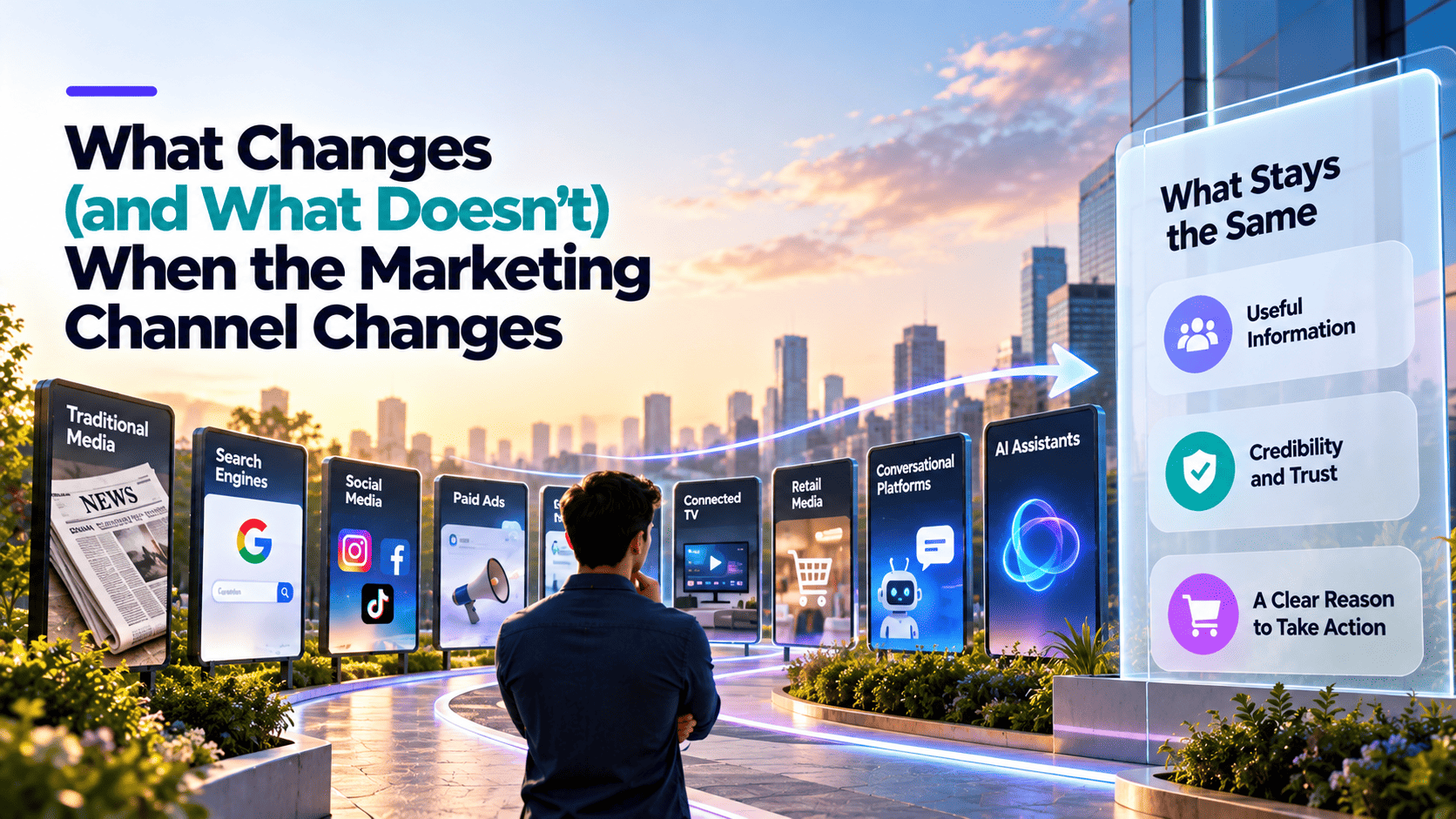
We've seen traditional media fade away for search engines, desktop to mobile, organic social media to paid ads, and more. AI assistants, connected TV, retail media and conversational platforms are currently impacting the way consumers find businesses.
Every major channel shift creates new opportunities. It also encourages businesses to reassess strategies that previously worked well.
But when we examine how marketing channels evolve, an interesting pattern emerges. Decisions about choosing one business over another do not change as quickly as the tools.
There is still a demand for people to receive information that is useful to them. Still they seek a sense of credibility. But they still need a good reason to take any action.
Recognizing difference is key to marketers' decision making without following all the latest trends.
Consider some of the ways people may search out a reliable enterprise software company.
Ten years ago that individual would have gone to Google and a couple of sites and downloaded a brochure.
In today's world, the process might begin with an AI assistant, a LinkedIn conversation and end with a product demo.
The discovery process is different, but the questions are similar:
A new platform can impact the timing and location of these questions. It doesn't often eliminate the need to respond to them.
So, the first step in Channel strategy is to begin with the behaviour of the customer and not the popularity of the platform.
To appreciate what's important now, you need to review past changes.
Search marketing revolutionized the way businesses get to their potential customers.
Companies wouldn't have to rely on interruption ads, but could reach audiences who are looking for products, services and solutions.
The importance of keywords, rankings and search visibility emerged.
However, it was still necessary to know the needs of customers to be able to do search marketing.
If a page for a popular keyword didn't answer the question of the visitor, then it was not of much value to the business.
What changed: How businesses captured existing demand.
What remained: The relevance and the useful information.
In contrast, the traditional advertising medium failed to provide this easily; social media did.
Consumers could comment, share experiences and ask questions and influence the perception of others regarding a brand.
In the end, businesses were given fresh opportunities to build communities, and part of the dialogue was lost.
That was not enough for promotion. Brands must respond and listen.
What changed: Communication moved from a distance to more immediate and interactive.
What remained: Trust and consistency remained in the relationship.
Mobile adoption brought digital experiences to people all day long.
People would be able to do their research on the go, make their comparisons in the downtime and even call businesses straight from the search results.
This was a change in the way the website was designed, the type of ads and the path they took to conversion.
Even if a business has good content, but the mobile experience isn't that great, visitors may not be able to take the next step.
What changed: Quick and convenient customer expectations.
What remained: Eliminating needless drag in the purchasing process.
The next one that's important is the addition of AI-powered discovery.
Before going to any business website, a customer can get a summary of what they can get or a shortlist of the businesses that are available.
This has made marketers more and more driven to pay attention to the information meaning and representation for automatic systems.
Helpful positioning, easily found information, uniform business information and valid information is helpful.
However, no matter how many times you have been associated with a response generated by an AI, it does not necessarily lead to a conversion or trust in the customer.
What changed: Some discovery and comparison activities may occur prior to the visit to a website.
What remained: There was still accurate information, differentiation and evidence that had an influence on decision making.
The biggest mistake is treating a new marketing channel as a substitute for strategy.
Once a platform becomes popular, companies might jump to sign up without knowing what they're looking to accomplish.
This generates activity, not necessarily progress.
There are three consistent errors to note.
Mistake 1: Confusing visibility with business results
A campaign can make impressions, get views or engagement seen, but without qualified prospects.
It's important that visibility links to a relevant business goal.
Mistake 2: Reusing the same message everywhere
A detailed LinkedIn post may explain a complex business issue, while a short video may introduce the same topic through a quick visual example.
Copying the same content in all these formats does not account for the way that people consume each channel.
The main idea should be the same. Its presentation needs to be altered.
Mistake 3: Abandoning established channels too early
A new channel could present new opportunities, but that doesn't mean an old one isn't still providing value.
Before companies start diverting their focus from solid sources of inquiry or sales, they have to have the proof.
Not all parts of the marketing function need to be reconstructed.
|
Marketing element |
What changes |
What stays important |
|
Discovery |
Search, social, AI, marketplaces |
Being relevant to customer needs |
|
Content |
Format, length, presentation |
Clear and useful information |
|
Targeting |
Platform signals and capabilities |
Understanding the audience |
|
Engagement |
Comments, messages, AI interactions |
Responsive communication |
|
Measurement |
Attribution methods and reporting tools |
Meaningful business outcomes |
|
Visual and technical requirements |
Consistent identity and positioning |
It differentiates between this, so that businesses can adjust without having to start all over again from scratch.
For instance, if a brand is new to AI-driven discovery, it might have to refine its service description and categorization. It doesn't have to affect its fundamental stance.
The question isn't what is the secret to being an AI-first brand.
It is, "Can customers and the systems assisting them clearly understand what our business offers?”
The marketing tools become obsolete. Some of the features are still relevant in almost all channels.
Understanding the motivations behind searches, clicks, watch time, and inquiries enables businesses to tailor messages for optimal impact.
A customer who is looking for information would require different information from the one who is ready to make a decision.
If customers don't get what a business is, the more they see of it, the more they will be confused.
Each marketing channel has a firmer base with clear positioning.
Customers can assess a business based on reviews, testimonials, demonstrations, detailed service info and documented results.
The best evidence will vary between industry and buying scenario.
Metrics should assist marketers to determine if an activity is helping to further business goals.
This could be qualified enquiries and lead to customer conversion rates for lead generation.
It could be completed transactions, repeat orders, or customer retention for ecommerce.
These skills are still applicable whenever new targeting systems or reporting features are added to platforms.
If you are thinking about spending a lot of time on an emerging marketing channel, consider these five questions:
Here are some questions to determine if the channel is a promising one or just a passing fad.
They also help to identify when it is appropriate to experiment.
Understanding how marketing channels evolve is not about predicting which platform will dominate next. It's the ability to identify shifts in customer behavior without compromising the fundamental aspects of marketing.
Working in digital marketing, branding, search and technology for over 20 years, our approach at GBIM is shaped by these areas.
Not all new platforms are like the old ones.
It allows us to look at new channels and ask some questions about it, rather than thinking that novelty equals effectiveness.
When developing a strategy our way with digital marketing and business growth involves grasping the brand, its target market and its goals.
Even real performance of campaigns counts.
We have digital marketing case studies across various industries and objectives and we can see these examples at first hand that there is no one-for-all channel strategy.
Different people have various requirements when looking for a healthcare provider with patient enquiry capabilities versus a logistics company looking to buy products for business use.
The platforms may overlap. The customer journeys don't.
It's here that experience and experimentation go hand in hand.
The lessons learned from the past can help with decisions but other assumptions may need testing.
Marketing will continue changing. Some platforms will grow, others will decline, and new ways of reaching customers will emerge.
The businesses best prepared for those changes will not necessarily be the ones adopting every tool first. They will be the ones that understand their customers, communicate clearly, and know how to evaluate results.
At GBIM Technologies, we approach changing digital environments with that perspective. We help businesses connect their marketing decisions to customer needs and measurable objectives, while remaining open to opportunities that genuinely support growth.
The channel may change. The reason customers choose a business still deserves the most attention.
Marketing channels change as technology develops, consumer habits shift, and businesses find new ways to reach audiences. New devices, content formats, and discovery tools create different opportunities for communication and customer engagement.
Not necessarily. New channels often change how customers discover and evaluate businesses, but older channels may continue delivering strong results. Their relevance depends on audience behavior, business objectives, and measurable performance.
Businesses should monitor customer behavior, evaluate emerging opportunities, test suitable formats, and measure results. Maintaining clear positioning and consistent messaging helps them adapt without losing their brand identity.
Customer understanding, trust, relevant messaging, credible information, and performance measurement remain important. Their application may differ across search engines, social media, email, AI assistants, and other platforms.
AI is influencing how people research information, compare options, and discover businesses. Marketers may need to make content easier to interpret, maintain consistent brand information, and evaluate new sources of traffic and enquiries.
No. Small businesses should prioritize channels where their target customers are active and where results can be measured. Testing a few relevant opportunities is generally more useful than maintaining an ineffective presence everywhere.
309, Rupa Solitaire,
Sector-1, Millennium Business Park,
Mahape, Navi Mumbai,
Maharashtra (400 710), INDIA.
Write to us at
hr@gbim.com