
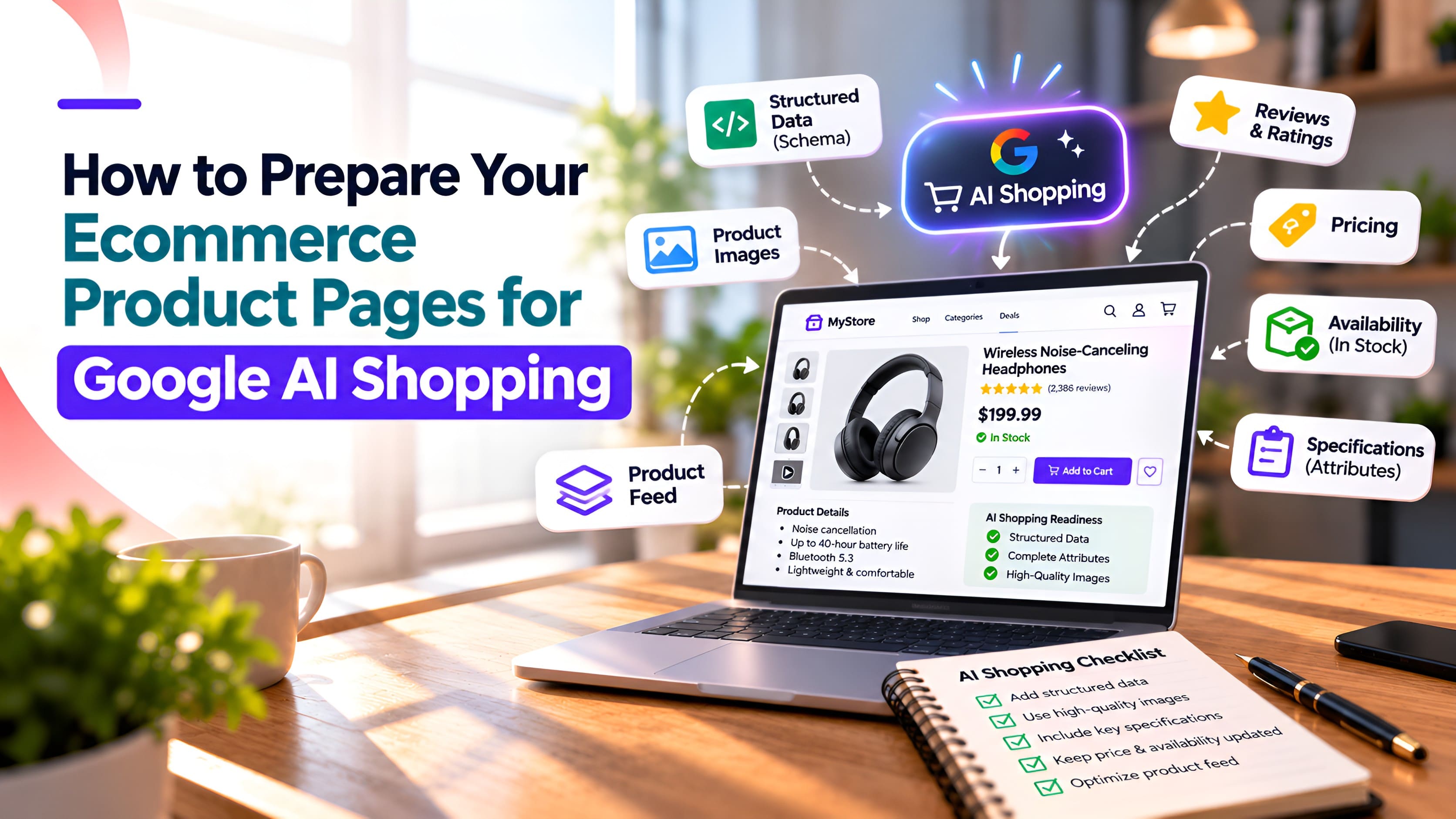
Imagine someone searching for a laptop for office use, online meetings and everyday browsing. Instead of visiting multiple websites, they will have the possibility of following the AI powered shopping results that will allow them to compare the characteristics and find products that fit their needs.
This is changing the way ecommerce companies might get to potential customers with product information. An e-commerce product page should motivate sales. It should convey correct information that consumers and Google's systems can comprehend.
That's where Google AI shopping optimization helps. Brands can optimize product description text, shopping data and website usability to get ready for changing product discovery without having to overhaul their current SEO strategies.
Typically, traditional searches start with a few words, for example, ‘best wireless headphones'. AI-driven retail experiences can also enable the customer to delve into the more specific needs such as comfort and compatibility, along with intended use.
For instance, if you're about to have a lot of long office calls, you may look for headsets that are ideal for that purpose, as well as for regular travel.
Product listings and merchant information and other relevant sources can aid customers in evaluating their options in Google's shopping experiences.
However, AI recommendations are not guaranteed. As Google's systems evolve, it still has a focus on the quality of the content, usability of the pages, and the reliability of product information.
The focus is on the understandability of the products for customers as well as for search systems.
The term "Wireless Bluetooth Headphones X200" has several implications, but it doesn't provide a lot of answers.
Are the headphones suitable for meetings? What is the battery life? What devices can be used?
Answers to questions that affect buying behavior are provided on a helpful product page.
|
Product element |
Why it matters |
|
Descriptive title |
Identifies the product clearly |
|
Specifications |
Explains important features |
|
Original description |
Connects features with practical needs |
|
Accurate images |
Shows appearance and design |
|
Availability |
Communicates purchasing options |
|
Delivery and returns |
Clarifies customer expectations |
|
Genuine reviews |
Provides additional customer perspectives |
The goal is to avoid unnecessary wordiness in the description. It's about being able to provide the necessary information without making customers search elsewhere.
Take this as a very general description:
Advanced wireless capable lightweight headphones.
A better alternative would be:
The light weight design comes in handy for everyday use while wireless technology ensures the headphones are compatible with other devices.
The second description is easier to comprehend and doesn't come with any promises unless it has real world practicality to back it up.
Information of various kinds is required for various categories. Sizing and fabric information are needed for fashion products, and dimensions, capacity and compatibility information are needed for appliances.
Product structured data is a type of structured data that provides machine-readable product data that can be made available on a website.
Google provides support for Product and Offer structured data for eligible merchant listings, that can pass on information like availability, product identifiers and shipping.
This can lead to certain search results showing up when shopping, but it doesn't guarantee you'll appear in AI-driven search results.
Make sure that the following information is consistent across your site and any shopping systems used:
If you are an ecommerce business that is utilizing Google Merchant Center, product feed details must match the relevant landing pages.
Inconsistencies can cause problems with the display, reduce eligibility and cause confusion to customers.
Clear product photos are essential when you can't show a product to customers.
The primary image is a very clear image that sets the picture of the product. Proportions, features and realistic usage can be explained using additional photographs.
Consider multiple angles, close-ups, precise views of different pictures and contexts using lifestyle photos.
Avoid editing photos in a way that's incorrect with regards to the actual product.
Google Merchant Center has its own image requirements, which must be adhered to, and the images that are submitted for shopping should be more than just pretty – they should be in keeping with the applicable policies.
Alternate text that describes images can enhance accessibility and convey information about the image.
It's important to remember that AI-powered discovery doesn't take the place of merchant credibility.
They may be looking on Google and not buying the product if the information and support of the company is not easily accessible.
Useful trust signals include:
Do not use a testimonial that is made up, or exaggerated benefits and product claims that aren't supported.
Reliable information enables customers to determine if a product and retailer is what they expect.
If you don't put something on an informational page, or you don't put enough information, you lose customers.
Test to see if product pages load the same, look good on mobile devices and have clear checkout options.
Product information must also be accessible by other search mechanisms, not just by interaction which could make it hard for some reliable information retrieval.
The other links should be designed to assist the customer in a natural way in moving from one product, category and supporting guide to the next that is relevant to the customer.
While these enhancements contribute to overall ecommerce SEO and customer experience, they don't ensure AI Shopping visibility.
For a successful Google AI shopping optimization, consider both product exposure and substantial business results.
|
Measurement area |
What to monitor |
|
Organic discovery |
Product-page impressions and clicks |
|
Shopping eligibility |
Merchant Center diagnostics |
|
Product visibility |
Available shopping performance reports |
|
Customer engagement |
Interaction with product information |
|
Business outcomes |
Product-page conversions |
Google does not provide a separate report for every AI-assisted shopping interaction.
Therefore, it is essential for businesses to not assume that any growth in traffic or conversions is due to AI search.
Instead, utilize related performance indicators over time and see whether there are any changes that address customer needs.
When you're getting ready to shop using AI, you don't need to rewrite all the descriptions around AI.
Focus on accurate information, easy navigation and reliable shopping details.
Businesses that exhibit these traits are more likely to satisfy the needs of customers in the traditional and new discovery environments.
At GBIM, we help ecommerce brands strengthen their digital presence through SEO, content strategy and performance-focused marketing. We focus on the interests of our clients' customers first to ensure their search visibility is optimized for their needs - and that they grow their businesses in measurable ways!
Google AI Shopping broadly refers to AI-powered shopping experiences within Google's ecosystem that help users discover, compare and evaluate products. These experiences may combine product information, merchant listings and other relevant sources.
No. Traditional ecommerce SEO remains important. Google recommends maintaining established SEO fundamentals, including helpful content, accessible pages and accurate information, for its AI-powered search experiences.
Google does not require special AI-specific structured data for AI Overviews or AI Mode. However, supported product structured data can help establish eligibility for certain merchant listings and product-rich search appearances.
Brands should provide original descriptions explaining relevant specifications, compatibility, intended use and practical benefits. The focus should be answering customer questions accurately rather than repeating search keywords.
Genuine customer reviews help shoppers evaluate products. Eligible review information may also support certain Google search features, but reviews do not guarantee inclusion in AI-generated recommendations.
There is no fixed timeline. Results depend on indexing, competition, existing website performance and product information quality. Businesses should monitor search and shopping reports regularly instead of expecting immediate visibility improvements.
309, Rupa Solitaire,
Sector-1, Millennium Business Park,
Mahape, Navi Mumbai,
Maharashtra (400 710), INDIA.
Write to us at
hr@gbim.com