
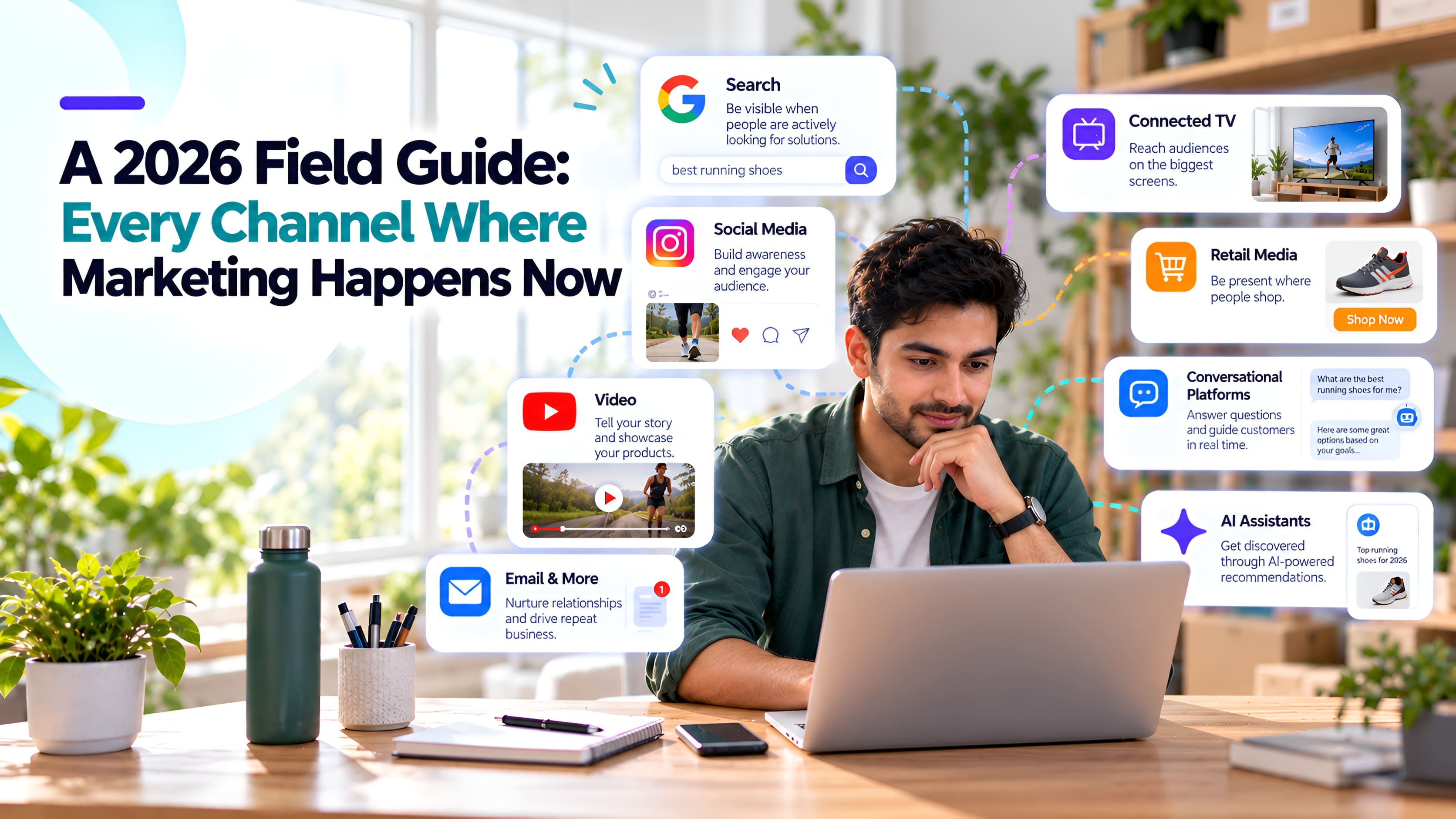
When a customer views a product demo on YouTube, requests a comparison with another product from ChatGPT, reads reviews on Google, and initiates a WhatsApp message sequence with a business before buying.
Which marketing channel deserves credit for that conversion?
There isn't one simple answer.
Marketing in 2026 takes place on search engines, AI assistants, social networks, marketplaces, messaging apps, connected TV, and some other digital places. These channels may impact the same customer at multiple touch points.
This digital marketing channels guide 2026 highlights the key channels of digital marketing that businesses should know about, explains the functions of these channels, and why they should be utilized.
It's not about attending all of the events. It's the knowledge of what makes customers look for, evaluate, trust and choose a brand.
Marketing channels can be better conceptualized by their function.
|
Channel category |
Common platforms |
Primary marketing role |
|
Search engines |
Google, Bing |
Capture existing demand |
|
AI discovery |
ChatGPT, Gemini, Perplexity |
Support research and comparisons |
|
Social media |
Instagram, Facebook, LinkedIn |
Build awareness and engagement |
|
Video platforms |
YouTube, Instagram Reels |
Demonstrate products and build familiarity |
|
Retail media |
Amazon, Flipkart |
Reach shoppers within marketplaces |
|
Quick commerce |
Blinkit, Zepto, Instamart |
Reach convenience-focused shoppers |
|
Messaging |
WhatsApp, Messenger |
Handle inquiries and conversations |
|
|
Newsletters, automated email campaigns |
Nurture relationships and encourage repeat engagement |
|
Connected TV |
Streaming apps, smart TV environments |
Build broad video awareness |
|
Websites and blogs |
Brand websites, educational resources |
Establish authority and support conversions |
|
Influencer marketing |
Creators, industry experts |
Build credibility through trusted voices |
|
Local discovery |
Google Maps, Business Profiles |
Reach location-based customers |
These categories overlap. Besides search, YouTube offers video discovery, and marketplaces ads, product research and purchase.
The key question here is what do each of these channels do for the customer journey?
People are still searching online, and search engines are key to bringing them and businesses together in the pursuit of information, services, or products.
The main two methods are used for different purposes:
Search is becoming conversational, too. Google has baked AI into search and ads, changing how people access information.
Clear website content, helpful answers, business information that is accurate, pages that meet search intent should be the focus for businesses.
Perfect for service brands, B2B brands, local brands and e-commerce brands with search needs.
AI assistants introduce another layer between businesses and prospective customers.
When it comes to accounting software, a researcher may need the help of an assistant to do some research in integrations, usability and business needs requirements.
The assistant can provide a summary of the information from a number of sources prior to the customer visiting a website.
This adds new aspects to the brand visibility:
AI discovery isn't ranking as it traditionally is. Just showing up in google doesn't automatically mean that you'll be included in an AI-generated answer.
Businesses should distinguish between organic AI-generated responses and separately labeled sponsored placements.
Best suited for: Brands that are product, service or solution oriented, have research needs, and require comparison.
Social networks can be used to find products that the customer doesn't know about.
Instagram Reels, Facebook content, and LinkedIn discussions have various impacts on various audiences.
A furniture company, for example, could present a video of a minimal storage solution. For software B2B businesses, LinkedIn can be helpful to explain an operational issue.
The content is relevant, it is appealing to the interests of an audience.
|
Platform |
Common business application |
|
|
Product discovery, visual storytelling |
|
|
Community engagement, local campaigns |
|
|
B2B awareness, professional credibility |
|
YouTube |
Tutorials, demonstrations, detailed explanations |
|
|
Visual inspiration and product exploration |
The choice of platforms should be based on audience behavior, rather than on popularity.
Marketplaces and fast commerce applications are coming into the picture as advertisement places.
Retail media places brands closer to the purchase decision, allowing them to engage consumers as they browse product categories, compare products, and are ready to buy.
The audience of quick commerce ads is a little bit different; typically, it's individuals seeking convenience and immediate availability.
Relevancy of the product is a key factor in these channels.
Businesses should pay attention to:
An effective advert will not make up for a confusing or incomplete product list.
For retail businesses, GBIM's e-commerce SEO services are applicable to enhancing product visibility even outside of paid results.
Messaging platforms make it easy to reach customers and communicate with them.
Businesses that receive a lot of product questions, appointment enquiries or service requests will find WhatsApp of special relevance.
Customers can simply ask their questions directly, without having to go through several pages of the website.
Messaging can be used by businesses for:
Ads have been introduced to WhatsApp's Status and Channels, and will be rolled out in stages in some regions.
These are not personal, private chats.
It's not simply a question of sending out more promotional pieces. It is providing useful communication at the time of the customer's need.
Social feeds are not the only place to leverage video marketing.
Short videos are effective for introducing products in a short period of time. Complex decisions can be made clear with longer YouTube video content. Connected TV is one means for engaging people.
Creator partnerships can introduce products through familiar, trusted voices.
The different formats are used for different purposes.
|
Video format |
Suitable objective |
|
Short-form video |
Generate interest and quick discovery |
|
Product demonstrations |
Explain features and practical benefits |
|
Expert interviews |
Establish credibility |
|
Customer stories |
Provide relatable proof |
|
Connected TV campaigns |
Build broader brand awareness |
Not all video formats are required for a business.
A detailed product explanation may be more useful to a technical B2B company than a handful of unrelated entertainment videos.
Algorithms change. Advertising formats evolve. Platforms may have varying policies.
Having a business website and a list of emails and a library of original content will provide a more solid foundation.
These channels enable businesses to maintain the communication channels with their audiences.
Include assets in use that are useful, e.g.:
Other channels are not ignored due to the owned content. A social ad might be used to lead to a targeted landing page, and an educational article can address questions to be answered during AI-driven research.
Businesses can explore GBIM's digital marketing services to understand how these activities connect within a broader growth strategy.
The biggest mistake is assuming every available channel deserves equal attention.
A practical selection process begins with four questions.
Identify the platforms your potential customers use to discover products, research services, and compare businesses.
A business struggling with awareness needs a different approach from one receiving inquiries but failing to convert them.
Take out indicators that meet the purpose of the channel.
Awareness campaigns may track qualified reach and branded search interest. Lead generation campaigns should measure inquiry quality and conversions.
The right content, monitoring and continuous improvement are needed in each channel.
Running too many channels with not enough manpower makes them run at a reduced capacity.
|
Business objective |
Channels worth evaluating |
|
Generate qualified B2B leads |
Search, LinkedIn, email, educational content |
|
Increase e-commerce discovery |
Search, marketplaces, social video, retail media |
|
Build local visibility |
Local SEO, Google Maps, social media |
|
Improve customer engagement |
Email, WhatsApp, social communities |
|
Establish expertise |
Blogs, YouTube, LinkedIn, AI discovery |
|
Expand brand awareness |
Social advertising, creators, connected TV |
This table is provided as a guideline only, and is not a definitive ranking.
A channel is appropriate only when it is the right audience to reach and it can be helpful in meeting a specific business objective.
This is a field guide designedproduct titles and descriptions to serve as a center for learning about the digital marketing field.
For a deeper understanding, explore these related articles:
Some marketing resources and digital marketing tools are also available which can support teams to review marketing strategy.
The best piece of advice from this digital marketing channels guide 2026 is to start with the customers' actions.
Understanding the places where your brand is discovered, where your brand is trusted, and what kind of engagements gets your customers to act is a crucial knowledge for businesses.
There are a lot of new platforms that are there and require your attention, but it shouldn't be a reason to abandon existing platforms.
At GBIM, we help businesses turn clear growth objectives into practical digital marketing strategies. We're focused on finding the right opportunities, creating digital visibility and developing strategies that will impact the business in a measurable way.
When you're evaluating your channel mix, we're here to assist you make your choices with more clarity.
Search engines, social media, video platforms, email, websites, marketplaces, messaging apps, and AI-powered discovery are important channels. Their value depends on the audience, industry, and business objective. No single channel is automatically best for every organization.
AI is changing how customers research products, compare brands, and discover information. It also supports advertising automation, content workflows, and campaign analysis. Businesses need accurate information, consistent positioning, and reliable measurement to adapt effectively.
No. Small businesses should prioritize channels where their customers are active and where results can be measured. Maintaining a few relevant channels consistently is often more useful than creating an inactive presence across numerous platforms.
Yes. Traditional SEO remains important for helping search engines discover, understand, and present website content. Clear structure, useful information, technical accessibility, and trustworthy content can also support visibility across AI-assisted discovery experiences, although inclusion is never guaranteed.
Retail media reaches shoppers within retailer-owned environments, often close to product comparison or purchase. Social media advertising reaches audiences based on interests, behavior, and other available targeting signals. Both can support discovery, but their contexts and measurement requirements differ.
A quarterly review provides a useful starting point for many businesses, with more frequent monitoring of active campaigns. Teams should assess audience behavior, lead quality, conversions, platform changes, and business priorities before making major channel decisions.
309, Rupa Solitaire,
Sector-1, Millennium Business Park,
Mahape, Navi Mumbai,
Maharashtra (400 710), INDIA.
Write to us at
hr@gbim.com