
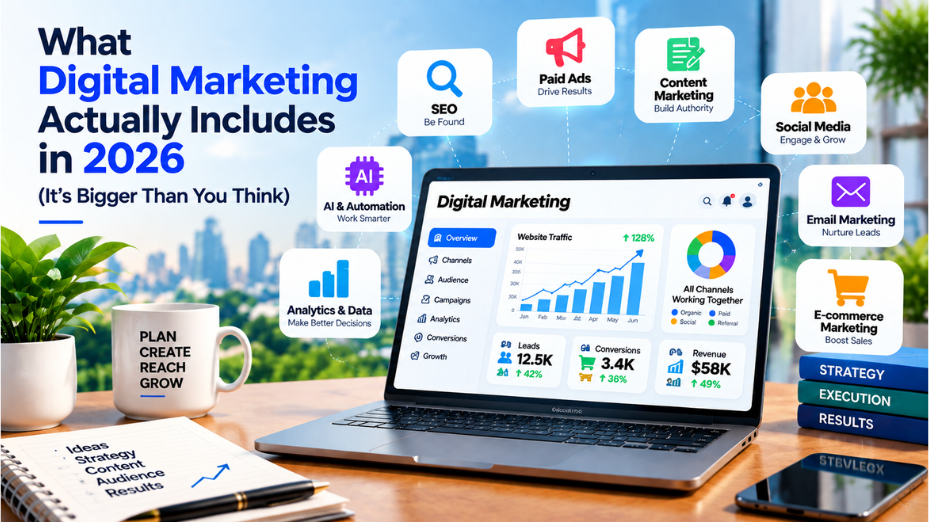
A time when a digital marketing plan could rely on a handful of recognizable boxes: Google Search, Facebook, email, and maybe display ads. Now that picture is incomplete.
A customer may spot a product in a short video, request an AI assistant to generate a list of options, visit Google to read reviews, see it again in a marketplace, and end up messaging the business on WhatsApp. Someone else may encounter the same brand through connected TV and take an entirely different route.
The landscape of digital marketing channels in 2026 is much broader than simply adding a few new platforms to an old marketing plan. The larger shift is the expansion of discovery, research, communication and commerce across increasingly digital surfaces and the indistinct lines between them.
The old channel-by-channel approach assumes that people behave neatly: search on Google, browse social media, open emails, and shop on an e-commerce site.
Real journeys are rarely that tidy.
Search can begin on a traditional search engine but continue through an AI assistant. Social media can create demand before someone knows what to search for. A marketplace can act as both a product discovery engine and a place to buy. Messaging can move from customer support to product discovery and ongoing engagement.
For businesses, this changes the planning question.
It is no longer simply, "Which platforms should we be on?"
It is also, "Where are people discovering us, building confidence, comparing options, and deciding what to do next?"
That wider view is central to how we approach digital marketing at GBIM. Instead of treating every channel as an isolated activity, the more useful starting point is identifying the gap between discovery and decision.
A modern marketing ecosystem can be easier to understand when we map each surface according to the role it may play.
|
Digital Surface |
What Happens There |
Typical Marketing Role |
|
Search |
People actively look for answers, businesses, and products |
Demand capture |
|
Social media |
Content, creators, communities, and brands drive discovery |
Demand creation and engagement |
|
AI assistants |
Users research, compare, summarize, and ask for recommendations |
Discovery and consideration |
|
Retail media |
Brands advertise inside or around retailer environments |
Consideration and conversion |
|
CTV and online video |
Brands reach audiences through video-led experiences |
Awareness and reach |
|
WhatsApp and messaging |
Conversations connect businesses and customers |
Engagement and commerce |
|
Marketplaces |
People discover, compare, review, and buy products |
Commerce |
The important point is not that every business needs every row in this table.
It doesn't.
A B2B software company, neighborhood service business, fashion retailer, and industrial manufacturer may require completely different combinations. The map shows where marketing can happen; strategy determines which parts of that map actually matter.
Search remains one of the strongest expressions of intent online, but "search" itself is becoming broader.
Traditional organic results still matter. Paid search still matters. Local results, shopping listings, images, videos, maps, and other search features can also influence what users see before visiting a website.
Now AI-generated experiences add another layer.
A person researching a complicated purchase may move between a search engine, an AI-generated summary, several websites, reviews, and videos before making a decision.
That means search visibility increasingly involves thinking about the information people need throughout the research process, not merely achieving a position for one keyword.
Social platforms were once discussed mainly as places to build audiences and publish content. That description now leaves too much out.
People use social platforms to:
This convergence of entertainment and discovery has been accelerated by short-form video. For marketers, that translates to a piece of social content that can be used for awareness, research, trust-building, or to drive actions depending on when the customer comes across it.
Social, therefore, does not occupy one fixed position in the funnel.
AI assistants are among the newer digital marketing channels in 2026, gaining greater relevance as customer discovery habits continue to change.
Users can pose detailed questions using natural language rather than a short keyword and open multiple results. Users may ask for explanations, comparisons, summaries, ideas, or recommendations and follow-up questions.
AI assistants are not replacing search engines, by any means.
They are used differently, depending on the activity, user, platform and information available. Search engines are evolving too, as they have their own AI experiences.
For businesses, the practical lesson is simpler: customers have another environment in which they can learn about a category, understand a problem, and evaluate possible solutions.
Being understandable and discoverable across these environments is becoming part of the wider visibility challenge.
Marketing used to drive people toward a store.
Increasingly, the store itself is part of the marketing environment.
Retail media allows brands to reach people within retailer ecosystems, often when they are already browsing or comparing products. Marketplaces combine search, advertising, reviews, product information, and transactions within the same environment.
Agentic commerce may push that convergence further. AI-assisted shopping experiences are beginning to reduce some of the manual work involved in finding and comparing products, while supported systems can increasingly assist with actions deeper in the shopping journey.
The distance between "marketing" and "buying" is therefore becoming shorter in some digital environments.
Messaging deserves its own place on the map.
WhatsApp, in particular, shows how quickly a platform's marketing role can expand. A customer might encounter a business elsewhere, begin a WhatsApp conversation, ask a question, receive information, and continue the relationship after making a purchase.
Messaging can therefore sit at several points in the journey rather than simply appearing at the end as a support channel.
This is especially relevant in markets such as India, where conversational commerce is developing alongside social and video-led product discovery.
Imagine someone considering a new home appliance.
They first notice the brand during a CTV program.
CTV: They later encounter a creator discussing the category on social media.
Social: They ask an AI assistant what features they should compare.
AI research: They search Google for specific brands and reviews.
Google Search: They visit a retailer to compare available models.
Retailer: They contact the business through WhatsApp with a final question.
WhatsApp: Decision
Which channel generated that customer?
Trying to give all the credit to one touchpoint misses what actually happened.
Each interaction performed a different job.
This is why channel selection should follow an understanding of the customer journey rather than the other way around. Businesses can explore further strategic and industry material through our GBIM Resources hub.
There will always be a temptation to chase whichever platform is receiving the most attention.
But new does not automatically mean relevant, and established does not mean outdated.
Looking across the digital marketing channels in 2026, businesses should focus less on being everywhere and more on understanding where their customers discover, evaluate and act.
"Which channel should we use?"
It is:
"Where does our audience discover, evaluate, build trust, and act and where are we currently losing them? "
One company may need stronger organic visibility. Another may already have plenty of traffic but struggle with conversion. A third may need paid acquisition, better creative, stronger marketplace visibility, or a more connected customer journey.
At GBIM, we prefer to start with that business problem rather than force a channel into the plan. Our approach to digital marketing in India looks at the wider path from visibility and credibility to qualified demand and conversion. Once the real gap is clear, choosing the right combination of channels becomes a much more useful exercise.
The landscape includes search engines, paid search, social media, online video, email, websites, marketplaces, retail media, messaging platforms, AI-assisted discovery, influencer marketing, and other digital advertising environments. The relevant mix depends on where a particular audience actually spends time and makes decisions.
Yes. SEO remains an important part of digital marketing because people continue to use search engines to research questions, products, services, and businesses. However, search visibility now needs to be considered alongside other discovery environments rather than in isolation.
AI assistants are becoming another environment in which people research subjects, compare choices, and discover information. It is more accurate to see AI as an emerging discovery and interaction layer than to assume it behaves exactly like a traditional advertising or search channel.
Paid search generally reaches users through search-engine advertising. Retail media operates within or around retailer-owned environments and data, which can place advertising closer to product browsing and purchase activity. Both can capture intent, but they operate in different contexts.
There is no universal combination. Channel selection should depend on the target audience, customer journey, business objective, buying cycle, existing visibility, and the points where potential customers currently drop out of the journey.
That is unlikely to be the useful way to think about the change. Search, websites, email, social media, and paid advertising continue to serve important purposes. What is changing is how they interact with newer surfaces such as AI-assisted discovery, conversational commerce, retail media, and evolving video environments.
309, Rupa Solitaire,
Sector-1, Millennium Business Park,
Mahape, Navi Mumbai,
Maharashtra (400 710), INDIA.
Write to us at
hr@gbim.com