
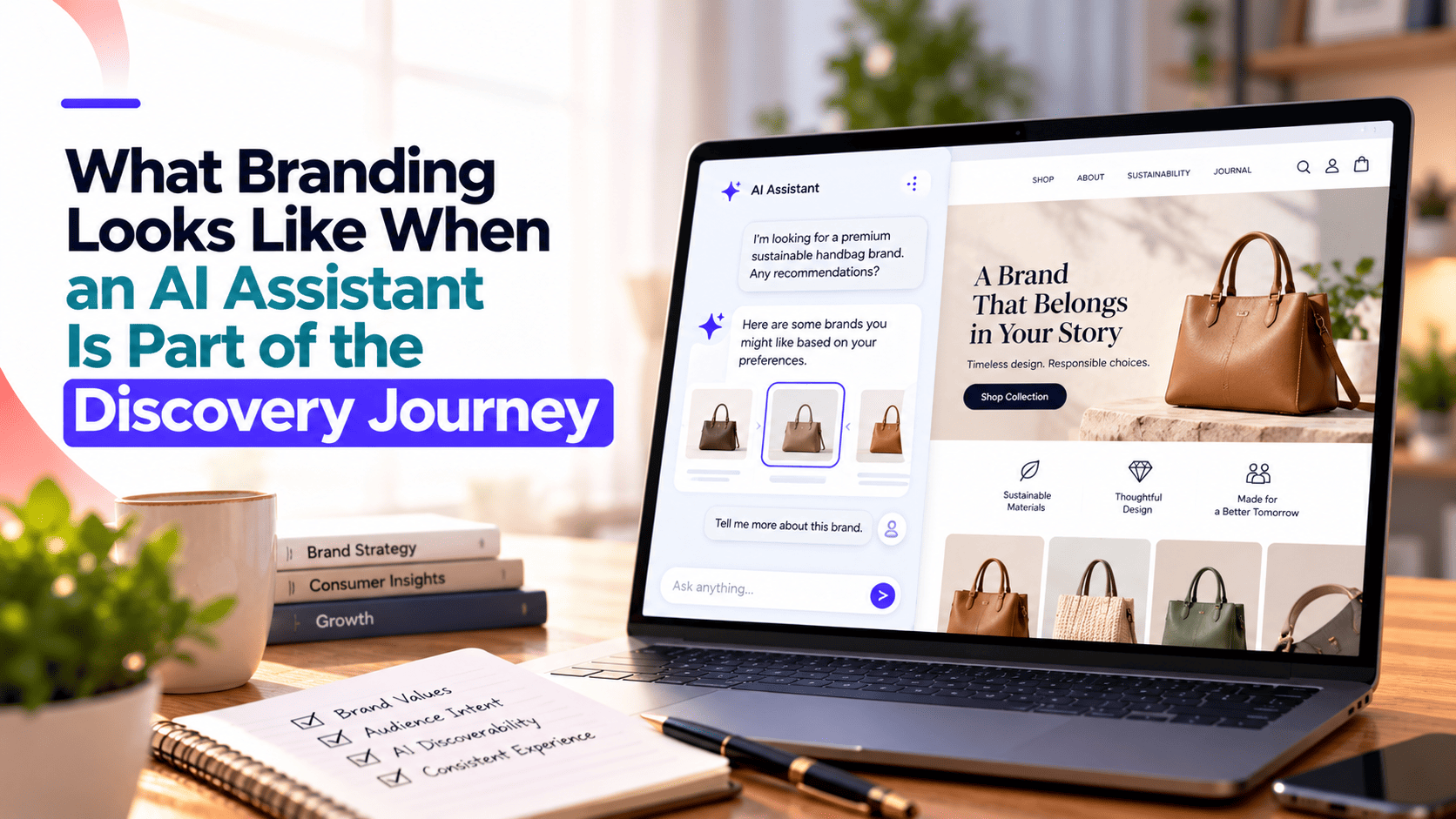
A potential user types the question, “Who are some of the good project management companies for small businesses?” into an AI assistant.
The assistant suggests some brands, explains their functions, targets and target groups and distinguishes them from one another.
Your company appears in the response. But something is wrong.
The assistant states that your software is an enterprise solution even though you are mainly targeting small businesses. It references a product functionality that's been long gone and doesn't include the benefit your company has been telling you for years.
The customer has already formed an impression before visiting your website.
This example demonstrates the increasing branding problem. Businesses no longer communicate with customers only through their websites, advertisements, and social media pages. AI tools can also shape customer perception of a brand from the get-go.
Branding for AI discovery involves ensuring that the company's identity, position, and accompanying information is easily understandable and consistent on digital media.
It does not call for giving up on traditional branding. It means that more attention has to be paid to the flow of brand information, outside of your control.
Traditional brand discovery is usually as a result of a direct interaction.
The customer reads an ad, clicks on a site, views a video or reads a review. The business has a lot of ownership influence over the message it is sending out via its owned channels.
There's another layer with AI-powered discovery.
A conversational assistant can summarize the information from websites, business listings, published articles, reviews and other accessible information.
The customer does not get the whole brand journey; it's a shortened one.
This interpretation might be helpful. It can also be missing information or be incorrect.
The difference is important because it is not the same thing when described on the brand's website than when described elsewhere.
Businesses don't control each and every AI-generated response. They can, however, enhance the information available that is quality and consistent about them.
Consider how an AI assistant might interpret information about a business.
It must determine the company name, its mission, and look for evidence to back up their description of the company.
The requirements can be structured as three layers.
|
Layer |
Question it answers |
Examples |
|
Identity |
Which business is this? |
Brand name, website, business details |
|
Positioning |
What does the business offer? |
Services, target audience, specialization |
|
Evidence |
Why should the description be trusted? |
Case studies, reviews, credible mentions |
Failure to communicate on any layer can cause confusion.
A company may maintain uniform contact details but advertise its services in various ways on its site, professional profiles, and in its directory listing.
There can be multiple possible interpretations of the company's activities that an AI system might consider.
The first step is to have a clear source of truth.
Many websites rely on broad positioning statements.
There are many website pages that use general positioning.
We provide cutting-edge solutions that revolutionize companies.
Compare it with:
We offer independent retailers cloud-based inventory management software for their online and offline retail operations.
The second statement describes the product, the audience, and the situation of the business.
It provides a better insight into the company for both humans and automated systems.
The following are helpful questions to ask when creating a brand description:
The answer does not need to be complicated.
Clear positioning often works better than abstract language filled with industry buzzwords.
Consistency does not mean copying identical sentences onto every page.
A homepage, LinkedIn profile, industry directory, and service page can use different language while communicating the same fundamental identity.
When the underlying claims conflict, problems occur.
For example:
Website: "Specialist accounting software for freelancers."
Business directory: "Enterprise financial management solutions."
Social profile: "A complete digital transformation company."
The descriptions may cause readers to draw different inferences about the business.
By having a brand messaging document, teams can remain consistent while not appearing to be the same on every channel.
Structured data gives supported search systems clues as to what information on a website and organization it is.
The organizational schema can be used to talk about the name, site, logo, etc. of the company and other information about the organization.
Where appropriate, other structured data types can be used to describe products, services or published content.
Structured data is a tool that can be valuable for businesses evaluating their branding for AI discovery in the broader context of their information strategy.
But there is one caveat.
Structured data is not a guarantee that an AI assistant will talk about a brand, recommend it or recreate the description a brand loves.
There are various retrieval methods and sources of information used by AI systems. They might also differ in their answers to different questions.
It is important, therefore, that structured data helps to ensure accurate information, and not to regulate answers generated by AI.
An entity is a person, organization, place, product, or concept that is recognized.
The objective is to differentiate your company from companies with the same name for brand recognition.
Practical steps include:
It is especially crucial for companies that have similar names, multiple brands or multiple product lines.
Now suppose a software company states that it is ending a certain feature.
The web page is updated as soon as possible. Older comparison articles, business directories and third party reviews, however, still reference the discontinued feature.
An AI assistant can be provided with both recent and obsolete data.
The company does not have the ability to edit all of the independent publications, but can take steps to minimize confusion.
Examine the information that customers can access outside of your website.
|
Information source |
What to review |
|
Business profiles |
Name, category, description, location |
|
Industry directories |
Service information and specialization |
|
Review platforms |
Product descriptions and customer feedback |
|
Media coverage |
Outdated or inaccurate company information |
|
Partner websites |
Brand name and service references |
|
Social profiles |
Setting up and what's on offer |
Focus on finding reliable sources that are relevant to your field and that you are likely to find when you conduct customer research.
If you can control the information, then update it.
If independent sources contain factual inaccuracies, businesses can request corrections.
Avoid creating fake reviews, or misleading placements as a third party credibility.
Two businesses can communicate their identities clearly and still sound almost identical.
Consider these descriptions:
Business A: "We are a digital marketing company for businesses to grow.”
Company B: "We focus on B2B long sales cycle organic search and lead gen.”
Both are understandable.
The second, however, gives a bit more information about its audience and specialization.
It could be significant if a customer asks an AI helper for a certain kind of provider.
Clear category positioning helps potential customers understand whether a business is relevant to their needs.
It does not guarantee inclusion in recommendations, but it reduces ambiguity.
Businesses developing their positioning can benefit from a structured brand consulting approach that connects customer needs, market differentiation, and brand messaging.
AI discovery poses a measurement issue.
The classic KPIs of traditional branding teams include awareness, direct traffic, branded searches, and customer perception.
While these measures are still helpful, companies should also be familiar with the descriptions of these measures which are provided by AI systems.
A practical review can include:
Be careful with these observations.
Answers generated by AI may vary based on the context, such as the specific words used, the location, the individual's needs, the model version, and the information that is available.
A few prompts are not enough to reliably calculate a visibility score for the market as a whole.
Testing on similar queries that have been tested previously can give direction, but it shouldn't be confused as a comprehensive overview of customer behavior.
Pick a key service or product.
State how your business would like customers to perceive it.
Then compare this description with five sources:
Search for the contradictions as opposed to slight wording nuances.
Does every source identify the same primary offering? Is the target audience clear? Are important claims supported?
If the answers are vastly different, it might not be a problem with AI visibility.
This may suggest that you need to redefine your brand positioning.
If businesses are on the journey of building their broader brand, GBIM's branding services can help start the process of aligning positioning and communication efforts across various channels.
While AI assistants could transform customer discovery of businesses, they won't replace the core principles of branding.
However, customers must still be aware of what a business has to offer, whether or not it will meet their needs and why their business is worth considering.
The difference is that an AI assistant may now provide the first explanation.
That explanation should be simpler for businesses to get right, and this is achieved by keeping a tight grip on positioning, information and supporting evidence.
At GBIM Technologies, we help businesses build consistent brand identities and communicate their values across digital channels. Our brand services include strengthening the brand image of companies to their customers. If your brand messaging has gotten lost in websites, profiles, and on other touch points, we can help you get clarity when it comes to how your business is being represented.
Branding for AI discovery involves making a company's identity, positioning, and supporting information clear and consistent across digital sources that AI systems may use when generating responses. It builds on traditional brand management rather than replacing it.
No. Businesses cannot directly control every AI-generated description. They can improve the accuracy of their websites, business profiles, structured data, and other information sources to reduce the likelihood of misunderstanding.
Structured data can help supported search systems interpret organizational information, but it does not guarantee brand mentions or recommendations in AI-generated answers. Clear website content and credible external information also matter.
Consistent naming helps customers and information systems identify the same organization across different websites and platforms. Inconsistent names or descriptions may create confusion, particularly for businesses with similar names.
Businesses can test relevant customer questions across AI assistants and review the accuracy of generated descriptions. These checks should use multiple queries and be repeated over time because responses are variable.
AI discovery adds another consideration to brand communication, but it does not replace positioning, customer experience, reputation, or trust. Businesses still need a recognizable identity and a credible reason for customers to choose them.
309, Rupa Solitaire,
Sector-1, Millennium Business Park,
Mahape, Navi Mumbai,
Maharashtra (400 710), INDIA.
Write to us at
hr@gbim.com