
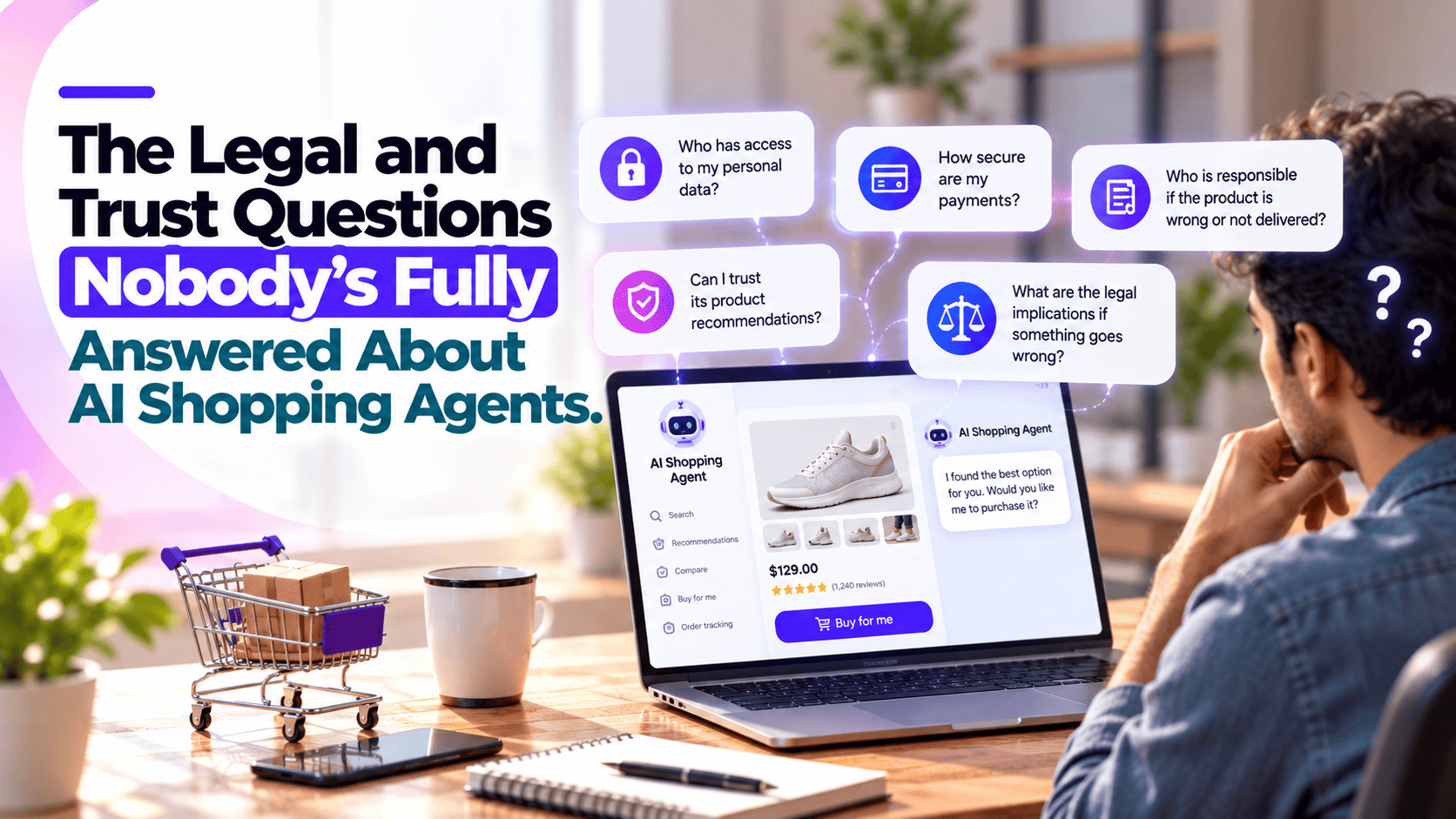
Try and ask an AI assistant to get you a pair of running shoes, read customer reviews, choose your size and place a purchase. You sign up for the purchase and the assistant takes care of the details.
Convenient? Absolutely.
However, what about when the retailer does not allow the AI assistant to access its website?
Now that is no longer a question, it is a reality. AI shopping agents aren't just recommending products; they're doing things that customers would normally do. They are able to maneuver websites, engage with shopping carts, and, in environments where supported, assist with purchases.
The technology is developing faster than some legal and regulatory questions can be resolved.
For retailers, technology companies, and digital marketers, AI shopping agent legal issues now extend beyond website access. They include the consumer's consent, security of payment, privacy, accountability, and trust.
A recent dispute between Amazon and Perplexity shows why these questions deserve attention.
In November 2025, Amazon sued Perplexity AI over the use of its Comet browser assistant on Amazon's shopping platform.
Amazon said that Perplexity's AI assistant used customers' accounts without adhering to the rules laid out by Amazon. Perplexity maintained that consumers should be able to choose AI tools to assist with their online activities.
The dispute led to a basic question:
Does the retailer also have to authorize an AI assistant if the customer gives permission to the AI assistant to do their shopping?
In March 2026, a federal court issued a preliminary injunction barring the alleged conduct in the case of Amazon.
However, the case took another turn on August 4, 2026.
The U.S. Court of Appeals for the Ninth Circuit reversed the injunction and remanded the case for more proceedings. The appeals court determined that Amazon failed to prove the likelihood of success needed for preliminary relief on the computer-access claims. The ruling did not set a precedent for AI shopping bots but rather tackled specific conditions in the given case.
The decision did not establish that AI shopping agents can access every website without restrictions.
It also left unanswered all questions of a contractual, privacy, and consumer protection nature.
The case highlights one of the emerging tensions between customer choice and a retailer's control of its digital ecosystem.
In the traditional online shopping method, the user goes to a particular website and makes decisions on the spot.
The addition of AI shopping brings in the third player.
Consider the difference:
|
Shopping activity |
Traditional shopping |
AI-assisted shopping |
|
Product discovery |
Customer searches |
AI may search and recommend |
|
Product comparison |
Customer reads listings |
AI summarizes product information |
|
Website interaction |
Customer navigates |
AI may navigate on the customer's behalf |
|
Purchase approval |
Customer confirms |
Customer may delegate certain actions |
|
Responsibility |
Relatively direct |
May involve several parties |
The problem is that there are actually multiple definitions of permission.
A customer may authorize an AI assistant to access their account. Retailers may have their own policies on automated tools. The AI provider may also have restrictions on the capabilities of the AI assistant.
These permissions are not mutually exclusive.
That leaves businesses with an awkward question: What should they do to differentiate between customer-initiated automation and unwanted automated access?
One-size-fits-all is not applicable to any website, jurisdiction or shopping system.
Legal compliance is only part of the challenge. Customers must also feel confident that an AI assistant will act according to their instructions.
Suppose a customer requests a particular product, but the assistant selects a different model.
Who is responsible for the complaint?
The retailer fulfilled the order. The assistant was run by an AI provider. The activity was authorized by the customer.
Responsibility might be subject to the applicable law, contractual terms, representations to the customer, and the circumstances.
Businesses should set up clear rules for how to recognize and resolve order disputes when they come up that are assisted by AI rather than assuming all of the order dispute situations will be covered by the existing customer service process.
The shopping assistant could require details of delivery, products desired, account information, and other private information.
But, there should be proportional access to information for the task.
A Product Recommendation Assistant typically does not require the same permissions as a system that would be allowed to complete a transaction.
Businesses should consider:
When it's not visible where the information is going, it becomes more difficult to trust.
An AI shopping assistant can perform a comparison of products on availability, ratings from users, specifications, or business relationships.
However, customers may not know the reason why one product is listed higher than the other.
Was it recommended due to their needs? Since the information was more understandable? Or, as part of a business deal?
These distinctions matter.
Sponsored recommendations, commercial relationships and meaningful limitations in product comparisons should be considered in the communication of these.
An assistant could get the product compatibility, availability, delivery terms or return terms wrong.
If the error is not the retailer's, but it is the customer's experience, they may blame the retailer.
This is where it is more important than ever to have accurate product information.
Retailers should make sure their product descriptions are clear, there is up-to-date information on availability, policies are easy to understand, and product identifiers are consistent.
It's a distinction that exists between asking an assistant to research products and authorizing them to complete a transaction.
For some, it might be necessary to approve each and every purchase. Others might opt for delegated limited power.
When there is some confusion, it may be eliminated by clearly defining authorization boundaries, confirmation steps, and transaction records.
The right controls will vary based on the shopping experience and requirements.
Not all questions are answered.
The Competition and Markets Authority (CMA) of the United Kingdom recently released guidance in March 2026 on AI agents used in consumer-facing business practices.
Its location matters: businesses continue to be held accountable for conforming with relevant consumer protection laws when using AI agents, be it their own or provided by third parties.
Transparency, accurate information, appropriate consent and testing are all highlighted as important factors of guidance.
This does NOT mean there is one "universal" international rulebook. Consumer protection needs vary from one jurisdiction to another.
Nonetheless, the message is universal with online retailers.
Using AI does not eliminate existing responsibilities toward customers.
In September 2026, banks like NatWest, Bank of America, ING and Capital One issued warnings over AI shopping agents and their risks of data privacy and fraud.
Their concerns highlight the need for transparency in authorization and security measures in the evolving landscape of AI-powered purchasing.
AI shopping introduces a new consideration for online visibility.
An automated assistant may interpret product-page information before a customer visits the website.
But it doesn't imply a retailer has to revamp its website immediately on the basis of the idea of autonomous purchasing.
It translates to product information needs being comprehensible to both humans and machines.
Practical priorities include:
Such enhancements benefit existing eCommerce search trends and lay the groundwork for the future of AI-powered search.
Our e-commerce SEO services are dedicated to boosting your product's visibility and enhancing the information your customers receive when shopping.
Most importantly, Structured Data doesn't give AI agents access to restricted systems. Search visibility and access to authorization are two different questions.
Companies aren't required to guess the resolution of any legal battle before they're able to sensibly take steps to protect themselves.
They can start by going over the regions they have in control.
|
Area |
Question to ask |
|
Website access |
Are our policies on automated access clear? |
|
Product information |
Can customers and supported tools interpret our listings accurately? |
|
Customer consent |
Are authorization and confirmation steps understandable? |
|
Privacy |
Do we know how customer information is handled? |
|
Customer support |
Can we resolve problems involving AI-assisted orders? |
|
Marketing transparency |
Are sponsored placements and commercial relationships clearly identified? |
This checklist should be used as a guide to operational review, and is not intended in place of legal advice.
It's also worth having trusted legal and security advisers review retailers' plans for third-party AI shopping integrations.
AI shopping agents might enhance the process of online shopping, making it quicker and easier. Convenience will not be enough to ensure adoption.
The customer must be assured that their data is secure, that their orders are carried out, and that errors can be remedied.
Retailers must have the same confidence that automated interactions are respectful of their systems and business policies.
The debate surrounding AI shopping agents extends beyond legal rights. It's about establishing trustworthy relationships among customers, retailers, and AI providers.
At GBIM Technologies, we use our expertise in SEO and e-commerce marketing to help businesses strengthen their online presence. We're interested in giving customers clear information about products, credible online experiences, and sustainable, organic growth as AI continues to alter the way customers discover and assess them.
Technology could turn the way of buying around. Trust will continue to be key to customer expectations.
AI shopping agents are not universally illegal. Their legality depends on how they operate, the permissions involved, applicable laws, and the specific activities performed. Some automated shopping experiences operate through approved integrations, while others raise unresolved access and authorization questions.
The main concerns include unauthorized website access, customer consent, data privacy, payment security, contractual restrictions, consumer protection, and responsibility for incorrect transactions. Different jurisdictions may apply different legal standards.
Amazon challenged Perplexity's use of its Comet shopping assistant. A district court initially granted Amazon a preliminary injunction in March 2026. In August 2026, the Ninth Circuit vacated that injunction and returned the case for further proceedings. The ruling did not resolve every legal issue surrounding AI shopping agents.
Retailers can establish access policies and deploy technical restrictions, but whether particular restrictions are legally enforceable depends on the circumstances and applicable law. The Amazon–Perplexity dispute demonstrates why these questions require careful legal analysis.
Retailers can improve product information, maintain accurate availability data, review automated-access policies, strengthen privacy safeguards, and clarify customer support procedures. They should also assess any third-party AI integrations before deployment.
There is no reliable basis for assuming complete replacement. AI assistants may increasingly influence product discovery and purchasing, but websites still serve important roles in product information, customer support, transactions, and brand credibility. Retailers should prepare for multiple shopping journeys rather than abandoning established channels.
309, Rupa Solitaire,
Sector-1, Millennium Business Park,
Mahape, Navi Mumbai,
Maharashtra (400 710), INDIA.
Write to us at
hr@gbim.com