
Every time a new technology comes out, the marketing industry has some sort of panic. A new AI advertising feature becomes available, and companies are suddenly instructed to revamp their whole approach to marketing.
However, the difference is between a product announcement, a limited rollout, and a marketing channel that businesses can expect to rely on.
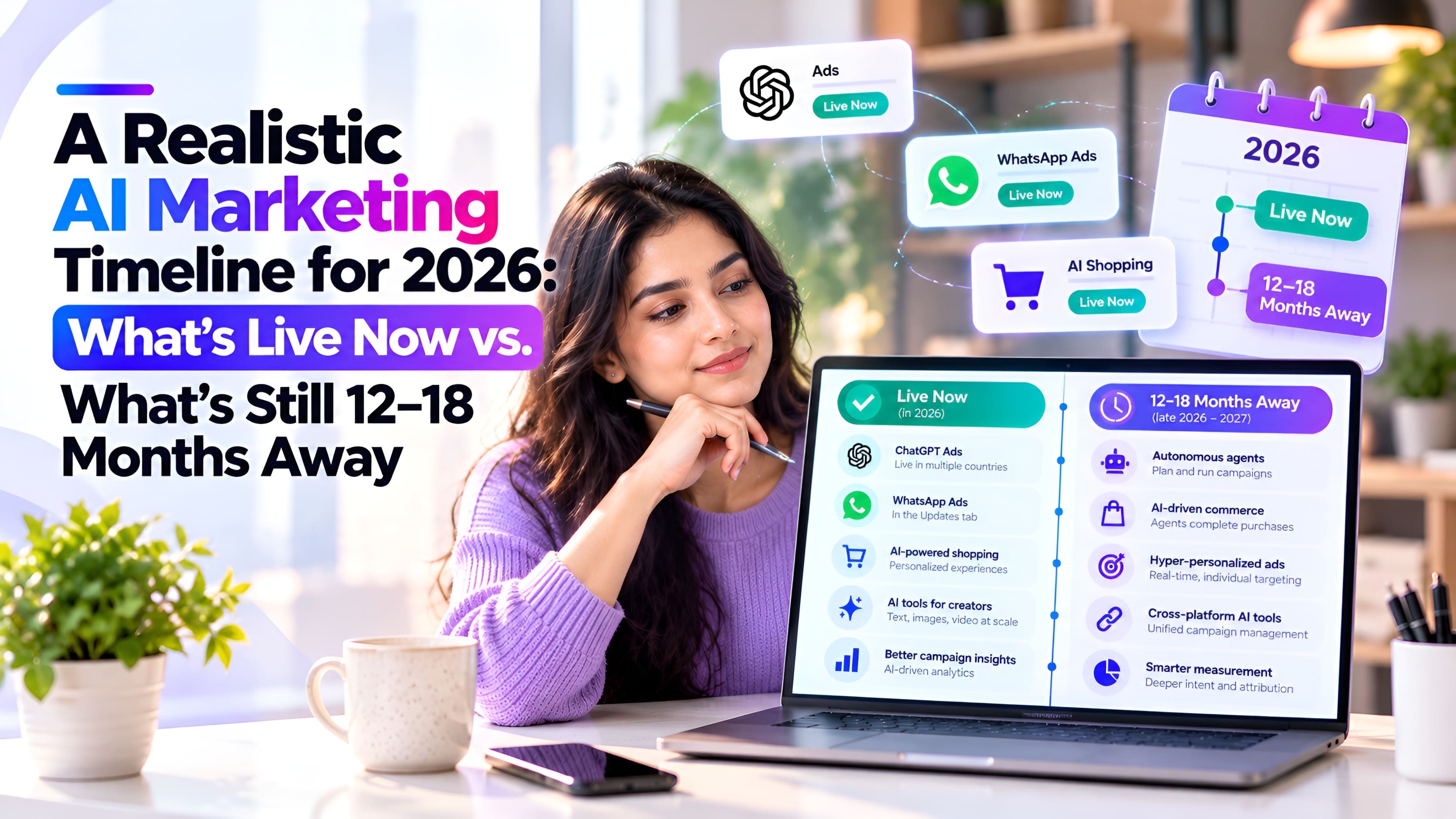
In October 2026, ChatGPT ads are now available in multiple countries, WhatsApp will add ads to its Updates tab, and AI-powered shopping is transitioning from recommending products to offering personalized shopping experiences. These are not common experiences for most businesses however, where fully autonomous purchasing, universal AI checkout, and consistent AI driven attribution are commonplace.
First, when grasping the AI marketing timeline 2026, it's essential to distinguish between what is in place and what is in progress.
Here's a breakdown that's easy to understand about the evolution of marketing technology, what businesses can try out, and which are worth paying attention to in the next 12-18 months.
Not all AI marketing innovations are in the same stage. There are tools already that have live campaigns. Some are approved for access or are still being tested.
|
Marketing development |
Status in October 2026 |
Business priority |
|
ChatGPT Ads |
Live in supported markets, including India |
Evaluate eligibility and test opportunities |
|
WhatsApp Status Ads |
Introduced, with availability varying by account and market |
Check account access and audience fit |
|
AI-assisted content production |
Widely available |
Improve existing workflows |
|
AI search and product discovery |
Operational across supported experiences |
Strengthen content and product information |
|
AI-powered campaign optimization |
Established across major advertising systems |
Review measurement and performance |
|
In-chat purchasing |
Available through supported partner integrations |
Prepare product and commerce data |
|
Fully autonomous shopping across retailers |
Still emerging |
Monitor developments |
|
Unified AI marketing attribution |
Not yet consistently available across platforms |
Maintain reliable first-party measurement |
The difference is important because available, limited access and experimental technologies require different strategies for businesses.
ChatGPT advertising is not just a possibility, but a reality.
In February 2026, OpenAI started advertising in the United States. As of August 31, it announced a new rollout of advertiser access via Ads Manager across India, Europe, the Middle East and North Africa.
The company expanded to other Asian markets in September.
For marketers, this creates another opportunity to reach eligible audiences researching products, making comparisons, or exploring services.
There are, however, some significant restrictions.
For this reason, businesses should consider ChatGPT Ads as another channel to complement, rather than replace, Google Ads or social ads.
The best idea is to measure the relevance of the audience, check the existing reporting and evaluate if the channel is helping to achieve valuable business results.
In the past, WhatsApp was more of a personal messaging app and a means for customer support and direct business communication.
That's no longer the case.
In 2025, advertising was rolled out inside the Updates tab, and other commercial features were added to WhatsApp Status, both of which will be rolled out gradually.
Status advertising provides businesses the chance to communicate with users in an environment they know and understand in the mobile space without adding ads into private conversations.
This is especially important for Indian businesses that are already leveraging WhatsApp for customer communication.
Potential applications include:
Nevertheless, businesses need to verify the availability of these features in their advertising accounts before planning ads based on these features.
There's also a creative strategy required for WhatsApp ads. Content optimized for search results or long-form video may not perform well in a short, mobile-first Status experience.
One of the most useful AI advancements is far less dramatic than an autonomous shopping agent.
AI-driven tools are already being used in marketing teams for various tasks such as audience analysis, creative variations, campaign optimization, reporting, and content workflows.
These applications can help to minimize the repetitive work and enable teams to discover patterns faster.
Think of a company running campaigns on various channels. AI tools can help identify unusual changes in campaign performance, which the team can then investigate further without having to read each report.
There is a need for human supervision.
AI-generated recommendations may be incomplete and automated optimization relies on the quality of the data used.
If you're considering your business's strategy, it's crucial to know the link between automation, measurement and channel selection in digital marketing.
AI shopping is taking off, although the functionality varies among AI firms and retailers.
In September 2025, OpenAI rolled out Instant Checkout in ChatGPT, which allows users to purchase from participating retailers. It has an Agentic Commerce Protocol that enables the integration of AI-powered shopping experiences into merchant systems.
Checkout features and merchant acceptance will rely on the integrations supported, eligibility and current merchant availability.
This means that there are three distinct activities that should be separated for businesses.
The activities have varying degrees of maturity.
For many retailers, it's better to make product descriptions, availability data, product attributes, and website accessibility more useful than to overhaul the entire checkout process with AI agents.
More and more companies are asking if their brand is recommended by artificial intelligence.
It's a fair question, but it's still not easy to measure.
An AI assistant can provide varied answers based on various inputs like the question, sources available, the context of the user, and the capability of the product.
This means that it is impossible to explain performance in all AI environments with a single brand visibility score.
Marketers are able to start tracking:
These signals provide valuable insights, but it's important to remember that not every piece of AI-generated content is the result of a specific marketing effort.
The following developments are possibilities to monitor through 2027 and early 2028, not confirmed launch schedules.
In the future, AI assistants can help with more complex shopping tasks, such as those involving multiple products, preferences, and shopping systems.
To make this a widely trusted source, providers need to work on the authorization, payment security, product availability, returns and merchant integration.
To avoid becoming complacent and thinking that traditional e-commerce journeys will vanish, businesses should keep a check on the adoption.
New reporting and optimization features for AI-powered discovery experiences are possible in advertising systems.
But businesses should not be complacent that they will see better organic AI recommendations simply from paid ads.
The two stay separate activities and have different rules and measurement considerations.
Marketing teams can find new pathways to link up with website visits, enquiries and purchases using AI discovery.
The challenge is that consumers often interact with several platforms before converting.
Until measurement improves, marketers should continue using dependable analytics, conversion tracking, and first-party business data.
Instead of waiting for the possible launch dates, companies can break down their tasks into three parts.
|
Timeline |
Recommended actions |
|
Now to 3 months |
Review and refine product information, measure eligibility for AI advertisements, audit current campaigns, and enhance measurement |
|
3 to 6 months |
Test accessible new channels, compare results with existing campaigns, and refine AI-assisted workflows |
|
6 to 12 months |
Expand successful experiments, review AI shopping integrations, and improve cross-channel reporting |
|
12 to 18 months |
Reconsider new agent capabilities, platform policies, and opportunities supported by actual adoption |
These are recommendations for when to plan on using certain technologies, not predictions on when certain technologies will start.
It's essential that companies check on major search advances in confirmed sources. When interpreting fluctuations in search visibility, our Google algorithm update resources might offer some context.
There are three common mistakes worth avoiding.
Treating announcements as adoption: A feature being announced does not mean customers are actively using it at scale.
Replacing proven channels too early: Search, email, social media, and established advertising channels continue to serve important customer needs.
Measuring activity instead of outcomes: More AI-generated content or automated campaigns doesn't necessarily mean better marketing performance.
A new technology is worth considering when it addresses a meaningful business need, targets an appropriate target user, or enhances a quantifiable process.
That standard should not be subject to change if technology changes.
AI marketing is evolving rapidly, and not all the new features need to be taken up right away.
The best strategy is to enhance what is successful, experiment with very real opportunities and be ready for things that might impact customer behaviour.
At GBIM Technologies, we help businesses understand how the digital marketing landscape is changing, but always with the focus on visibility, relevant traffic and measurable results. We're not interested in every technology that comes along being a business need.
The goal is not to predict every change accurately. It's about creating a marketing plan that can adapt when significant changes happen.
One significant change is the expansion of AI-powered interfaces into advertising, product discovery, and shopping assistance. ChatGPT advertising has expanded to additional markets, while AI-assisted commerce is developing through supported merchant integrations.
Yes. OpenAI announced advertiser access in India on August 31, 2026. However, individual advertiser eligibility, supported categories, and available campaign features remain subject to platform requirements.
Meta has introduced advertising within WhatsApp Status in the Updates tab. Businesses should check their advertising account and regional availability because rollout and access may vary.
There is insufficient evidence to conclude that they will replace traditional websites. AI shopping may change how customers discover and purchase products, but websites still play important roles in product information, customer service, trust, and fulfillment.
Small businesses should first improve their existing marketing foundations. Accurate website content, reliable analytics, clear product information, and consistent brand messaging are useful regardless of which AI technologies become widely adopted.
A quarterly review is a practical starting point, with additional checks when major platforms announce relevant changes. Businesses should evaluate confirmed availability, audience adoption, measurement capabilities, and actual campaign performance before making significant strategy changes.
309, Rupa Solitaire,
Sector-1, Millennium Business Park,
Mahape, Navi Mumbai,
Maharashtra (400 710), INDIA.
Write to us at
hr@gbim.com