
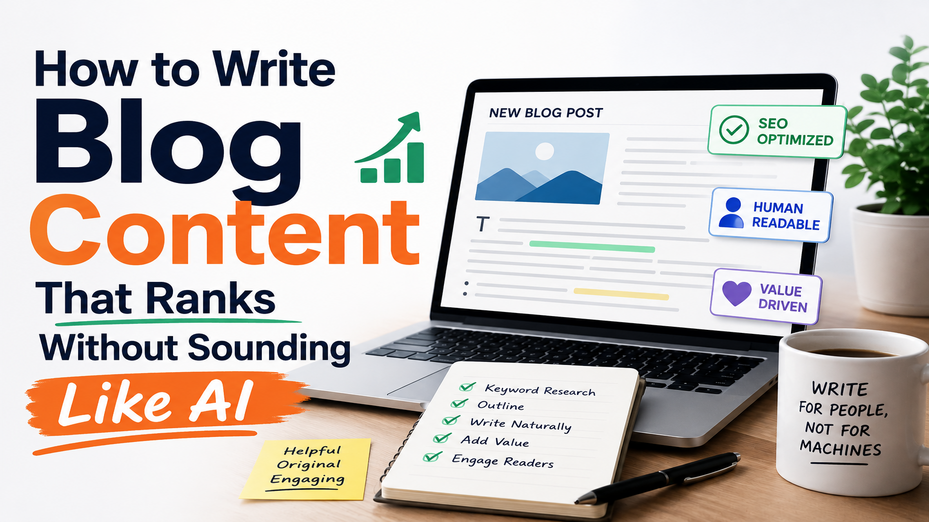
You can follow every SEO rule and still end up with a blog nobody wants to read. The problem is often not optimisation. It is the writing. If you're searching for how to write blogs that don't sound like AI, you are probably trying to solve a familiar problem: creating content that is useful enough to rank, but natural enough to sound like it came from someone who actually understands the subject.
The answer is not to avoid AI altogether. It is to avoid writing like a machine. Good blog content needs search intent, first hand understanding, editorial judgement, useful detail and a voice that sounds human.
Most readers can recognise the pattern, even if they cannot explain exactly why.
The article starts with a broad statement, defines the topic, lists a few benefits, moves through predictable subheadings and ends with a neat summary. Every sentence is grammatically perfect. Every paragraph has roughly the same rhythm. Nothing is technically wrong, yet nothing feels particularly memorable either.
This usually happens when writers optimise for structure before thinking about the reader.
Common warning signs include:
SEO does not require any of this.
A search optimised article can have personality, strong opinions, examples and an editorial point of view.
Human writing is not about adding mistakes or making sentences deliberately messy.
It is about making decisions.
A human writer decides which point deserves more explanation. They know when an example is useful and when it is unnecessary. They might challenge a common assumption, qualify a claim or use a short sentence because that is the clearest way to make the point.
Consider these two approaches.
Generic:
"Content marketing is an important strategy that helps businesses increase visibility, engage audiences and achieve their marketing goals."
More useful:
"Publishing three blogs a week won't help much if all three answer questions your customers stopped asking six months ago."
The second sentence gives the reader something to think about. It also creates a natural opening for discussing content research, search intent and audience behaviour.
That is the difference.
Start with the reader, then build SEO around the answer.
Before writing, identify four things:
Then map your keyword strategy to those questions.
For example, someone searching "how to write blogs that don't sound like AI" probably does not need another definition of artificial intelligence. They want practical guidance on making content sound natural while still meeting SEO requirements.
That means the article should focus on writing decisions, examples, editing techniques, search intent and quality checks.
The keyword belongs in that conversation naturally. It should not dictate every heading.
If you use AI as part of your writing workflow, treat the first draft as raw material rather than the finished article.
Generic content tends to sit safely in the middle.
Human writers make useful distinctions.
Instead of saying that "both short and long form content can be effective", explain when each works and why. Instead of saying that keyword research is important, explain what poor keyword research looks like in practice.
Readers remember judgement more than definitions.
Words such as "effective", "powerful", "important" and "valuable" do very little without context.
Ask:
Effective for whom?
Useful for what?
Important because of what?
For example:
"Strong internal linking improves SEO."
is less useful than:
"Internal links are most useful when they help a reader move naturally from a broad topic to a more specific answer."
The second statement tells the reader how to think about the tactic.
Examples should not simply decorate the article.
Suppose you're explaining search intent. Instead of writing:
"Understanding search intent helps you create relevant content."
Show the difference:
Someone searching "best CRM software" is likely comparing options. Someone searching "how to use a CRM" needs educational guidance. Targeting both queries with the same article may satisfy neither reader particularly well.
That example makes the principle immediately clearer.
Writing naturally does not mean ignoring search optimisation.
You still need a strong structure and clear topical relevance.
A practical SEO content workflow looks like this:
Research → Search intent → Topic structure → Draft → Optimisation → Human edit → Final review
During optimisation, check:
Then comes the step that is often skipped: edit the article as a reader, not as an SEO checklist.
Read the introduction without looking at the keyword. Does it make you want to continue?
Read the headings alone. Do they tell a coherent story?
Read the conclusion. Does it leave the reader with something useful?
If not, more keyword optimisation will not fix the problem.
The more useful question is whether the content deserves to rank.
Using AI to assist with research, outlining or drafting does not automatically make an article poor. The problem comes when the output is published with little original thinking, weak factual checking or no meaningful value beyond what already exists elsewhere.
A strong content process should therefore add something beyond the initial draft:
The goal should not be to make content "undetectable as AI". The goal should be to make it useful, credible and genuinely worth reading.
A useful editing pass is not just a grammar check.
Look specifically for patterns.
If the article takes 150 words to arrive at its first useful point, shorten the introduction.
If you have already explained why search intent matters, don't explain the same principle again under three different headings.
If a sentence could appear unchanged in an article about almost any marketing topic, it probably needs more specificity.
A paragraph made entirely of long sentences can feel mechanical. So can one made entirely of short ones.
Mix them naturally.
This simple test catches more than many automated tools. Awkward phrasing, repetitive sentence structures and unnatural transitions become obvious when spoken.
At GBIM, we see content as part of a wider digital marketing strategy rather than an isolated exercise in inserting keywords.
Our content marketing services cover strategy, content development, creation, optimisation, promotion and reporting. That broader process matters because good content decisions should be connected to audience needs and measurable performance.
Our approach also considers the wider digital ecosystem. Search visibility can depend on factors beyond the article itself, which is why content strategy may need to work alongside SEO, social media, website development and other digital marketing activities.
For us, the human element is particularly important at the writing stage. Research should tell us what people are looking for. SEO should help us understand how they search. But the final article still needs a clear idea, useful explanation and a voice that does not feel assembled from templates.
Before you publish your next blog, ask yourself these seven questions:
If you answer "no" to several of these, don't immediately add more SEO elements.
Edit the writing first.
The debate around AI and content often becomes too binary. The choice is not simply between writing everything manually and letting AI produce everything.
There is a much more useful middle ground.
Use technology where it saves time. Use research tools to understand demand. Use SEO data to identify opportunities. Use AI where it genuinely improves the workflow.
But keep human judgement at the centre of the finished article.
That is the practical answer to how to write blogs that don't sound like AI. Do not chase artificial imperfections. Give the content a reason to exist, understand the reader before choosing the keywords, add useful judgement and edit ruthlessly.
At GBIM, we approach content with that balance in mind: search visibility matters, but it works best when the underlying content is genuinely useful to the person reading it.
Add subject specific examples, stronger opinions, clearer explanations and natural sentence variation. Then edit the draft for repetition, generic claims and unnecessary filler.
They can, but ranking should not be the only objective. The content still needs to demonstrate usefulness, relevance, accuracy and genuine value for the reader.
No. Use relevant keywords where they make sense, but avoid forcing exact match phrases into sentences where a natural variation would communicate the idea better.
There is no useful universal density target. Include it where contextually appropriate and rely on related terms and natural language to establish topical relevance.
Repetition, generic statements, predictable structures, excessive filler, unnatural transitions and a lack of specific examples are common warning signs.
AI detectors can be inconsistent, so they should not be treated as the final measure of content quality. A stronger review focuses on originality, accuracy, usefulness, expertise and natural writing.
For high quality business content, human review adds significant value. It helps verify claims, introduce subject expertise, improve clarity and make sure the article actually serves the reader.
309, Rupa Solitaire,
Sector-1, Millennium Business Park,
Mahape, Navi Mumbai,
Maharashtra (400 710), INDIA.
Write to us at
hr@gbim.com