
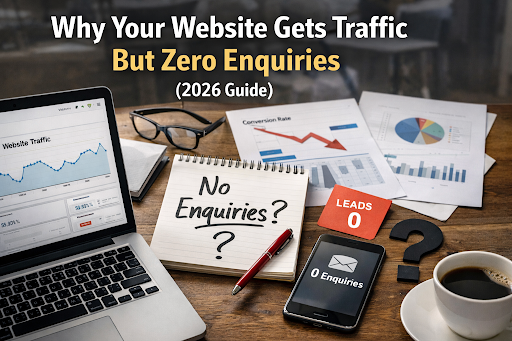
You open Google Analytics. Traffic looks fine. Maybe even growing.
But the enquiry form is empty. The phone is quiet. And you cannot figure out why.
This is not a traffic problem. This is a conversion problem. And it is far more common across Indian businesses than most people admit.
Most businesses treat Google Analytics like a report card. If the visitor numbers go up, they assume things are working.
They are not measuring the right thing.
Here is a simple way to see what is actually happening:
|
Monthly Visitors |
Conversion Rate |
Monthly Leads |
|
3,000 |
0.3% |
9 |
|
3,000 |
1.0% |
30 |
|
3,000 |
2.5% |
75 |
The traffic is identical in every row. The only thing that changes is how well the website does its job.
Most Indian SME websites sit at 0.3% to 0.5%. The average benchmark for a well-optimised site is 2% to 3%. That gap is not a small improvement. It is the difference between a dead pipeline and a functioning one.
India has over 750 million internet users. The majority browse on mobile, often on mid-range devices and variable 4G connections.
If your site takes more than 4 seconds to load on mobile, a large portion of your visitors are gone before they see a single line of your content.
Google's own research puts it plainly: the probability of a bounce increases by 90% when load time goes from 1 second to 5 seconds.
How to check: Go to pagespeed.web.dev. Test your homepage on Mobile. Anything under 60 is actively costing you leads.
Walk through your homepage right now. Ask yourself honestly: within 5 seconds of landing, does a visitor know what to do next?
Most websites fail this test. The CTA is vague. It is buried. Or it simply does not exist above the fold.
Compare these two:
One is a label. The other is a reason to act.
Every key page on your site needs one clear, specific, benefit-led next step. Not two. Not five. One.
Over 78% of web traffic in India is mobile. Yet most websites are still designed with a desktop mindset and made "responsive" as an afterthought.
Common problems that kill mobile conversions:
The simplest test: Pick up your phone. Go to your own website. Try to submit an enquiry from start to finish. Note every moment of friction. Each one of those moments is a visitor you are losing.
Before an Indian buyer enquires, they need to feel confident the business is legitimate and capable.
A website that looks like a template, has no real client proof, and lists services without showing outcomes does not clear that bar.
Trust signals that consistently improve conversion:
None of these are cosmetic additions. Each one directly answers the question a hesitant visitor is silently asking: "Can I trust these people?"
This is the most technically misunderstood reason on this list.
Not all traffic is equal. If your website is ranking for informational keywords like "what is digital marketing" or "how does SEO work," you are attracting people who want answers, not vendors.
The keywords that generate enquiries are the ones with commercial or transactional intent:
How to check: Go to Google Search Console. Look at the queries sending traffic to your top service pages. If most of them are informational, you have an intent mismatch. No amount of CRO will fix that until the traffic itself is better qualified.
Even if everything else is working, visitors will not enquire if they cannot immediately understand:
Most Indian business websites list features. The ones that convert lead with outcomes.
"Full-service digital marketing solutions" means nothing.
"We help Indian B2B companies generate consistent inbound leads from Google within 90 days" means something specific. It speaks to someone. It earns a click.
You do not need an agency to find the leaks. Work through this:
Speed
Mobile UX
CTA check
Trust signals
Search intent
Most people who do this audit find at least 3 to 4 clear, fixable problems within 15 minutes.
You do not need an expensive analytics stack to start improving conversions. A few focused tools can reveal most of the problems on a typical business website.
This is the foundation. It shows where your visitors come from, which pages they visit, and how many conversions happen.
Look specifically at:
Often you will discover that one or two pages generate most of the leads.
Clarity is a free tool that records anonymous user sessions and heatmaps.
It shows things like:
Watching just 10 to 15 recordings often reveals usability problems you would never notice otherwise.
Search Console helps you understand why people are visiting your site in the first place.
Review the search queries bringing traffic to your service pages. If the queries are mostly informational, your visitors may not have buying intent yet.
This insight alone can explain why traffic is high but enquiries remain low.
If you prefer seeing everything in one place, platforms like DM Cockpit combine multiple marketing insights into a single dashboard.
Tools like this allow you to:
Instead of switching between multiple tools, an integrated dashboard can help agencies and teams monitor SEO, traffic performance, and campaign data together, making it easier to spot opportunities for improvement.
Slow websites lose visitors before they even see your offer.
Testing your pages in PageSpeed Insights highlights issues like:
Fixing just the top two or three speed problems often improves both user experience and conversions.
Not all fixes are equal. Based on consistent patterns across Indian business websites, these changes tend to produce the fastest visible impact:
Use TinyPNG. Get every image under 200KB. This alone often cuts load time by 3 to 4 seconds.
Indian users trust WhatsApp deeply. A simple floating button can meaningfully increase the volume of people who reach out.
Lead with what the visitor gets. Be specific. Remove the word "Submit" from every form on your site.
Name. Phone number. One qualifying question. That is it. Every additional field you remove typically increases completions by 10 to 15%.
Not a testimonial. A result. "We helped X company get Y outcome in Z weeks." One sentence with a real number does more for trust than a paragraph of claims.
A website that gets traffic but no leads is not a mystery. It is a website with identifiable, fixable problems.
The businesses that are winning in India in 2026 are not necessarily the ones spending the most on ads. They are the ones that figured out how to turn the visitors they already have into actual enquiries.
That shift, from traffic-focused to conversion-focused, is the highest-return move available to most Indian businesses right now.
If you want a second pair of eyes on your website, we offer a free audit that covers load speed, CTA structure, trust signals, and conversion funnel gaps. No pitch. Just a clear, honest view of what is and is not working.
Request your free website audit at gbim.com
The most common reasons are slow mobile load speed, no clear CTA, missing trust signals, and traffic that lacks purchase intent. Usually two or three of these are present together.
Most well-optimised sites convert between 2% and 3%. The majority of Indian SME websites sit at 0.3% to 0.5%, which means significant lead volume is being left behind.
Yes. Sending paid traffic to a site that does not convert well means paying more for each lead than necessary. Improve conversion first, then scale spend.
Use Google Search Console to review the queries sending traffic to your service pages. Look for commercial intent keywords like "agency in [city]" or "service for [industry]" rather than broad informational terms.
Not necessarily. Redesigns improve aesthetics. Conversions improve when you address the specific friction points visitors are experiencing. These are related but not the same thing.
Basic changes like a better CTA, faster images, and a simplified form can show measurable results within 2 to 4 weeks. Some changes show an impact within days.
Consistently, yes. Across Indian markets, a WhatsApp option lowers the barrier to contact for users who would never fill a form but will happily send a quick message.
309, Rupa Solitaire,
Sector-1, Millennium Business Park,
Mahape, Navi Mumbai,
Maharashtra (400 710), INDIA.
Write to us at
hr@gbim.com