
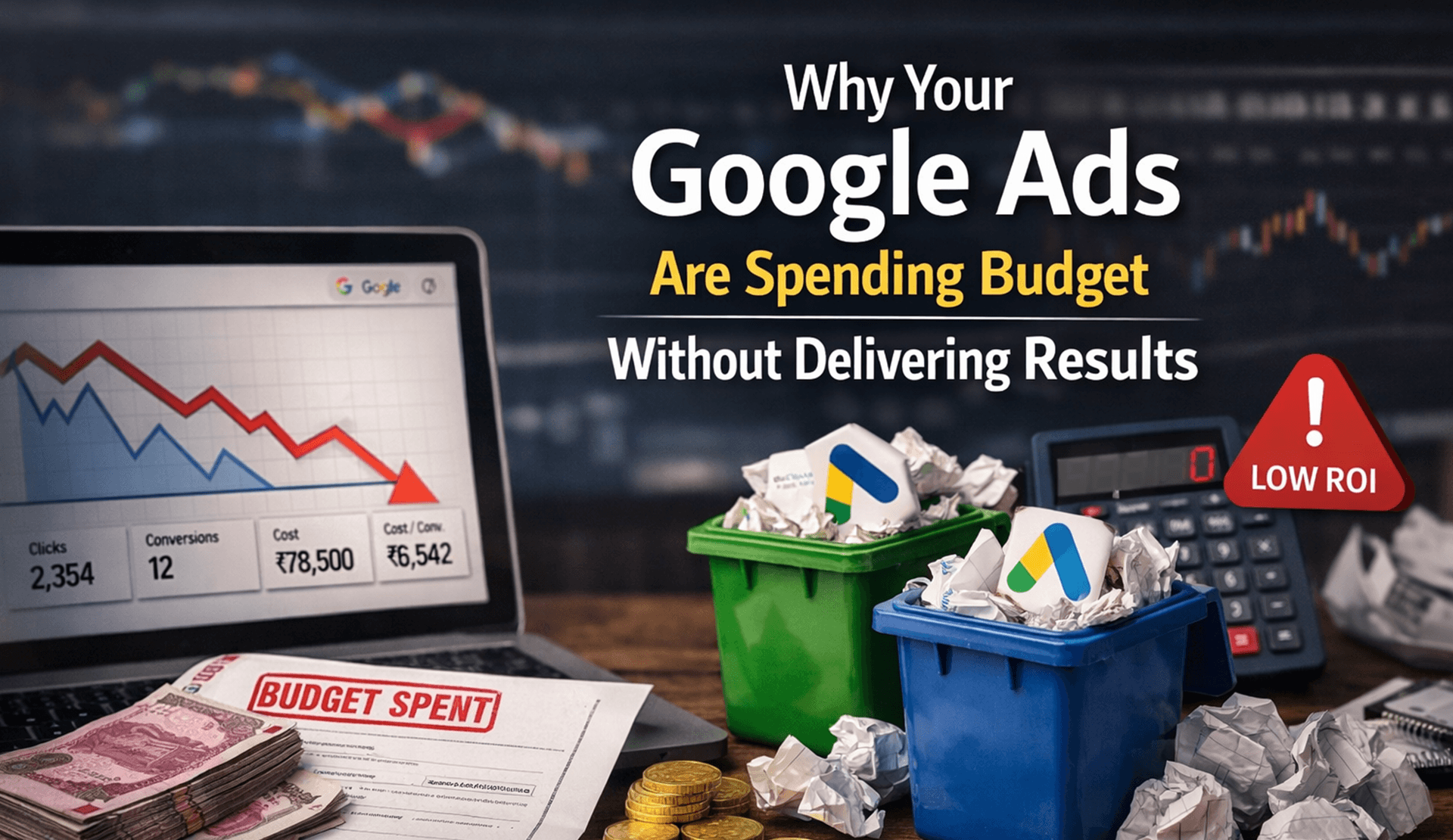
Let us be honest. Running Google Ads without a proper strategy is expensive. And a lot of businesses in India are doing exactly that — spending money every month, watching campaigns run, and wondering why the leads that come in are either low quality or just not converting.
It is not a budget problem most of the time. It is a strategy problem.
Google Ads management in 2026 is more complex than it has ever been. Automated bidding, Performance Max campaigns, AI-generated ad copy, audience signals, value-based bidding — there are more levers than most businesses realise. And pulling the wrong ones costs money fast.
This blog is for business owners, marketing managers, and anyone running or overseeing a Google Ads account who wants to understand what actually works right now.

The common assumption is that if a campaign is live and traffic is coming in, things must be working. That is rarely true. Here are the most frequent reasons campaigns fail to deliver real ROI:
Keyword matching is too broad. When broad match keywords are left unchecked without a solid negative keyword list, ads show up for wildly irrelevant queries. You end up paying for clicks that were never going to convert.
Landing pages are an afterthought. The ad gets you the click. The landing page gets you the lead. If your landing page is your homepage, or a generic service page with no clear call to action, the click becomes a wasted spend.
Bidding strategy is misaligned with campaign goals. Maximise Clicks sounds appealing. But if your goal is leads, not traffic, this strategy works against you. Choosing the wrong bid strategy is one of the fastest ways to drain a budget.
Conversion tracking is not set up correctly. This one is critical. If you do not know what is converting, you cannot optimise. Running a campaign without proper Google Ads conversion tracking is essentially flying blind with someone else's money.
Performance Max (or PMax) is Google's newest fully automated campaign type. It uses machine learning to show ads across Search, Display, YouTube, Gmail, Maps, and Shopping — all from one campaign.
The pitch sounds compelling. The reality is more nuanced.
PMax works well when you have clean, high-quality conversion data. When you have extensive assets — multiple headlines, images, videos. When your account has enough history for the algorithm to learn from.
Without those things in place, PMax can be a budget-consuming black box that you have very little visibility into. Smart campaign management means knowing when to use PMax and when a more controlled Search campaign structure is the better choice.

Let us move past the basics and talk about what is genuinely effective in 2026.
Google's shift toward audience-first targeting is real. Audience signals — your existing customer lists, website visitors, similar audiences — now play a massive role in how your ads are shown and to whom.
Building and uploading strong customer match lists gives your campaigns a significant advantage. If Google knows what your existing customers look like, it can find more people like them. And that dramatically improves ad relevance and conversion probability.
Every keyword has an intent behind it. Someone searching "digital marketing agency pricing" is in a very different mindset than someone searching "what is digital marketing." Writing ads and building landing pages that match the specific intent of the keyword — not just the keyword itself — is what separates campaigns that convert from campaigns that just spend.
Google Ads Quality Score is a signal of how relevant your keywords, ads, and landing pages are to each other. Higher Quality Score means lower cost-per-click. Lower Quality Score means you pay more for the same position.
Many advertisers focus entirely on bid amounts while ignoring Quality Score. A well-optimised ad group with strong Quality Score will often outperform a high-bid campaign on a poorly structured account.

This cannot be overstated. PPC landing page optimisation is arguably the highest-leverage activity in paid advertising, and it is almost always underprioritised.
What a high-converting Google Ads landing page should include:
Run A/B tests on your landing pages. Even small changes — headline wording, button colour, form length — can move conversion rates meaningfully.
Here is where things get complicated. Most businesses attribute conversions to the last click. But the reality is that buyers rarely convert on the first interaction. They see an ad, visit the site, leave. Come back via organic search. Then convert later through a branded search.
If your attribution model only credits the last click, you are misreading which campaigns and keywords are actually contributing to conversions. Multi-touch attribution gives a more accurate picture, especially for longer sales cycles in B2B or high-consideration purchases.
Understanding this properly changes where you invest your ad budget.

There is no universal answer, but there is a framework. Rather than starting with a budget and building a campaign around it, start with your cost-per-lead goal and work backwards.
If you need 20 leads per month, and industry benchmarks suggest a cost per lead of Rs. 1,500 for your niche, you need Rs. 30,000 in qualified ad spend per month — minimum. Factor in learning periods, low-quality clicks, and testing phases, and the realistic number is often 30-40% higher than what the math suggests.
Underinvesting in Google Ads is a common mistake. Campaigns need data to optimise. A budget too small means the algorithm does not have enough conversion signals to learn from, and performance stagnates.
Stop optimising for impressions and click-through rates alone. The metrics worth watching closely:
At GBIM, we have managed Google Ads campaigns across industries ranging from e-commerce to B2B SaaS to healthcare. Our approach is rooted in data — we build campaigns that are structured for performance, not just for appearances. If your ads are spending but not converting, we are happy to audit what is happening and show you what is actually fixable.
Why is my Google Ads budget spending fast but not generating leads?
Usually a combination of broad keyword targeting, weak landing pages, and incorrect bidding strategy — each one drains budget without driving qualified conversions.
How long does a Google Ads campaign take to optimise?
Most campaigns need at least four to six weeks to gather enough data before meaningful optimisation decisions can be made.
What is a good cost per lead for Google Ads in India?
It varies by industry — but for service businesses, Rs. 800 to Rs. 2,500 per lead is a reasonable benchmark depending on service value and competition.
Should I use Performance Max or standard Search campaigns?
PMax works best with clean conversion data and strong creative assets; for most businesses starting out, structured Search campaigns with clear intent targeting deliver better initial results.
What is Google Ads Quality Score and why does it matter?
Quality Score reflects the relevance of your keywords, ads, and landing pages — higher scores mean lower costs per click and better ad positions.
How important is the landing page for Google Ads performance?
Extremely — the landing page determines whether a click converts, making it equal in importance to the ad itself.
Can small businesses in India afford Google Ads?
Yes, with smart campaign structure and realistic budget expectations — the key is starting focused, not broad, and scaling as data justifies it.
309, Rupa Solitaire,
Sector-1, Millennium Business Park,
Mahape, Navi Mumbai,
Maharashtra (400 710), INDIA.
Write to us at
hr@gbim.com