
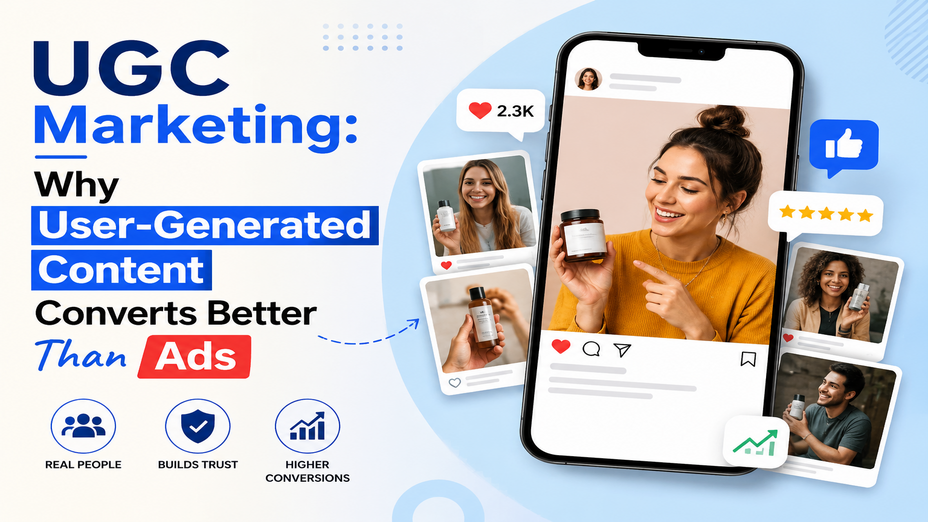
If you are wondering what is UGC content and why it dominates modern social feeds, the answer is simple: it is authentic, brand-specific media created by real consumers, employees, or dedicated creators rather than brands in a polished studio. For e-commerce founders, performance marketers, and growth teams, user-generated content bridges the gap between cold promotional pitches and genuine peer recommendations. It delivers lower customer acquisition costs, higher click-through rates, and measurable sales conversion because modern buyers trust everyday people far more than corporate scripts.
At its foundation, what is UGC content extends far beyond random customer selfies tagged on Instagram. In contemporary performance marketing, UGC marketing represents a strategic blend of organic customer advocacy and structured creator assets.
Unlike traditional high-production studio commercials with staged lighting and trained actors, UGC creators shoot on smartphones, speak directly to the camera, and show raw, unvarnished product interactions.
Consumer behaviour has permanently shifted, especially across Gen Z and millennial demographics. Digital natives have developed acute "ad blindness" to glossy billboards, generic stock photography, and hyper-edited video ads. When an ad looks like an ad, users swipe away within fractions of a second.
Studio Ad: Polished Script -> Skepticism -> Ad Fatigue -> Swiped Away
UGC Video: Native Visual -> Relatability -> Social Proof -> High Conversion
Here is why authentic user-generated content consistently outperforms conventional studio assets across paid social feeds:
To understand why performance marketing teams are shifting budgets toward creator-led content, look at how both formats compare across key operational and performance metrics:
|
Performance Metric |
Traditional Studio Commercials |
User-Generated Content (UGC) |
|
Production Cost |
High ($3,000 to $15,000+ per shoot) |
Low to Moderate ($150 to $600 per asset) |
|
Turnaround Time |
3 to 6 weeks |
3 to 7 days |
|
Viewer Trust Level |
Low (viewed as biased sales pitches) |
High (perceived as unbiased social proof) |
|
Creative Iteration |
Difficult; requires costly reshoots |
Rapid; swap hooks, audio, and CTAs in minutes |
|
Average Click-Through Rate (CTR) |
Baseline (often suffers from ad fatigue) |
2x to 4x higher on Meta and TikTok |
|
Shelf Life & Scalability |
Rigid; burns out quickly in paid ad sets |
Highly modular for dynamic creative testing |
Succeeding with UGC marketing requires structured systems rather than casual guessing. Gathering dozens of random videos without a strategic funnel will burn ad spend quickly.
Step 1: Audience Insight -> Step 2: Clear Brief -> Step 3: Fast Hook -> Step 4: Iterative Scaling
Before sourcing a single video, pinpoint the primary objection preventing customers from converting. Is it price? Ease of use? Ingredients? Delivery time? Your UGC creators must focus on disarming that exact barrier within their first 10 seconds of video.
Do not write rigid word-for-word scripts. Giving a creator a robotic teleprompter script ruins the organic charm that makes the asset convert in the first place. Instead, provide:
The first 1.5 to 3 seconds determine whether a user stays or scrolls. Use direct pattern interrupts:
Run your top-performing user-generated content directly through the creator's personal handle using Meta Partnership Ads or TikTok Spark Ads. This whitelisting strategy removes corporate branding from the top of the post, drastically improving organic engagement and lowering cost-per-click.
Even promising campaigns can stumble if basic distribution and production errors go unchecked. Watch out for these three major traps:
High-performing brands do not isolate UGC marketing to social media ads alone. Integrating social proof across your entire digital presence multiplies its revenue impact.
Executing consistent, revenue-generating campaigns requires constant testing, creative iteration, and deep performance insights. We at GBIM work closely with businesses to transform raw customer sentiment and creator assets into scalable, high-converting digital campaigns.
Our team helps brands identify high-impact creative angles, develop robust paid social testing frameworks, and integrate authentic social proof across every stage of the customer journey. Rather than relying on guesswork, our services support sustainable growth by blending data-driven performance marketing with content formats that genuinely resonate with modern audiences.
What is the difference between UGC and influencer marketing?
Influencer marketing pays for access to an established audience, whereas UGC focuses on acquiring authentic media assets to run across a brand's own marketing channels.
Why does UGC convert better than standard brand advertisements?
It mimics organic peer recommendations, bypassing consumer ad fatigue and establishing immediate trust through relatable, real-world demonstrations.
Do businesses have to pay creators for UGC?
While spontaneous organic UGC from everyday customers is free, structured and reliable UGC assets for paid advertising campaigns are typically commissioned from freelance creators.
What platforms deliver the highest ROI for UGC marketing?
TikTok, Meta (Instagram Reels and Facebook Feeds), and YouTube Shorts currently yield the highest conversion rates and lowest acquisition costs for video UGC.
Can B2B companies use user-generated content effectively?
Yes. B2B brands use client video testimonials, LinkedIn employee spotlights, screen-recorded platform tutorials, and case study breakdowns as high-impact UGC.
How does UGC help a website's search engine optimisation (SEO)?
Customer reviews, user-submitted media, and community discussions provide fresh, semantically rich content that increases time-on-page and signals high topical relevance to search engines.
309, Rupa Solitaire,
Sector-1, Millennium Business Park,
Mahape, Navi Mumbai,
Maharashtra (400 710), INDIA.
Write to us at
hr@gbim.com