
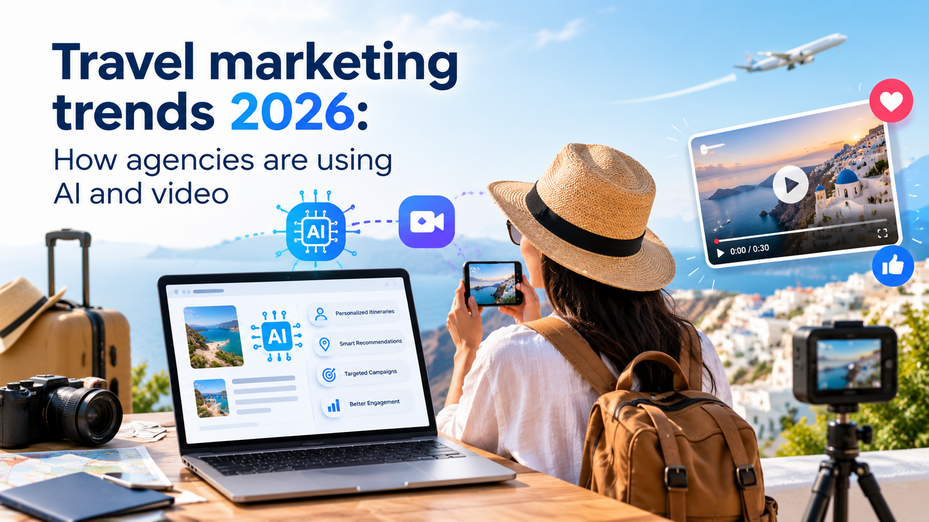
If you're looking for travel marketing ideas 2026, don't start with another generic destination Reel.
Travelers now research trips across search, social, maps, videos, reviews, and AI tools. They want to see the destination, understand the experience, compare options, and feel confident before they book.
That gives travel brands a useful opportunity: use AI to produce and test content faster, but use real experiences, strong creative, and useful information to make that content worth consuming.
Here are practical ways to do it.
Travel content has one major advantage: a single experience can be broken into many useful formats.
A destination campaign could become:
The mistake is creating each asset from scratch.
Start with one strong source of information, then adapt it for different platforms and search intents.
GBIM's content marketing services include content strategy, creation, optimisation, promotion, and reporting across formats including video and social content.
AI can help travel marketers with research, scripting, variations, storyboards, captions, translations, and creative concepts.
But there is a line worth keeping.
Don't use AI to invent a hotel room, destination experience, attraction, or view that a traveller won't actually get.
Instead, use AI to make your real material more useful.
For example:
Real footage: A family checking into a resort.
AI assistance: Create three versions of the script for families, couples, and weekend travellers.
Creative team: Choose the strongest angle, refine the visuals, edit the footage, and make sure the final message reflects the actual experience.
Google's guidance supports using AI when it helps create useful content, but warns against using automation to produce large amounts of low value content for search rankings. Google's guidance on generative AI content
You don't need an elaborate production brief to test an idea.
Use a prompt like this:
Create a 30 second vertical travel video concept for [destination]. Target audience: [audience]. Focus on [experience]. Structure it as: 0 to 3 seconds: strong visual hook; 3 to 15 seconds: three specific experiences; 15 to 25 seconds: why this trip suits the audience; 25 to 30 seconds: clear booking or enquiry CTA. Use an energetic but natural tone. Do not invent attractions, prices, facilities, or experiences. Base every factual claim only on the information provided.
Then give the concept to your creative team.
AI generates the starting point. Human judgement decides whether it's actually good.
Travel videos shouldn't only show beautiful places.
They can solve pre booking doubts.
Try videos such as:
"What does ₹50,000 get you in Goa?"
"Is this resort suitable for families?"
"What does a Maldives trip actually look like?"
"3 things to know before visiting Dubai in summer."
"Airport to hotel: here's what the transfer looks like."
These formats are more useful because they answer questions that can affect the booking decision.
Google also recommends relevant, high quality video as part of creating useful content, and videos can appear in Search, Video mode, Images, and Discover. Google's video SEO best practices
Most travel brands are good at inspiration.
"Visit Kashmir."
"Experience Bali."
"Discover Europe."
The harder and more useful content helps someone decide.
Create content around:
This is where travel SEO can become a real booking channel.
GBIM's digital marketing work for tourism businesses focuses on the digital journey travellers follow while researching destinations, accommodation, activities, and transport.
Don't create one campaign for "travellers".
Segment the intent.
A honeymoon traveller might search for privacy, resorts, experiences, and packages.
A family might care more about safety, room configuration, activities, transfers, and convenience.
A budget traveller may prioritise price, transport, and itinerary flexibility.
The destination hasn't changed. The content has.
This simple shift can improve everything from keyword targeting to video scripts and landing pages.
Here's a practical idea most travel brands can implement immediately.
Ask your sales and customer service teams for the 20 questions customers ask before booking.
Turn each question into:
Now your content calendar comes from customer behaviour instead of brainstorming sessions.
It also gives you material that competitors may not have because the questions come directly from your own customers.
That is the kind of original value Google encourages. Its current guidance recommends content with unique information, analysis, or experience rather than simply rewriting what already exists online. Google's people first content guidance
Travel searches are increasingly conversational.
Someone may ask:
"Where should I go for a 5 day family holiday in December?"
That's different from searching "best holiday destinations".
Travel websites should therefore create pages that answer specific questions clearly and completely.
But don't create a separate page for every imaginable AI query.
Google specifically advises against producing large numbers of pages simply to capture variations of searches or AI prompts. Google's guide to optimising for generative AI search
Build one genuinely useful page when one page can answer the need.
Before producing a video, decide what it needs to achieve.
|
Video type |
Best use |
|
Destination Reel |
Awareness |
|
Itinerary video |
Consideration |
|
Hotel walkthrough |
Evaluation |
|
Customer testimonial |
Trust |
|
FAQ video |
Objection handling |
|
Offer video |
Conversion |
|
Travel tips |
Search and discovery |
This prevents the common problem of producing attractive videos without knowing what happens after someone watches them.
This is where agencies can make a real difference.
AI can generate options quickly. It cannot automatically understand whether a travel brand's visual identity feels premium, whether a destination shot feels authentic, or whether the first three seconds are genuinely compelling.
At GBIM, our creative capabilities cover video production, including social videos, ad campaigns, product and lifestyle shoots, motion graphics, and editing.
We can take a raw idea and turn it into a campaign system rather than treating video as a one off post.
Our broader digital marketing approach connects creative, search, paid media, content, and conversion instead of running each channel separately.
The better the raw material, the better the marketing.
Provide:
Also identify what must not be claimed.
Travel marketing loses trust quickly when a promotional video shows something that doesn't match the actual experience.
If you're starting from scratch, don't try to publish everywhere.
Week 1: Identify your top three traveller segments and 20 real customer questions.
Week 2: Produce five short videos answering the strongest questions.
Week 3: Build or improve destination and itinerary pages around those questions.
Week 4: Promote the strongest content through paid social, search, and retargeting. Measure enquiries and bookings, not just views.
Then repeat what works.
The strongest travel marketing ideas 2026 aren't about producing more content.
They're about making every piece more useful.
Use AI to speed up research, scripting, variations, and production. Use real travel experiences to keep the content credible. Give video a clear purpose. Build search content around actual booking questions, and let your creative team turn those insights into campaigns people want to watch.
At GBIM, we combine strategy, content, video, SEO, social media, and paid marketing to build travel campaigns around the full journey from discovery to booking.
Focus on useful short video, destination SEO, customer question content, AI assisted production, creator content, retargeting, and booking focused landing pages.
AI can speed up research, scripts, content variations, storyboards, captions, translations, and creative testing. Human review should remain responsible for accuracy and brand quality.
They can use AI as a production aid, but factual travel content should not invent destinations, facilities, prices, or experiences. Real footage is preferable when authenticity matters.
Videos that answer specific traveller questions can be more useful than generic destination montages. Try itineraries, hotel walkthroughs, FAQs, comparisons, budgets, and practical travel tips.
It can. Google can surface videos in several search experiences, provided the content is accessible and follows its video SEO guidance.
Use original customer insights, real experiences, specific destination information, and content that helps travellers make decisions. Avoid producing the same generic destination guides everyone else publishes.
309, Rupa Solitaire,
Sector-1, Millennium Business Park,
Mahape, Navi Mumbai,
Maharashtra (400 710), INDIA.
Write to us at
hr@gbim.com