
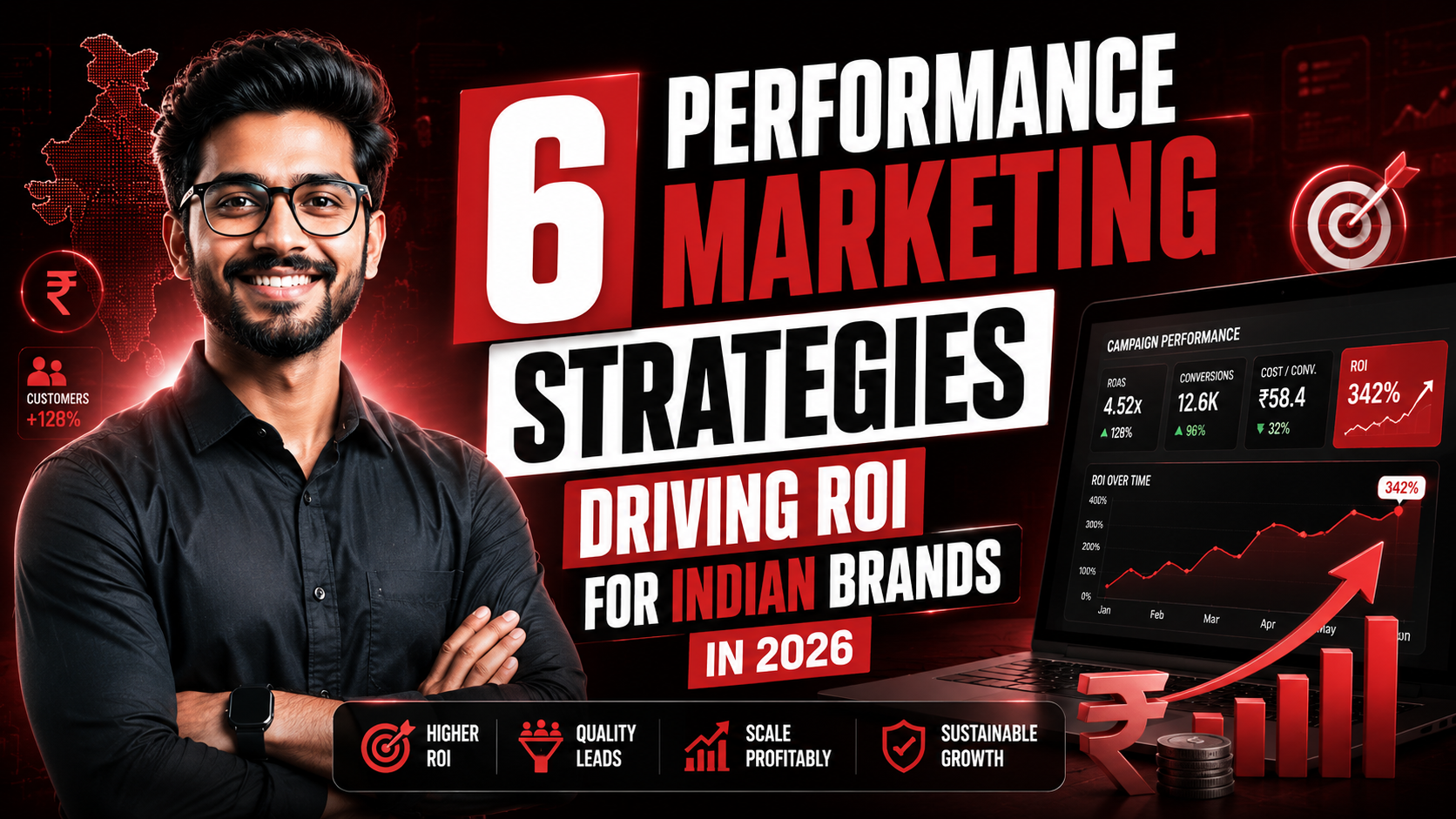
Performance marketing in India has become more demanding than ever.
Ad costs are rising across platforms. Consumer attention spans are shrinking. Attribution is becoming less reliable. At the same time, brands are expected to show measurable growth faster, often with tighter margins than before.
That pressure is changing how businesses approach performance marketing in 2026.
A few years ago, many campaigns could still survive on broad targeting, aggressive scaling, and vanity metrics. Today, that approach burns budgets quickly. Brands are becoming more cautious because they’ve already seen campaigns generate traffic without generating profitability.
At GBIM, one pattern has become increasingly clear across industries like ecommerce, SaaS, healthcare, education, finance, and real estate: the brands seeing consistent ROI are not necessarily the ones spending the most. They’re the ones building stronger systems around intent, conversion behavior, customer retention, and data-driven optimization.
The performance marketing strategies working in 2026 are far more grounded in business economics than platform hype.
One of the biggest shifts happening across Indian brands is the move away from single-stage campaigns.
Earlier, many businesses expected cold audiences to convert immediately after seeing one ad. That still works occasionally for low-ticket impulse purchases, but it struggles badly in categories involving trust, research, or comparison.
Most users today:
This behavior is especially visible in:
Brands relying only on "Buy Now" or "Book Now" campaigns are often seeing unstable ROAS because they’re skipping the trust-building phase entirely.
The brands performing better are building layered funnels:
Remarketing has become particularly valuable because first-time visitors rarely convert instantly anymore. The second or third interaction often matters more than the first click.
This is one reason performance marketing now feels less like advertising and more like customer journey management.
Broad targeting once scaled efficiently because platform algorithms had lower competition and cheaper inventory.
That environment has changed.
In 2026, broad targeting often creates:
Indian brands generating better ROI are becoming far more selective about intent signals.
Search intent has regained importance because users actively searching for solutions convert differently from users casually browsing social platforms.
For example:
Someone searching: "best CRM for real estate companies"
already has a defined problem.
That user behaves very differently from someone interrupted by a random social media ad while scrolling Instagram.
This is why search-driven campaigns are performing strongly again, particularly for:
Intent-led traffic usually costs more upfront, but conversion quality is significantly stronger.
And in performance marketing, lead quality matters more than traffic volume.
A surprising number of campaigns fail after the click.
But the landing experience destroys momentum.
Indian users are increasingly impatient with:
Mobile behavior has intensified this problem because most users now interact primarily through smartphones.
Many brands still treat landing pages as secondary assets instead of conversion environments.
That disconnect affects profitability directly.
Some of the strongest-performing campaigns in 2026 are improving ROI not by increasing ad budgets, but by reducing friction:
Small improvements in conversion rate often outperform large increases in traffic volume.
That’s especially true when customer acquisition costs are already high.
Privacy changes have made audience tracking less predictable across platforms.
Brands relying entirely on ad platforms for customer intelligence are finding it harder to scale efficiently.
The businesses adapting best are investing more heavily in first-party ecosystems:
This shift gives brands more ownership over customer relationships instead of depending entirely on paid acquisition every time they need revenue.
Retention has also become financially smarter.
Acquiring new customers in India is becoming more expensive year after year across:
As a result, brands maximizing customer lifetime value are usually outperforming businesses chasing constant new-user acquisition.
The economics simply work better long term.
This trend has become difficult to ignore.
Highly polished advertisements often struggle against creator-led content that feels more native to the platform itself.
Users have become extremely good at filtering obvious ads.
But they still respond to:
That’s why many Indian brands are shifting budgets toward:
especially across:
Interestingly, some lower-production campaigns are outperforming expensive studio creatives because they feel less scripted and more believable.
This shift is uncomfortable for traditional advertising teams, but consumer behavior is moving in that direction regardless.
Authenticity now influences conversion rates more than polished production quality in many industries.
One of the healthiest changes happening in 2026 is that brands are becoming less emotionally attached to specific platforms.
Earlier, many businesses identified themselves through channels:
Now the focus is shifting toward economics.
Smart brands are asking:
Budgets are moving faster based on actual performance instead of trends.
This flexibility matters because platform performance changes constantly. A strategy working aggressively today may weaken six months later as competition increases.
The brands surviving long-term are usually the ones willing to adapt quickly instead of forcing outdated acquisition models to keep working.
This is probably the biggest shift of all.
The strongest-performing brands no longer treat performance marketing as just an advertising function. It now overlaps heavily with:
At GBIM, we focus on performance marketing strategies that connect campaign performance with actual business growth, not just traffic or surface-level reporting. That includes understanding how users move through the funnel, where conversion friction appears, how acquisition costs evolve, and what it realistically takes to scale campaigns sustainably in competitive Indian markets.
Because in 2026, performance marketing is no longer about generating attention alone.
The real challenge is building acquisition systems that continue producing profitable growth even as competition and advertising costs increase.
One of the biggest trends is the shift toward full-funnel performance marketing, where brands focus on customer journeys instead of only direct conversions.
Increased competition across Google, Meta, YouTube, and ecommerce advertising has pushed ad costs higher. Weak targeting and poor conversion systems make the problem worse.
Yes. Search campaigns remain highly effective because they capture users with active buying intent, especially for B2B services, SaaS, healthcare, and local businesses.
First-party data helps brands build direct customer relationships through CRM systems, email marketing, and retention campaigns without relying entirely on third-party tracking.
Authentic creator-led content and short-form videos are performing strongly because users engage more with relatable and platform-native content than heavily polished advertisements.
309, Rupa Solitaire,
Sector-1, Millennium Business Park,
Mahape, Navi Mumbai,
Maharashtra (400 710), INDIA.
Write to us at
hr@gbim.com