
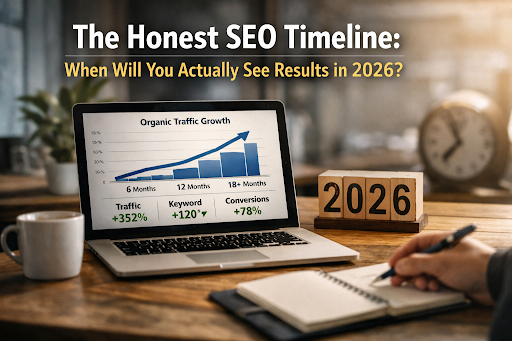
Most businesses start SEO with genuine optimism.
They've seen competitors ranking on page 1. They know organic traffic is valuable. They brief the agency, approve the plan, and then wait.
Month one passes. Nothing changes. Month two. Still quiet. Month three. A few small movements maybe.
And that's when the doubt creeps in. Is this actually working? Are we just wasting money here?
The frustration is valid, honestly. But it almost always comes from one place — nobody properly explained what SEO does at each stage, and what a realistic timeline actually looks like for a business like yours.
So that's what this is.
When you update your website, Google doesn't just process it the same day. Googlebot crawls your site on its own schedule, evaluates your content against hundreds of signals, and then places it in results based on relevance, authority, technical quality — all of it.
That evaluation isn't a one-time thing either. Google keeps reassessing pages as more data comes in over time.
Consistent ranking basically comes down to three things working together:
When all three are strong, timelines get shorter. When even one is weak it slows everything else down. This is honestly why two businesses in the same city, same industry, same budget can have completely different experiences with SEO.
Nothing visible happens here. Rankings stay flat. Traffic doesn't move. For most business owners this part is genuinely uncomfortable to sit through.
But this phase, more than anything else, determines what happens later.
Here's what's going on underneath:
Most SEO campaigns that fall apart by month five, they failed here first. The technical foundation was rushed, or the keyword research was too shallow, or nobody set up proper tracking. Everything built on a weak base shows the cracks eventually.
What to expect: No ranking changes yet. Problems being fixed that were quietly holding the site back.
This is where the work from the first two months starts to actually register with Google.
Crawl frequency tends to increase on sites that have been properly optimised. Updated pages begin showing up in search results, usually at modest positions first. The Search Console data starts shifting in a direction that's worth paying attention to.
What typically becomes visible around this time:
None of this looks impressive on its own. But these early signals do matter — they tell you the site is being re-evaluated and things are moving in the right direction.
What to expect: Early movement on lower-competition terms. Impressions growing. Local visibility is starting to improve.
For most Indian businesses this is the phase where the campaign actually becomes tangible.
Mid-tier keywords start competing more seriously. Organic traffic shows a clear increase that you can actually report on. If local SEO has been part of the plan, city-specific searches start producing consistent visibility around this time.
What this typically looks like in practice:
The reporting also starts telling a proper story here. Search Console and GA4 have enough history by now to show what's gaining traction and where the next push should go.
What to expect: Real traffic growth. First organic leads. A campaign that is visibly producing something.
This is where SEO becomes genuinely different from every other channel.
With paid advertising, results are tied directly to how much you're spending. Stop paying and traffic stops, same day. SEO doesn't work that way. Pages built in month four keep getting stronger. Content published in month three starts picking up natural backlinks. A rising domain authority means new pages rank faster than the older ones did when you first started.
This compounding effect is why experienced marketers treat SEO as a long-term asset rather than just another monthly campaign spend.
By month twelve a well-run campaign typically shows something like:
What to expect: Core keywords competitive. Organic leads coming in regularly. ROI measurable and improving month on month.
Businesses that stay committed past the twelve-month mark reach a position that takes competitors real time and real investment to displace.
The website stops just being a website at this point. It becomes a proper asset. Content generating qualified traffic consistently. A domain Google trusts enough to rank new pages faster than before. A brand showing up across the searches that your target audience is actually making.
Businesses that "tried SEO for three months and moved on" never reached this. The ones that treated it as a long-term investment — they usually find it becomes the most reliable thing in the whole marketing mix.
Every business is different and these variables genuinely shift the curve one way or the other.
Domain history An established domain with some existing authority moves faster than a brand new one starting from scratch. A domain with past penalties or a history of spammy backlinks can actually dip before it starts climbing.
How competitive your market is. Ranking for "interior designer in Mumbai" is a very different challenge compared to "interior designer in Nagpur." The more established competitors are in your specific market the longer it takes to move past them. Worth being honest about this from the beginning.
Content quality Google's Helpful Content system has gotten noticeably better at identifying content written for algorithms rather than for actual people. Detailed, experience-backed content earns rankings. Generic filler does not, and hasn't for a while now.
Your backlink profile Links from credible, relevant sources are still one of the strongest signals Google uses. A site that's consistently building quality backlinks will always move faster than one that isn't doing anything about it.
Technical site health Crawl errors, slow mobile speeds, duplicate pages, weak site structure — these things create a ceiling on what SEO can achieve until they're dealt with properly.
If your business is focused on a specific city, local SEO quite often delivers visible results faster than a broad national campaign. In low to medium competition markets meaningful movement can show up within 6 to 10 weeks, sometimes less.
The reason is fairly simple. You're competing against local businesses, a lot of which have incomplete profiles, inconsistent directory listings, and very little content that's actually specific to their location.
Getting local SEO right in India in 2026 looks something like this:
For searches like "SEO company in Mumbai" or "digital marketing agency in Bangalore" this is often the most practical and direct path to page 1.
|
Timeframe |
What Is Happening |
What You Should See |
|
Month 1 to 2 |
Technical fixes, keyword research, on-page work |
No visible change, foundations being built |
|
Month 3 to 4 |
Google registering changes, early indexing updates |
Long-tail rankings appearing, impressions growing |
|
Month 4 to 6 |
Mid-tier keywords, local visibility rising |
Page 1 movement, first organic leads |
|
Month 6 to 12 |
Authority compounding, primary keywords ranking |
Consistent leads, measurable ROI |
|
Month 12+ |
Sustained growth, domain trust fully established |
Category-level visibility, compounding returns |
That's really the question underneath all of this isn't it.
The honest answer is yes — but only if the expectations going in are realistic.
Treated as a short campaign with a 90-day deadline, SEO will fall short almost every time. Treated as a channel that builds real compounding value over 12 months and beyond, it becomes one of the most cost-effective ways to generate qualified leads that most businesses have ever run.
Paid advertising has its place, no question. It works quickly and it scales in a predictable way. But it stops the day the budget does. SEO keeps producing after the foundational work is done and that value compounds every month it keeps running.
The businesses winning on search in India right now aren't always the biggest spenders. They're just the ones who started 12 months ago and didn't stop.
At GBIM we've worked on SEO campaigns across industries and cities in India long enough to know that the biggest obstacle is rarely the strategy itself. It's an expectation.
Businesses that understand what each phase looks like and stay the course with that clarity almost always see strong returns. The ones expecting page 1 in six weeks tend to leave right before the compounding starts.
If you want an honest look at where your website currently stands and what a realistic roadmap might look like for your specific market, we're happy to take a look.
Most businesses start seeing meaningful movement somewhere between months 3 and 6, with competitive keywords reaching page 1 between months 6 and 12 assuming consistent work throughout.
Yes, noticeably so. City-specific searches carry less competition and with proper local optimisation visible results can come in 6 to 10 weeks, making it the most practical starting point for location-based businesses.
Temporary dips are common when structural site changes are made. Google re-evaluates pages during this period and things typically recover and improve within a few weeks if the work was done correctly.
More important than it's ever been honestly. Google's Helpful Content system actively filters thin generic pages. Content that demonstrates real expertise and serves the reader consistently outperforms content written for search engines.
Ask for monthly reporting that shows keyword ranking movement, organic traffic from GA4, and impressions in Search Console. Steady progressive improvement every month is a completely fair expectation to have.
Google Ads delivers traffic tied directly to spend and stops when the budget does. SEO takes longer to build but produces traffic and leads continuously without a cost per click, compounding in value as authority grows.
309, Rupa Solitaire,
Sector-1, Millennium Business Park,
Mahape, Navi Mumbai,
Maharashtra (400 710), INDIA.
Write to us at
hr@gbim.com