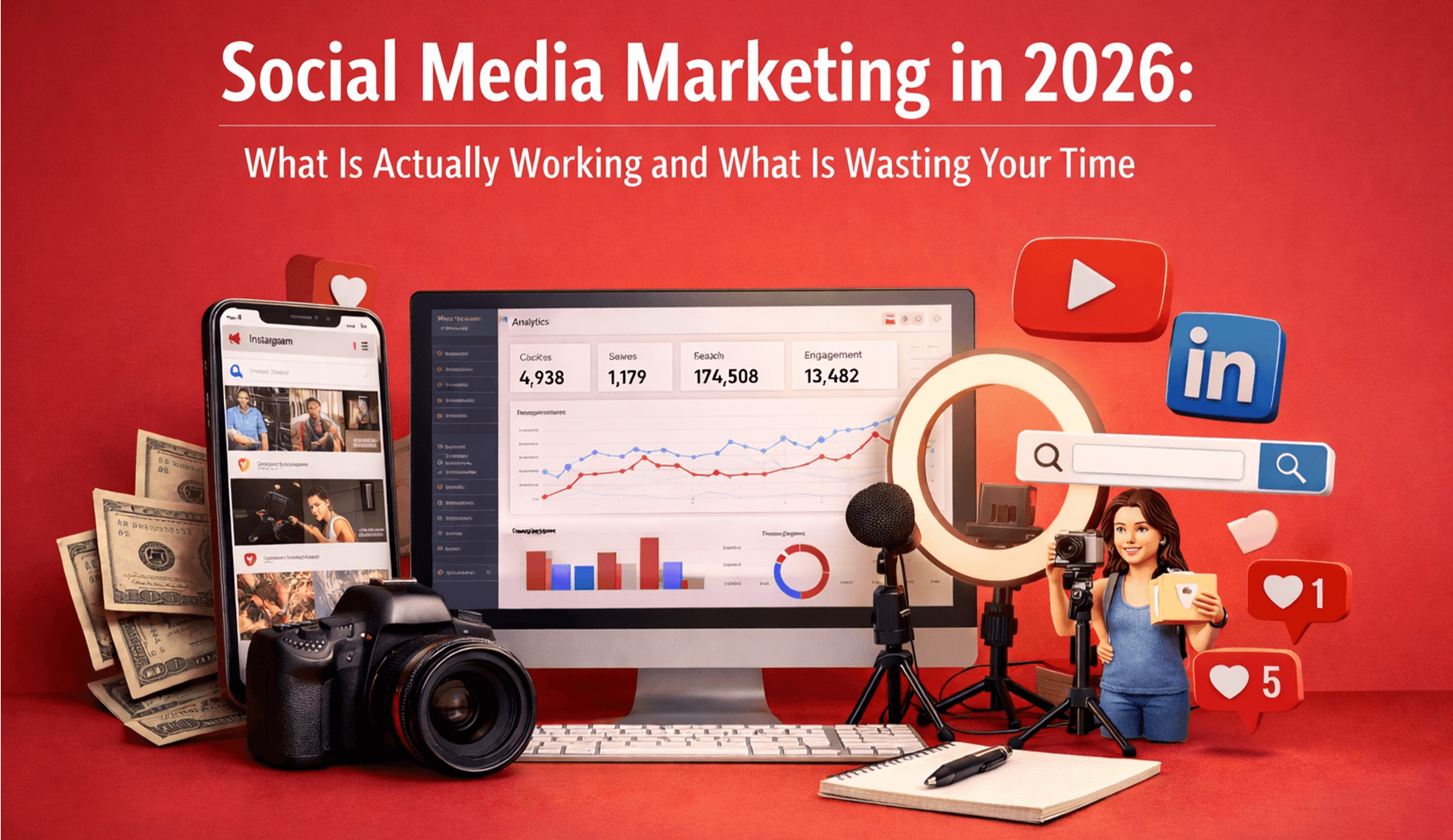
Social media is not what it was. Not even close.
Three years ago, the advice was simple: post consistently, use good visuals, respond to comments. That still matters. But the platforms have changed, the algorithms have shifted, and the way people use social media — especially for research and decision-making — has evolved in ways that most brands have not caught up with yet.
Social media marketing in 2026 requires a different kind of thinking. Not just about content, but about distribution, about search, about trust, and about how social platforms now function as discovery engines in ways that directly compete with Google.
This guide is practical. It covers what is working now, what has quietly stopped working, and what brands need to do differently to actually see results from their social presence.

Here is a shift worth understanding properly. Younger audiences — particularly 16 to 34-year-olds — are increasingly using Instagram, YouTube, and even LinkedIn to research brands and services before making decisions.
They are not typing queries into Google first. They are scrolling. They are searching within the app. They are watching short videos and reading captions before they ever visit a website.
This is what is being called social SEO. And it changes everything about how brands should approach their content.
Practically, it means:
If you are still writing captions as an afterthought and relying on hashtags to do the work, you are optimising for a version of social media that no longer exists.

Not every platform is right for every business. This sounds obvious, but the pressure to "be everywhere" leads a lot of brands into spreading thin and doing nothing particularly well.
Instagram remains dominant for visual brands, lifestyle, D2C, and service businesses targeting younger demographics. The algorithm currently strongly favours:
Carousel posts are also showing a quiet resurgence for educational and informational content. Text-heavy carousels that break down a topic — think "5 things to know about X" — tend to generate saves and shares, which extends their reach.
LinkedIn is genuinely having a moment. Organic reach on LinkedIn is still high compared to other mature platforms, and the audience is actively in a professional mindset — which means content has context.
What is working on LinkedIn right now: first-person narrative posts that share real experience or insight, not company announcements. Thought leadership content from founders and senior team members outperforms brand page content almost universally.
Short videos are gaining traction on LinkedIn. Native documents (PDF carousels) still perform well for educational content. And the algorithm rewards content that sparks genuine conversation in comments — not surface-level engagement bait.
YouTube is not optional anymore, especially if you are in a space where trust and education matter. YouTube content now surfaces in Google search results. That means a well-optimised video can rank both on YouTube and on Google, doubling the exposure from a single piece of content.
Long-form content is making a comeback for high-consideration purchases. Buyers watch 10-15 minute product breakdowns, service explanations, and case study walkthroughs before making decisions. Short-form gets awareness. Long-form builds trust.

Real talk. Some of these are surprisingly common.
Posting without a strategy. Showing up inconsistently, with no content pillars, no audience understanding, and no content-goal alignment. Just posting because "we should be posting."
Measuring vanity metrics. Follower count tells you almost nothing about business impact. Profile visits, website clicks, DMs, story saves — these are better indicators of whether your content is doing anything useful.
Ignoring comments and DMs. Social media is social. Brands that publish content and do not engage with responses are leaving the most valuable part of the platform unused. The algorithm also rewards accounts that participate in conversations, not just broadcast.
Treating every platform the same. What works on Instagram does not work on LinkedIn. Content needs to be native to the platform — in format, in tone, in how it is consumed.
The era of big celebrity endorsements is not over, but the ROI conversation has changed. Micro-influencer marketing — working with creators who have 10,000 to 100,000 followers in specific niches — is consistently outperforming mega-influencer campaigns on engagement and conversion metrics.
Why? Because trust is concentrated. A food influencer with 25,000 highly engaged followers in Mumbai has a far more invested audience than a celebrity with 2 million passive followers. And the cost is dramatically lower.
For brands in India especially, niche influencer partnerships represent one of the best ROI opportunities in social media marketing right now.

The brands winning on social media in 2026 are not posting more. They are posting smarter.
They have defined content pillars — typically three to five themes that align with both their brand values and their audience's interests. Every piece of content maps to one of these pillars, which means the account has a consistent identity over time.
They use original insights — real data, real customer stories, behind-the-scenes content that competitors cannot replicate. In a world where AI can generate generic content instantly, originality is the differentiator.
They plan but stay flexible. A content calendar matters, but so does the ability to respond to trends and conversations in real time. The accounts that can do both consistently build the strongest organic reach.
Organic social builds brand and trust over time. Paid social amplifies content that works and targets specific audiences with precision. The two work together, not in place of each other.
For Meta Ads (Facebook and Instagram) in 2026, the most effective approach is:
Spending on social ads without organic presence is like building on sand. The ads work, but the moment they stop, there is no equity left. Brands need both.
At GBIM, we have been doing social media marketing for brands across industries for over 18 years. We understand that social media in 2026 is not about being everywhere — it is about showing up with purpose, with the right content, on the right platforms, for the right audience. If your social presence feels like it is spinning without traction, we would genuinely love to help you build something that actually works.
Which social media platform should my business focus on in 2026?
It depends on your audience — Instagram for visual and D2C brands, LinkedIn for B2B, YouTube for trust-heavy or educational categories.
How often should a business post on social media?
Consistency matters more than frequency — three to five high-quality posts per week on your primary platform outperforms daily posting of mediocre content.
What is social SEO and why does it matter?
Social SEO is the practice of optimising your content for in-app search on platforms like Instagram and YouTube, which are increasingly used for brand research.
Do hashtags still matter in 2026?
Hashtags have reduced impact compared to earlier years — keyword-rich captions and engagement signals now matter significantly more for content distribution.
Are micro-influencers better than macro-influencers for ROI?
For most brands, yes — micro-influencers offer higher engagement rates and more targeted audiences at a fraction of the cost of larger creators.
How do I measure if my social media is working?
Track website clicks, DMs, content saves, story views, and conversion-attributed traffic from social — not just follower growth or likes.
Should I run paid ads if my organic social status is weak?
Paid ads can supplement organic, but building some organic presence first gives the algorithm better signals and makes paid campaigns more effective.
309, Rupa Solitaire,
Sector-1, Millennium Business Park,
Mahape, Navi Mumbai,
Maharashtra (400 710), INDIA.
Write to us at
hr@gbim.com