
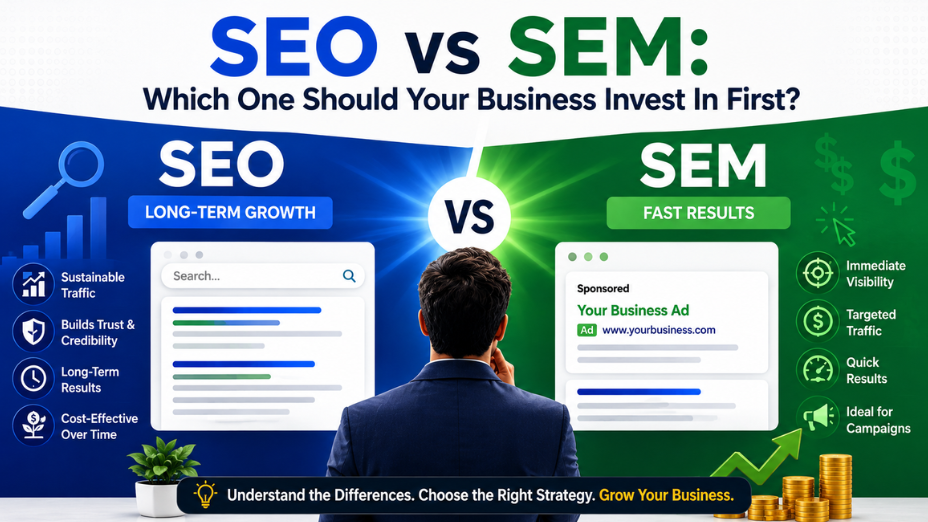
Deciding where to allocate your digital marketing budget starts with understanding the core SEO vs SEM difference. Search engine optimization (SEO) builds long-term organic visibility, while search engine marketing (SEM) leverages paid advertising for immediate search engine presence. Designed for business owners, founders, and marketing leaders, this practical guide cuts through agency jargon to clarify which strategy yields the highest return on investment for your specific growth stage. Whether you need immediate sales inquiries or sustainable lead generation, you will gain complete clarity on where to deploy your next marketing dollar.
Search engine results pages are the primary entry point for buyers actively seeking solutions. Both SEO and SEM share a single objective: capturing high-intent search traffic at the exact moment a customer searches for your product or service.
However, the operational mechanism behind each channel differs fundamentally:
Understanding how these two search disciplines operate individually allows you to select the right growth engine for your organization.
Search Engine Optimization is the practice of continuously enhancing your website to increase its visibility in non-paid organic search results. Google evaluates hundreds of ranking factors, ranging from user experience and mobile performance to content depth and backlink credibility.
A comprehensive organic search strategy relies on three essential pillars:
To establish scalable organic visibility for your business, explore structured SEO services customized to your commercial objectives.
Search Engine Marketing encompasses paid advertising strategies designed to place your website at the top of search engine results. Modern search marketing uses paid search platforms like Google Ads and Microsoft Advertising to bid on high-intent conversion keywords.
For fast lead generation and rapid customer acquisition, tailored PPC services ensure every ad dollar drives tangible business returns.
Evaluating the core operational differences helps determine which channel aligns with your cash flow and revenue goals:
|
Evaluation Factor |
Search Engine Optimization (SEO) |
Search Engine Marketing (SEM) |
|
Primary Cost Model |
Upfront strategy and management cost; zero cost per organic click |
Pay-Per-Click (PPC) model based on keyword auction bids |
|
Speed to Market |
Medium to long term (3 to 6+ months) |
Immediate visibility upon ad approval |
|
Traffic Sustainability |
Compounding long-term organic visibility |
Temporary; active only while ad spend continues |
|
Target Search Intent |
Informational, commercial, and research queries |
High-intent, transactional buyer keywords |
|
Click Distribution |
Captures majority of overall search clicks across non-brand queries |
Secures top ad spots above organic listings |
|
Trust Signal |
Builds lasting brand authority and organic search trust |
Signals sponsored commercial placement |
Choosing between SEO and SEM is not about which strategy is superior in theory. It depends entirely on your business model, cash flow, and market position.
If your business needs sales inquiries within the next two weeks to maintain revenue targets, SEM is the essential starting point. If you have an established revenue foundation and want to reduce customer acquisition costs over the next 12 months, SEO provides the ideal strategic base.
In industries where the cost per click on Google Ads is exceedingly high, relying exclusively on paid search can strain profit margins. Conversely, if top organic spots are dominated by legacy domains with decades of backlink accumulation, SEM offers a practical way to gain exposure while your organic domain authority grows.
Complex B2B services require extensive research. Informational search queries are best captured by comprehensive SEO content that educates potential clients during their research phase. Direct service requests, such as immediate commercial repairs or urgent consulting, benefit immensely from instant SEM placements.
Businesses operating in defined local service areas can dominate regional searches by combining paid location ads with targeted Local SEO tactics. Companies expanding into multi-country markets need structured International SEO frameworks to build multi-region search authority.
A brand-new domain lacks historical trust signals in search engine algorithms. Launching paid ad campaigns allows a new site to generate immediate business inquiries while an organic search roadmap establishes long-term domain strength.
Prioritizing SEO as your primary initial strategy makes financial sense under these core conditions:
Focusing on SEM first is recommended when immediate market feedback and rapid sales traction are mandatory:
The most effective digital growth strategies avoid treating SEO and SEM as mutually exclusive choices. Combining both channels creates powerful operational synergies:
Navigating search marketing decisions requires transparent data, technical precision, and proven strategic execution. We at GBIM help growing companies determine their ideal search marketing mix to capture market share and maximize ROI.
Our team helps businesses build sustainable organic rankings through technical site audits, intent-focused content creation, and strategic authority building. Concurrently, our services support paid acquisition through structured Google Ads management, precision landing page optimization, and clear conversion tracking. Rather than applying generic packages, we evaluate your commercial goals, competitive landscape, and budget to execute a custom search strategy.
Whether you need immediate lead acquisition through paid search or compounding organic traffic growth, GBIM provides end-to-end execution to transform search visibility into measurable business revenue. To explore more digital growth insights, read our dedicated digital marketing guides.
SEO focuses on securing non-paid organic search traffic through content and technical site optimization, while SEM uses paid advertising to purchase immediate search visibility.
SEO incurs no pay-per-click fee, making it more cost-effective long term, though it requires initial investment in content development, technical optimization, and authority building.
SEM generates immediate traffic as soon as campaigns go live, whereas SEO typically requires 3 to 6 months to establish consistent organic visibility and lead flow.
Yes, combining both strategies lets you secure immediate revenue through SEM while systematically building compounding, long-term organic authority through SEO.
A dual strategy works best: Local SEO establishes long-term presence on Google Maps, while SEM captures immediate local service calls.
No, running paid ads does not directly boost organic rankings, though search performance data from paid ads helps refine your organic content roadmap.
Choose SEM if you need immediate revenue, fast market testing, or rapid leads; choose SEO if you want to build durable brand authority and lower acquisition costs over time.
309, Rupa Solitaire,
Sector-1, Millennium Business Park,
Mahape, Navi Mumbai,
Maharashtra (400 710), INDIA.
Write to us at
hr@gbim.com