
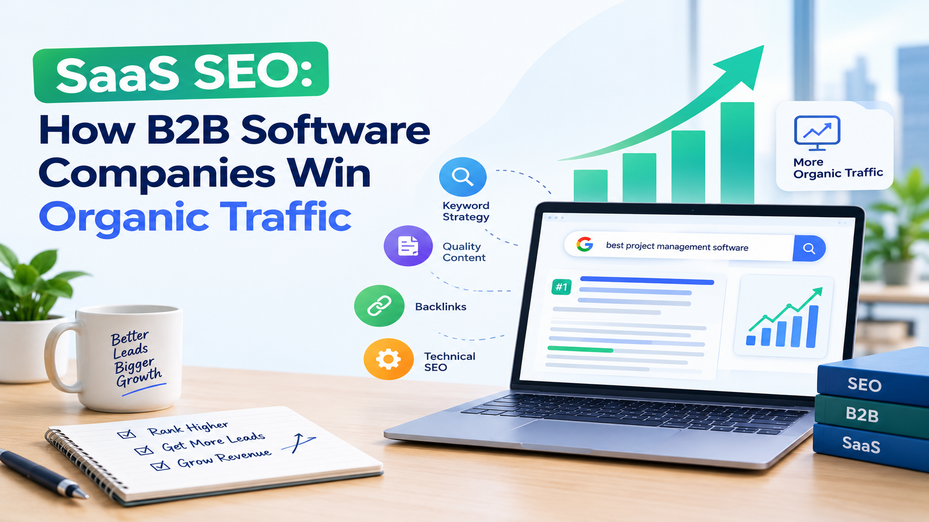
If you're investing in SEO for SaaS companies, more traffic isn't enough. You need the right people to find your software when they're researching a problem, comparing solutions, or ready to buy.
That means your SEO strategy cannot stop at blog posts. It needs strong product pages, use case content, technical SEO, comparison pages, and useful answers to the questions your buyers actually search. Here's how to build that system.
A SaaS buyer can make several searches before contacting a sales team.
They might search:
These searches aren't interchangeable.
The first needs educational content. The second needs a solution page. The third and fourth need comparison or evaluation content. The last may belong on a product or pricing page.
This is the foundation of SaaS SEO: match the page to the reason behind the search.
Don't start with a giant keyword list. Start with the product.
Identify:
For example, a CRM company shouldn't target only "CRM software".
It can build visibility around searches such as "CRM for B2B sales teams", "lead management software", "sales pipeline software", "CRM with WhatsApp integration", and relevant competitor alternatives.
The objective isn't to rank for every possible keyword. It's to find searches that connect to your product and buying journey.
A common SaaS SEO mistake is publishing hundreds of articles while important product pages remain thin.
Your website may need dedicated pages for:
Each page should answer a clear buyer question.
Take a project management platform. A page targeting "project management software for agencies" should explain agency specific workflows, resource management, client approvals, collaboration, and the product's relevant capabilities.
Supporting articles can answer related questions and link back to that page.
This creates a connected topic structure instead of a blog full of isolated posts.
A feature page shouldn't read like a product brochure.
If the feature is "automated reporting", explain:
What is it?
Give the reader a simple definition.
What problem does it solve?
Connect the feature to a business problem.
Who needs it?
Show the teams or use cases where it matters.
How does it work?
Explain the workflow clearly.
What should buyers consider?
Cover integrations, implementation, limitations, or dependencies.
The reader should finish the page knowing whether the feature is relevant to their business.
Searches containing "best", "vs", and "alternative" often come from people evaluating software.
A useful comparison page should cover the criteria that influence the decision:
|
Factor |
What the buyer wants to know |
|
Features |
Which product supports the required workflow? |
|
Pricing |
How does each pricing model work? |
|
Integrations |
Will it work with the existing stack? |
|
Implementation |
How difficult is migration and setup? |
|
Scalability |
Can it support future growth? |
|
Support |
What help is available after purchase? |
Don't make every comparison a sales pitch. Explain where each option fits and where it may not.
That makes the content more useful and gives buyers a reason to trust the information.
SaaS websites can generate a lot of URLs through product pages, documentation, resources, filters, integrations, parameters, and application areas.
Not every URL needs to appear in Google.
A technical SEO review should examine:
The goal is straightforward: help Google discover and understand the pages that deserve organic visibility.
Google Search Essentials also recommends making important pages accessible to search engines and using crawlable links.
A SaaS article shouldn't exist simply because a keyword has search volume.
Ask what the reader needs to know before making a decision.
Instead of writing another article called "10 benefits of CRM software", answer questions such as:
These questions are closer to real purchase decisions.
Google's people first content guidance recommends creating useful, reliable content primarily for people rather than content designed mainly to manipulate rankings.
For SaaS brands, that means bringing actual product knowledge, customer questions, workflows, examples, and useful detail into the content.
AI Overviews and AI Mode have changed how users discover information, but SaaS companies don't need a separate "AI SEO" formula.
Google says the same foundational SEO practices apply to AI search experiences. Pages need to be crawlable, indexable, useful, and supported by good site structure. There are no special technical requirements that guarantee inclusion in AI Overviews or AI Mode.
The practical approach is simple:
Answer the question clearly. Use descriptive headings. Explain concepts in context. Add information that competitors don't have.
Google's guidance on AI features also makes clear that appearing in AI features isn't something marketers can guarantee through a special optimisation trick.
Rankings are useful, but they aren't the final KPI.
For B2B SaaS, track:
A page that attracts 500 relevant visitors and generates qualified demos can be more valuable than a page with 20,000 visits and no sales impact.
Your SEO reporting should eventually connect search data with conversion and CRM data.
At GBIM, we start our SEO process with brand and industry analysis, followed by an SEO and website audit, keyword strategy, SEO strategy creation, client review, feedback, and implementation. You can see the process on our SEO services page.
For SaaS companies, this matters because keyword research has to reflect the product, buyer, market, and sales cycle.
Our B2B SEO services cover technology and software along with other B2B industries. The approach includes technical SEO audits, keyword research and mapping, on page optimisation, content marketing, conversion optimisation, and AI and generative engine optimisation.
GBIM's published work with Kitaboo also shows why organic performance should be connected to business outcomes. The case study reports 34,805+ user traffic, 100% qualified B2B leads, and a 30% reduction in bounce rate. You can view the example through GBIM's digital marketing work.
Before starting, we need more than website access.
Useful inputs include:
This helps us identify keywords that can support the business instead of chasing search volume for its own sake.
SEO for SaaS companies works when search strategy follows the buyer.
Build strong commercial pages. Create content around real problems and use cases. Make comparison content genuinely useful. Keep technical SEO clean, and measure organic performance through qualified leads and pipeline.
At GBIM, we connect SEO, content, website performance, and business goals so organic search has a clear job to do.
It is the process of improving a SaaS website's organic visibility for searches related to customer problems, solutions, features, use cases, industries, integrations, and product comparisons.
Focus on problem based, solution, product, feature, industry, integration, comparison, and alternative keywords that match the buyer journey.
No. Product, feature, use case, industry, integration, comparison, and technical SEO pages are equally important.
Yes, when customers genuinely compare products. These pages can capture commercial intent and help buyers make informed decisions.
There is no fixed timeline. Competition, website quality, content, technical SEO, authority, and the starting position all affect progress.
No. Google continues to recommend foundational SEO practices for AI search experiences. Useful, original, accessible content remains the priority.
309, Rupa Solitaire,
Sector-1, Millennium Business Park,
Mahape, Navi Mumbai,
Maharashtra (400 710), INDIA.
Write to us at
hr@gbim.com