
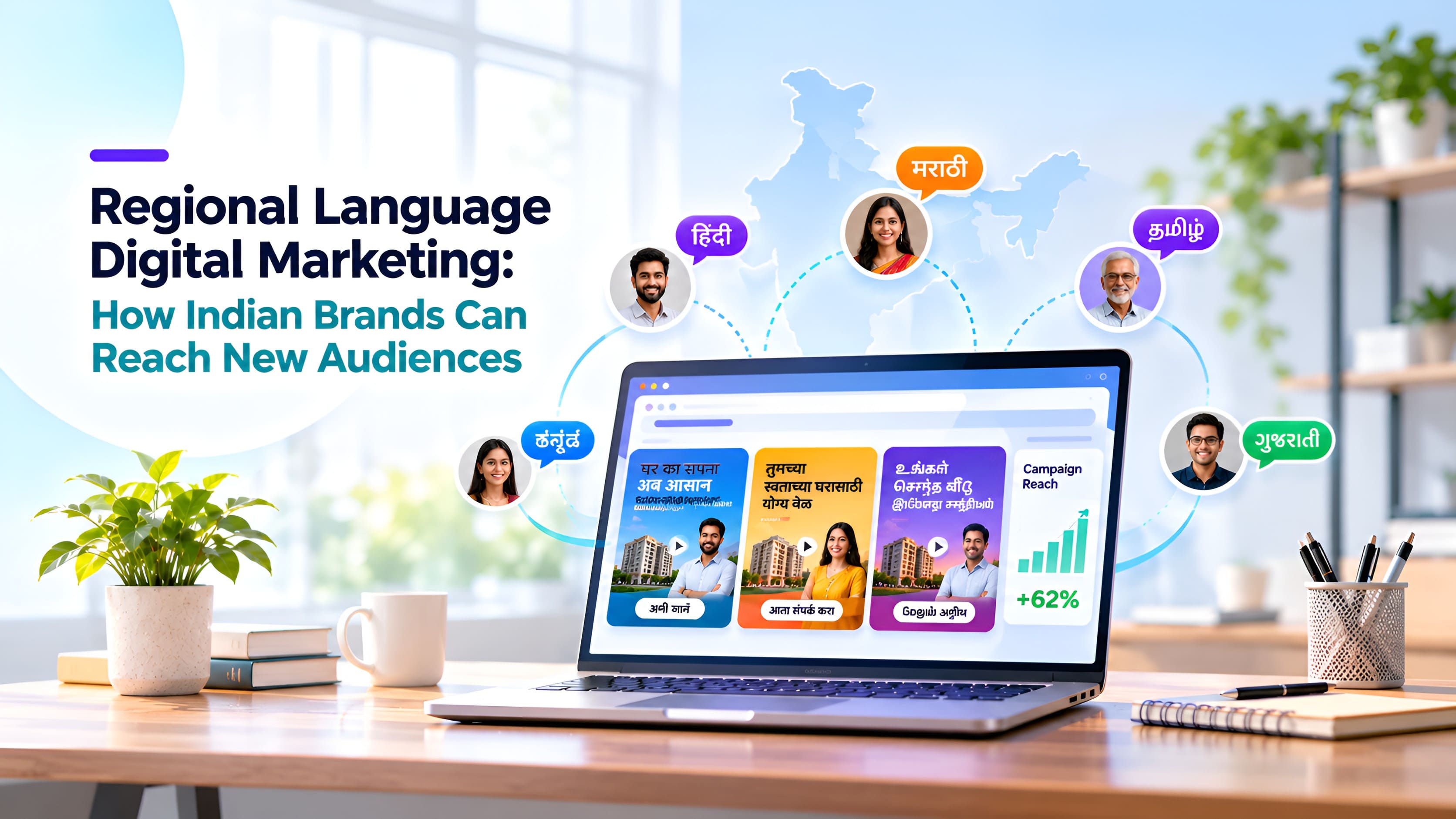
A customer in Jaipur views a Hindi review prior to purchasing a washing machine. In Coimbatore, a customer is looking at a similar product via Tamil videos and local-language search.
Customers want the same data on products but it does not have to be the same language.
That is why brands should take note of regional language digital marketing in India, which will help them reach non-English speakers.
As per IAMAI-Kantar Internet in India Report 2024, 57% of the internet users in urban areas preferred to access content in Indic languages. This finding emphasizes the need for familiar-language communication even in cities' marketplaces.
However, just translating the ads for these audiences isn't enough. Brands need to become familiar with local search habits, cultural preferences, and where local consumers are going to find their product.
There is a wide diversity in the Indian digital audience. Customers in different states may be communicating in different languages when researching a product, watching videos and communicating with businesses.
While English is still relevant, especially for professional interactions, it is not necessarily the preferred language of choice for consumers.
Consider these situations:
These are just a few examples of the influence language preference can have on the customer journey.
For businesses, regional communication is an opportunity to get the product's information out there and close to the people in their region.
A campaign is successful when it starts with an understanding of those it is trying to impact.
An audience is not just a language: The customer's expectations could also differ, depending on the location, the product they are in need of, their shopping patterns and their culture.
|
Audience factor |
What brands should investigate |
|
Preferred language |
Language used for searches and enquiries |
|
Regional interests |
Local preferences and cultural references |
|
Search behaviour |
Common phrases and mixed-language queries |
|
Content consumption |
Preferred videos, articles and social platforms |
|
Customer support |
Availability of assistance in local languages |
Another point is that a campaign for an appliance may vary along the Tamil Nadu state in comparison to the north.
These differences shouldn't be made on the basis of a blanket generalisation of a state, but on audience research.
Different digital channels serve different purposes. To select the best possible combination is better than posting translated material in all the places.
Customers may search for nearby services, product information and business locations using regional languages.
Brands can develop relevant landing pages, research local-language keywords and maintain accurate business information.
Google recommends separate URLs for different language versions of website content, with appropriate hreflang annotations where applicable.
However, technical optimisation cannot compensate for poorly translated or unhelpful content.
Video can be used to show product properties, to tell stories and use familiar speech.
Customers who cannot follow features with short ads in their own native language may benefit from a tutorial in their native language for the region.
Clear demonstrations and subtitles sometimes make things more accessible, as well.
Regional caption, video and campaign creatives enable brands to communicate on platforms like Instagram and Facebook.
A localised ad must be interesting to the audience but not alter the brand's personality.
There are also different language and advertising support requirements for each platform.
You can enable conversation in the customer's preferred language in WhatsApp.
After an enquiry businesses have the opportunity to answer product questions, provide information, and provide support.
Promotional communication shall comply with any such consent requirement, and the messaging policies of WhatsApp.
Translation is the process of translating the content from one language to another. Localisation adapts the message for the communication style and context of the audience.
|
Translation |
Localisation |
|
Converts existing words |
Adapts the overall message |
|
Often retains original examples |
Uses locally relevant examples |
|
Primarily focuses on language |
Considers language and cultural context |
|
May retain existing visuals |
Reviews visuals for regional suitability |
Assume a clothing company sells winter jackets in India.
For people in colder climates, the same marketing campaign could be applicable, but would not be as useful to those in a warmer climate.
Localisation assists companies in communicating with customers' real needs and not based on the way it was translated directly from one language to another.
The first step in the process of adopting regional language digital marketing in India is to have a specific approach before attempting to target multiple languages.
Review existing website traffic, customer enquiries, delivery locations and campaign performance.
Look for markets with customers who may not be fluent in the language, but are interested in buying the product.
Understand customers' native expressions of products and services.
Think about using a combination of language, local phrases and conversational expressions.
The problem is that English keywords are difficult to translate and thus can fail to capture the ‘real world' search intent.
Relate the types of content to customer needs.
Videos may be a good option to demo a product, while detailed landing pages may be suitable for customers who are making their way through their comparison process.
Develop messages that are believable to the target audience.
Native-language reviewers can identify awkward phrases, poor translations and inappropriate cultural references.
Begin specific campaigns and gauge customers' reactions.
Don't expand into new markets without comparing qualified enquiries, engagement quality and conversions.
Thus, businesses can analyze actual consumer behaviour.
Brands that prioritise quantity over quality in their translations can lose the effectiveness of regional marketing.
Common mistakes include:
There should be a consistency between the brand's advertising, landing page and customer support.
Campaign performance should be based on action rather than on the number of languages that are introduced.
Useful indicators include:
|
Performance indicator |
What it reveals |
|
Regional organic traffic |
Search visibility and visitor interest |
|
Content engagement |
Audience interaction with localised content |
|
Qualified enquiries |
Relevance of incoming leads |
|
Landing page conversions |
Effectiveness of customer journeys |
|
Customer feedback |
Communication quality and satisfaction |
These are indicators that can be used by analysing them across markets to determine where regional campaigns can be leveraged to support business objectives.
Expanding reach to regional audiences isn't all about eliminating English marketing. It is the art of communicating in the language of the brand, making it more accessible, but also relevant and useful.
Companies can create more effective customer journeys through audience research, thoughtful localisation and relevant digital platforms.
At GBIM, we can help you set up strategic SEO, content marketing, social media and performance marketing campaigns, and make them a reality in a manner that works with your business goals. We research customer behaviour and create digital strategies to make brand communication more relevant in various markets.
It's as simple as it gets – connect with your customers with your brand through their language.
Regional language digital marketing involves promoting products and services through content, advertisements and customer communication in languages preferred by specific audiences. It helps businesses communicate more effectively with customers across different markets.
The right languages depend on customer locations, search behaviour and existing demand. Hindi, Tamil, Telugu, Bengali, Marathi and Malayalam may be relevant for different markets. Brands should use audience research instead of selecting languages based only on population.
Regional language content can help websites reach people searching in those languages. Effective results depend on content relevance, technical accessibility and search demand. Translation alone does not guarantee improved rankings.
Yes. Small businesses can begin with local-language social posts, helpful videos, relevant website information and customer support. Testing one suitable market before expanding can make the strategy easier to manage.
AI tools can support initial translation and content drafting. However, human review remains important for checking accuracy, natural expressions, cultural references and brand consistency.
Businesses can monitor organic traffic, content engagement, qualified leads, landing page conversions and customer feedback across target regions. These indicators help identify which campaigns contribute to meaningful business outcomes.
309, Rupa Solitaire,
Sector-1, Millennium Business Park,
Mahape, Navi Mumbai,
Maharashtra (400 710), INDIA.
Write to us at
hr@gbim.com