
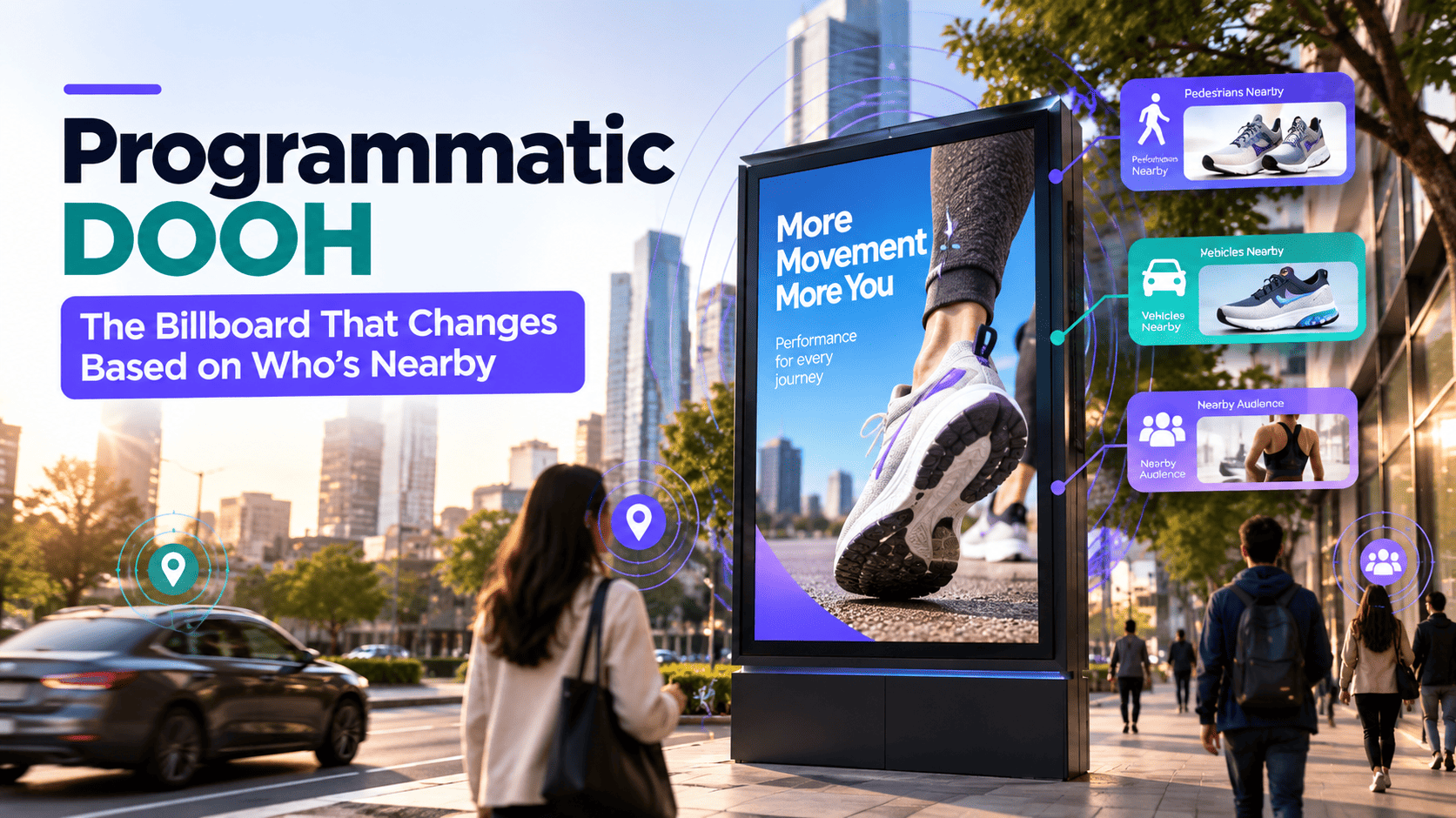
The time is 8:15am on a Monday. An ad created for commuters displays on a digital screen in the vicinity of a busy transit station. At lunchtime the same screen hosts a different creative. Next, it's cloudy, then rainy, and another version is back.
The screen wasn't moved. There is an environment around its context.
That simple example gets surprisingly close to programmatic DOOH explained without the advertising jargon. It's bringing some of the agility of digital advertising to the screens in the real world.
And in 2026, that makes outdoor advertising much more interesting than simply putting the same billboard up for several weeks.
Digital out-of-home (DOOH) is a term used for digital advertising outside the home. They may be seen in transit areas, shopping centers, outdoors, office buildings, and throughout other public or commercial areas.
According to the Interactive Advertising Bureau (IAB), DOOH can support dynamic content influenced by factors such as location, time of day, weather and audience characteristics. Programmatic buying is one way of purchasing and managing this digital inventory, it is not a requirement for something to qualify as DOOH.
That distinction matters.
DOOH is a digital billboard that cycles through a number of pre-programmed ads.
The term programmatic DOOH or pDOOH is a shortened term for programmatic digital outdoor advertising, which is a form of DOOH that utilizes automated media buying and can leverage data signals to decide when and where specific advertising should be displayed. According to OAAA, programmatic OOH is the automated process of buying digital-screen inventory bids and/or direct buys, with campaigns potentially being triggered by location, audience, time, weather and the environment.
Think of it as outdoor media borrowing part of the operating logic of online advertising.
Imagine a digital screen positioned near a shopping and business district.
It does not necessarily need one message all day.
Morning footfall increases as people travel to work. A brand could schedule creative designed specifically for that part of the day.
The important signal here is not an individual person's identity. It may simply be time and context.
The actual screen has not moved, but things around the screen have. There are active offices, people going for lunch, and retail activity could be up.
Various creatives can now make more sense.
Then weather can be another trigger.
A campaign can adapt to the weather conditions rather than the other way around, meaning a sunny afternoon might give way to a rain-themed campaign.
Dynamic creative based on weather is not a theoretical concept. The list of inputs that can inform contextual DOOH creative has included weather over the years, alongside time, location, travel information, sports data and brand-owned information.
The billboard turns from a printed poster into a malleable digital media surface.
This is where programmatic DOOH explained through examples becomes easier to understand.
Depending on the available inventory, platform, campaign setup and permitted data, useful signals may include:
|
Signal |
What It Could Change |
|
Time of day |
Morning, afternoon or evening creative |
|
Weather |
Context-appropriate messaging |
|
Location |
Creative relevant to the surrounding area |
|
Venue |
Different messaging for retail, transit or office environments |
|
Day of week |
Weekday versus weekend campaigns |
|
Audience data |
When and where selected audience groups are more likely to be present |
|
Brand-owned data |
Creative informed by suitable first-party information |
The IAB specifically identifies daypart, venue/environment, geographic location and first-, second- and third-party data among possible contextual targeting parameters.
There is an important limit, though: programmatic does not mean a billboard recognizes every passerby and instantly creates a personal advertisement for that individual.
More often than not, it is better to think in terms of contextual relevance at a location instead of personalization through one-to-one means.
Physical presence is a tremendous asset to outdoor advertising.
A large format ad can take over a site in a manner a small digital ad can't. That is no advantage to be taken away by programmatic DOOH. It adds flexibility to it.
It doesn't make sense for a brand to approach Tuesday morning and Saturday evening exactly the same way when it comes to ads.
Automation can enable advertisers to decide on the advertising placement and time rather than advertising at any time.
For marketers already thinking in terms of audiences, contextual signals and campaign optimization, pDOOH can make outdoor easier to consider as part of a wider digital advertising strategy.
That shift is becoming visible in India as well. The report, “2026 dentsu-e4m: A report on the trends that will shape the nation's programmatic advertising landscape,” singled out programmatic DOOH as a trend that will impact the country's programmatic advertising market.
When the location itself is important to the business, the use cases are generally most apparent.
Consider:
A retailer, for instance, may value screens around relevant shopping areas differently from screens elsewhere. An entertainment business may care about particular locations and time windows. A brand running a launch could coordinate outdoor activity with other paid advertising efforts.
That is where pDOOH becomes more than "a clever billboard."
It becomes another way to plan media around place, moment and audience context.
This is the part that can get lost in the excitement around automation.
A campaign can have sophisticated triggers and still be forgettable.
Outdoor creativity has limited time for communicating. Technology will not save the headline if it is too mysterious to understand or if the context introduces something irrelevant, the branding will not either.
The questions should therefore come in this order:
The questions should be addressed first, and only then automation should be the focus.
Marketers were trained to accept detailed reporting with an online ad campaign. Outdoor media are unique due to the fact they occur in a common physical space.
Audience estimates, opportunity-to-see, likelihood-to-see, dwell time, sensors, mobile data, panels and attribution methodologies can be used for DOOH measurement. The IAB's 2025 measurement guidance was developed particularly to achieve some consistency in an area where it's still important.
The same question is being discussed in the Indian industry in 2026 – with programmatic and digital OOH growing as new ways to connect with audiences, measurement, attribution and consistent verification are still areas in need of further development.
So, marketers should stay away from making direct comparisons between all the outdoor measures and a click-based digital campaign.
The channels work differently.
Perhaps the easiest way to understand programmatic DOOH explained is to stop thinking about the billboard itself.
Think about the moment.
Where is the audience? What are they likely doing? What time is it? What is happening around the screen? Would a different message be more useful now than it was three hours ago?
Programmatic DOOH provides advertisers with additional opportunities to respond to those questions, and adds a layer of real-world visibility to an advertising medium that often lacks it.
That's the reason the channel is worth focusing on, especially for businesses whose customers navigate different stores, neighborhoods, commercial districts and transit spaces.
At GBIM, we do not see advertising channels in isolation, but as a longer customer journey. We support businesses to link media, audience and context, and creative strategy to ensure that each channel plays a distinct role in the overall digital plan.
Programmatic DOOH is an approach to buying and delivering advertising on eligible digital out-of-home screens using automated technology and predefined campaign criteria. Those criteria can include factors such as location, time, available inventory, and other supported contextual signals.
Not exactly. A digital billboard describes the screen or advertising format. Programmatic DOOH refers to the technology and buying approach that can determine when eligible ads appear across digital outdoor inventory.
They can where the campaign, platform, data source, and available screen inventory support weather-based triggers. This allows advertisers to prepare different creative for relevant conditions rather than displaying one message continuously.
Programmatic DOOH should not automatically be understood as identifying every person who passes a screen. Campaigns may use contextual or aggregated information depending on the platform, market, data source, and applicable privacy requirements.
It may be particularly relevant to retailers, hospitality businesses, event marketers, automotive brands, multi-location companies, and other organizations where physical location or timing plays an important role in reaching customers.
Usually, it is more useful to consider the role each channel plays rather than treating them as direct substitutes. DOOH can support physical-world visibility, while search, social, and other digital channels can serve different stages of discovery and response.
309, Rupa Solitaire,
Sector-1, Millennium Business Park,
Mahape, Navi Mumbai,
Maharashtra (400 710), INDIA.
Write to us at
hr@gbim.com