
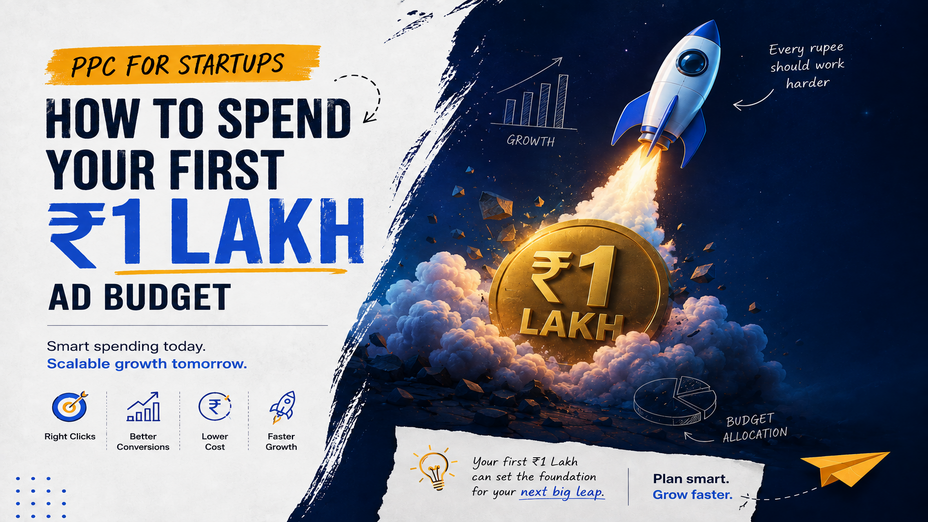
Deciding how much to spend on ads as a startup can feel like gambling in the dark. For early-stage founders and growth managers in India, launching your first paid campaigns requires a structured approach to validate messaging without wasting capital. An initial ₹1 Lakh budget is the sweet spot for testing PPC for startups. It gives you enough data to test channels, discover real customer acquisition costs, and generate qualified leads. This guide breaks down exactly how to split your first ₹1 Lakh ad budget across Google Ads, Meta Ads, and landing page testing so every rupee builds scalable revenue.
When launching paid campaigns for the first time, your goal is not immediate market domination. Your immediate goal is learning. A budget of ₹100,000 provides sufficient statistical significance to understand your unit economics.
Spending less than ₹50,000 often leaves you stranded in the algorithm learning phase. Conversely, burning ₹5 Lakhs without validated funnel data usually leads to high acquisition costs and wasted spend.
Here is what your first ₹1 Lakh ad budget actually buys you:
Before allocating budget to paid channels, you must prepare your digital foundation. Running traffic to an unoptimized destination is the fastest way to burn your marketing capital.
Never launch a campaign without tracking installed. Set up Google Analytics 4 alongside the Meta Pixel and Conversions API. Track every phone call, form submission, WhatsApp click, and checkout event. If you cannot track conversions accurately, you cannot optimize your campaigns.
Sending paid ad traffic to your website homepage rarely works. Homepages contain too many navigation links and generic messages, which lowers your conversion rate. Create a single-minded landing page focused on one clear value proposition and one call to action.
Know your target numbers. What is the maximum amount you can afford to pay for a qualified lead or customer? If your product price is ₹5,000, paying ₹8,000 per acquisition makes no sense unless you have a high customer lifetime value.
To ensure your tracking, web assets, and analytics are correctly configured before launching ads, explore our comprehensive digital marketing services built for growing businesses.
When figuring out how much to spend on ads as a startup, spreading your money evenly across five different platforms will starve every campaign of data. Focus on two core channels: Google Search for active intent, and Meta for audience targeting.
Here is the strategic budget allocation model we recommend for early-stage validation:
|
Channel / Category |
Budget Allocation |
Primary Objective |
Key Target Metrics |
|
Google Search Ads |
₹50,000 (50%) |
Capture high-intent, ready-to-buy search demand |
Click-through rate (CTR), Cost per lead (CPL) |
|
Meta Ads (Facebook & IG) |
₹35,000 (35%) |
Build visual awareness and test creative messaging |
Cost per impression (CPM), Link click-through rate |
|
Retargeting Campaigns |
₹15,000 (15%) |
Re-engage warm landing page visitors who did not convert |
Conversion rate, Return on ad spend (ROAS) |
Google Ads puts your business right in front of prospects who are actively searching for a solution. When building your initial campaign structure:
While Google captures existing search traffic, Meta Ads introduces your brand to prospective buyers who are not actively searching yet.
Around 95% of first-time visitors leave your website without making an inquiry or purchase. Retargeting campaigns keep your brand visible as prospects move through their decision-making process.
Managing paid media requires balancing creative output, bid management, and full-funnel analytics. We at GBIM help early-stage businesses and growing brands eliminate wasted ad spend through structured, data-led campaign engineering.
Our team helps startups maximize paid acquisition by:
If you are ready to launch your first ad campaigns or want expert guidance on structuring your paid media strategy, visit GBIM to build a predictable customer acquisition engine.
A initial testing budget of ₹50,000 to ₹100,000 provides enough data to test channels and establish a baseline customer acquisition cost.
If users are actively searching for your product category, start with Google Ads. If your product is visual or creates a new category, prioritize Meta Ads.
Search ad campaigns on Google can generate inbound leads within the first week, while Meta campaigns typically take 1 to 2 weeks to optimize.
A target ROAS of 3x to 4x is healthy for established e-commerce brands, though early startup validation campaigns often aim to break even while refining unit economics.
Low conversions usually indicate a mismatch between your ad message and landing page, slow page load speeds, or a weak offer.
Self-managing ad accounts often leads to wasted budget on wrong match types and unoptimized bids, whereas hiring an experienced agency ensures structured setup and faster optimization.
309, Rupa Solitaire,
Sector-1, Millennium Business Park,
Mahape, Navi Mumbai,
Maharashtra (400 710), INDIA.
Write to us at
hr@gbim.com