
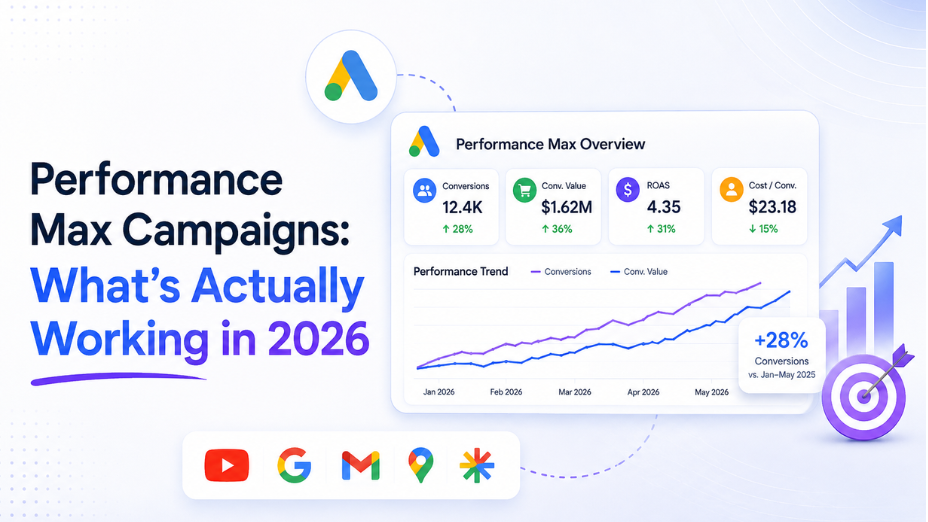
Looking for actionable Performance Max tips to stop wasting ad spend and scale qualified leads or revenue in 2026? Performance Max is Google's automated, multi-channel campaign format that runs ads across Search, YouTube, Display, Discover, Gmail, and Maps using algorithmic bidding. Designed for e-commerce brands, B2B lead generators, and growth marketers, PMax consolidates inventory to maximize conversions. However, relying purely on default automated settings often inflates customer acquisition costs. You are in the right place to discover how experienced media buyers tweak signals, structure asset groups, and refine exclusions to achieve profitable ROAS.
When Google introduced Google Ads Performance Max, marketers were promised effortless cross-channel reach. In practice, letting the algorithm run on autopilot usually leads to bloated budgets, low-intent leads, and ad spend directed toward easy branded search clicks instead of incremental new customers.
To make PMax work in 2026, you cannot treat it as a set-it-and-forget-it campaign. Successful media management requires aggressive governance, structured inputs, and strategic exclusions.
Before diving into optimization tactics, it helps to understand where default setups break down. Left unguided, PMax optimizes for the path of least resistance to claim conversions.
Taking back control requires turning Google AI into a guided assistant rather than an autonomous decision-maker.
One of the most effective Performance Max tips is separating branded traffic from non-branded acquisition. When PMax mixes both, your reported return on ad spend (ROAS) looks fantastic on paper, but actual business growth remains flat.
Apply an account-level brand exclusion lists policy or build a dedicated brand exclusion list inside your PMax settings. If you want to capture brand searches, run a dedicated, tightly controlled Search campaign with specific match types. This forces PMax to do what it was actually built for: finding net-new customers across the web.
Grouping all product categories or services into one single asset group dilutes your messaging. Instead, build a clean PMax campaign structure aligned with conversion value or margin.
For e-commerce stores:
For B2B and lead generation:
Google uses audience signals as an initial direction vector to accelerate the algorithm's learning phase. Relying only on generic demographic interests leads to broad, wasted outreach.
To speed up learning and improve targeting accuracy, supply rich seed data:
Smart Bidding is only as smart as the conversion data you feed it. If you treat a soft newsletter sign-up with the same conversion value as a high-intent consultation request, PMax will naturally optimize toward the easier, cheaper action.
Implement value-based bidding by assigning realistic financial values to different stage goals in your conversion funnel.
At GBIM, our search experts consistently audit conversion tracking pipelines to ensure machine learning algorithms prioritize real pipeline value rather than superficial metrics.
Historically, PMax made negative keyword management difficult. Today, you can apply negative keywords in Performance Max through account-level negative keyword lists or by requesting placement exclusions through account support.
Check your search terms insights regularly. Add terms that signal low purchase intent, such as "free", "login", "careers", "DIY", or irrelevantly broad search terms. Blocking junk queries keeps PMax focused on commercial intent.
For e-commerce brands, your product feed is the single most important asset in PMax. If your Google Merchant Center data is incomplete or inaccurate, even the best bidding strategy will stall.
Ensure your shopping feed optimization includes:
Combining a clean product feed with advanced techniques in AI in paid search advertising helps keep ad delivery focused on high-margin inventory.
A common question among search marketers is whether Performance Max should completely replace traditional Search campaigns. The answer is no.
When a user query exactly matches an active exact-match keyword in your Search campaign, Google prioritizes the Search campaign ad over PMax. This allows you to maintain exact control over high-priority search terms while letting PMax harvest incremental, long-tail traffic across YouTube, Gmail, Discover, and Display.
|
Feature |
Performance Max Campaigns |
Traditional Search Campaigns |
|
Primary Goal |
Cross-channel reach and incremental conversions |
High-intent search query capture |
|
Bidding Focus |
Algorithmic Smart Bidding across all inventories |
Keyword-level bid adjustments and tight match types |
|
Channel Coverage |
Search, Display, YouTube, Discover, Gmail, Maps |
Google Search SERP and Search Partners |
|
Control Level |
Strategic inputs (Signals, Assets, Exclusions) |
Granular keyword and negative keyword control |
Combining both formats into a cohesive strategy provides broad reach without sacrificing keyword-level control on your highest-converting terms.
Navigating automated ad platforms requires hands-on campaign governance, continuous data hygiene, and deep strategic oversight.
We at GBIM bring over two decades of digital marketing experience to help growth-focused companies turn complex ad setups into predictable revenue engines. Partnering with a specialized Google Ads agency gives your brand access to certified search strategists who manage bidding models, creative production, and feed health every week.
Our team helps businesses:
Whether you run an e-commerce platform or a B2B service firm, our services support your long-term growth through data-driven PPC strategies designed to maximize return on ad spend.
Performance Max typically requires 2 to 4 weeks (or roughly 30 to 50 conversions) to complete its learning phase and stabilize bidding performance.
Yes, but if you do not upload a custom video, Google will automatically create a low-quality slideshow video from your images, which can lower ad performance.
No, keep high-performing exact match Search campaigns running alongside PMax, as exact match keywords take priority over PMax in ad auctions.
You can view search term themes and categories under the "Insights" tab in Google Ads, or generate custom reports to inspect top search categories.
We recommend setting a daily budget that is at least 3 to 5 times your target Cost Per Acquisition (CPA) to give the algorithm enough data to optimize efficiently.
Audience signals serve as an initial targeting guide for Google AI, helping the system find ideal prospects faster based on your uploaded seed data.
309, Rupa Solitaire,
Sector-1, Millennium Business Park,
Mahape, Navi Mumbai,
Maharashtra (400 710), INDIA.
Write to us at
hr@gbim.com