
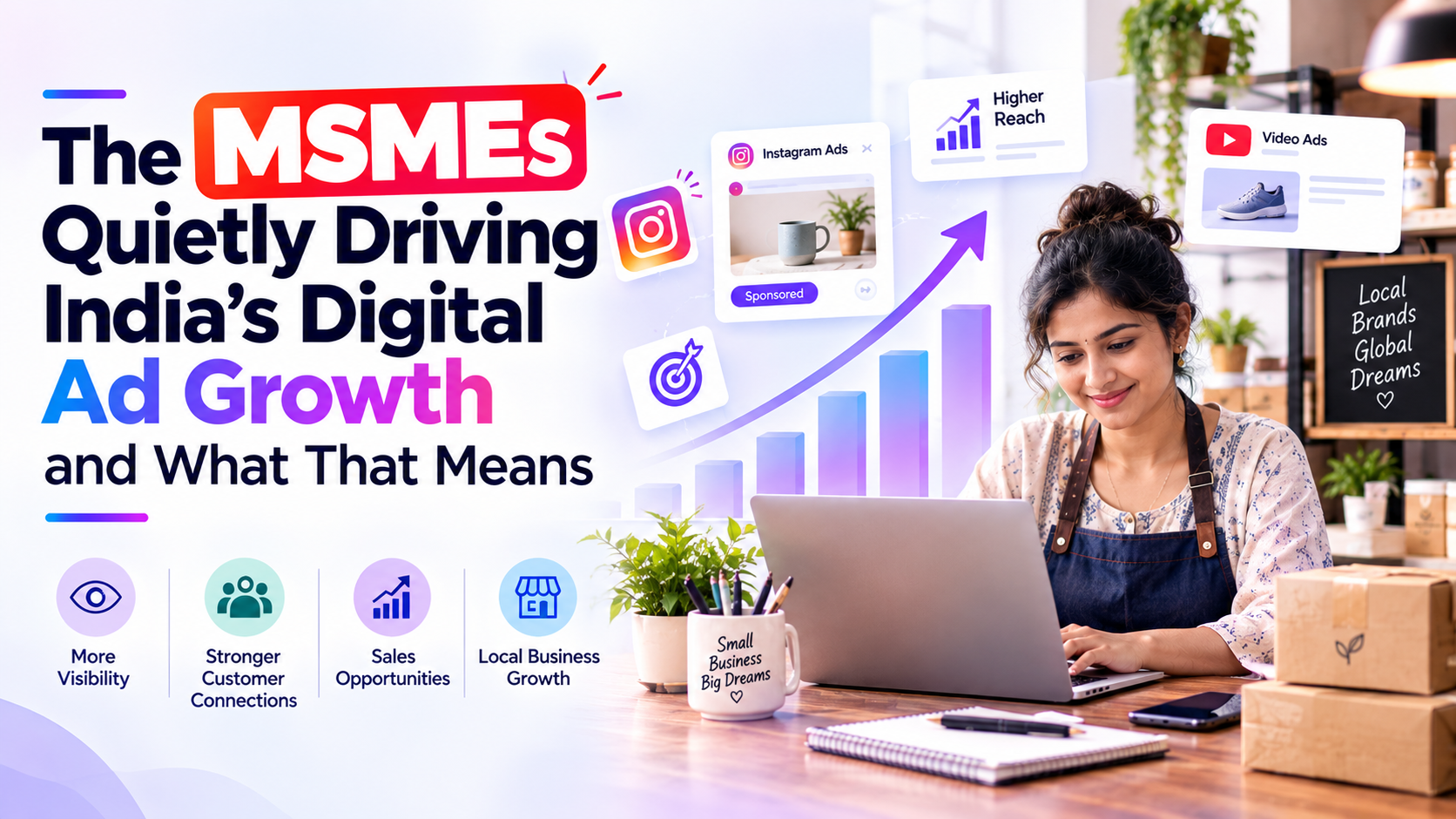
India's digital advertising story used to be easiest to tell through its biggest brands. The conversation was led by large e-commerce firms, consumer brands, banks and telecoms firms.
That picture is becoming less complete.
A significant part of MSME digital marketing growth in India is now coming from thousands of smaller businesses putting digital channels closer to the center of how they find customers. MSME digital advertising grew by 21 per cent YoY, and stood at ₹35,814 crore in 2025, according to the Pitch Madison Advertising Report 2026.
That number matters more than its size. It points to a structural change in who can participate seriously in advertising.
Digital marketing is no longer something a business has to "grow into." For many smaller companies, it is where marketing begins.
India's wider advertising market is already moving decisively toward digital.
The Pitch Madison report's expanded measurement puts total digital advertising at ₹93,156 crore in 2025, accounting for 60% of the advertising market under its new definition. MSME digital advertising alone represented ₹35,814 crore.
A second industry standard has a similar overarching narrative to tell. Under Dentsu's methodology, digital media would account for 59% of Indian ad spend and stand at ₹71,621 crore in 2025. While variations in the numbers may be due to differing definitions or measurement techniques, both reports demonstrate the overall trend of an increasing contribution by digital to the Indian advertising economy.
What is especially interesting is who is contributing to that shift.
A local manufacturer does not need to advertise like a national FMCG company. A professional services firm does not need the media plan of an e-commerce marketplace. As a B2B company expands, they can target a small number of decision makers.
Digital channels make those differences easier to accommodate.
There is no single explanation for the shift. Several changes have happened at roughly the same time.
There used to be certain requirements involved in advertising that were pretty strict. Small businesses may have had fewer realistic choices when it comes to targeting particular audiences and determining the reaction.
Digital platforms changed that.
Digital channels like search, social media, online video, marketplaces and more let businesses begin with a specific audience or goal, not a mass reach goal.
Self-service tools have pushed that accessibility further. However, the FICCI-EY 2026 media and entertainment report states that the self-service models are helping to drive increased adoption of programmatic among SMEs and in-house brand teams.
The question for an MSME now becomes, "Where should we advertise and what should we measure?"
Digital marketing does not make every campaign successful. It does, however, create more opportunities to observe what happens after a campaign launches.
A business can examine signals such as:
That feedback can be extremely important to a smaller business.
If resources are scarce, it is important to know that one audience, message, landing page, or channel is performing differently than another to influence the next marketing action.
This is why a structured approach to digital marketing in India is becoming a more significant issue for MSMEs. It's not so helpful to be on five channels as to know which channels actually move a customer closer to a decision.
The common narrative of AI in advertising usually revolves around the ability to target ads with great precision or to fully automate them.
For smaller businesses, one of its more immediate effects may be much simpler: getting more marketing work done with the same team.
AI-assisted tools can help teams develop early creative concepts, resize or adapt assets, generate variations, summarize campaign information, organize research, and accelerate repetitive production work.
That does not remove the need for human judgment.
A tool doesn't have the ability to sensibly determine if the message truly represents the brand, if it conveys a regional reference, or if it conveys the reason a customer will choose one business over another.
But it can help to eliminate some of the friction in the production and testing of marketing material. AI-powered ad tech is another growth driver for Dentsu's 2026 forecast, in addition to mobile-first behaviour, short-form video, regional content, performance marketing, and digital commerce.
For smaller marketing teams, that increased operational capacity matters.
Another not so obvious part of the MSME story is that customers are more accessible online than ever before.
More parts of the customer journey are now going online as a result of digital payments, online commerce, regional-language content, increasing connectivity and mobile-first behavior.
It is not just confined to the mega cities of India.
Regional and niche businesses can leverage digital channels without having to have a nationwide presence in traditional media. Dentsu singled out some of the factors contributing to deepening participation in India's digital economy, namely MSME digitalization, broadband programs, digital public infrastructure, UPI and ONDC.
This creates a reinforcing cycle:
That helps explain why MSME digital marketing growth in India is bigger than a temporary advertising trend.
This is where the story needs some caution.
Access to advertising tools can make launching campaigns easier. It cannot make the underlying strategy correct.
An MSME can still end up with:
In fact, easier execution can sometimes make this problem worse. When launching another campaign takes only a few clicks, activity can grow faster than strategy.
The better question is not:
"What else can we run?"
It is:
"Where is our actual growth problem?"
A business that isn't getting discovered is not the same type of business that gets traffic but can't convert. One could have lots of questions and send in the wrong type of leads.
That is where marketing consulting can help: when you find the right channels to solve the real business challenge, not just every new digital channel that has to be accessed.
Perhaps the most interesting part of this trend is not that MSMEs are buying more digital advertising.
It is that more of them are beginning to operate with marketing feedback that was once much harder to obtain.
Campaign information may reveal attention grabbers. Customers' behavior when searching can show them what they need. Friction can be unveiled in landing page performance. Lead data can provide insight into whether reach is becoming an effective demand.
This can make marketing a regular business process instead of a sporadic marketing event.
And the economic impact is becoming visible beyond advertising itself. A 2026 report from Google and the India SME Forum, with technical inputs from Deloitte, estimated that MSME digital advertising generated ₹49,731 crore in economy-wide output in 2025.
The 21% increase should not be read simply as "MSMEs are spending more."
The more useful interpretation is that India's digital advertising base is broadening.
More businesses can reach narrow audiences. More customer journeys can be measured. Some production friction is being mitigated by the use of tools that help with AI. Digital infrastructure is bridging the gap between business and customers, going beyond the limits of geography and media.
But those advantages also raise the standard for execution.
As MSME digital marketing growth in India continues, simply running ads will become less differentiating. The value will lie increasingly on understanding the audience, strategically selecting channels, linking campaigns to a good digital experience, and interpreting the data from the campaign afterward.
At GBIM, we assist businesses in making the most of these growing digital possibilities and transforming them into a more integrated approach to growth. We don't add channels for the sake of it, we simply need to know where to get visibility, demand, conversion or measurement to improve, and do everything possible to focus marketing around that business need.
According to the Pitch Madison Advertising Report 2026, MSME digital advertising reached ₹35,814 crore in 2025, an increase of 21% year over year. The report's expanded definition also places MSMEs as a substantial part of India's wider digital advertising ecosystem.
Digital channels offer relatively direct access to targeted audiences, measurable campaign data, self-service tools, and multiple ways to reach customers across search, social, video, marketplaces, and other online environments. Increasing digital adoption among Indian consumers also makes these channels more relevant to smaller businesses.
No. B2B companies can also use search, professional networks, content, email, targeted advertising, and other digital channels to reach decision-makers. The appropriate channel mix depends on how customers research and choose suppliers.
AI-assisted tools can speed up activities such as research, initial content development, creative variations, campaign analysis, and repetitive production work. Human oversight remains important for strategy, factual accuracy, brand judgment, and cultural context.
No. Greater activity does not guarantee stronger outcomes. Audience selection, positioning, creative quality, landing-page experience, measurement, and the connection between marketing goals and business goals all affect performance.
Start with the business problem. Determine whether the priority is discoverability, qualified enquiries, conversion, retention, or another measurable objective. Once that is clear, it becomes easier to decide which digital channels deserve attention rather than spreading effort across every available platform.
309, Rupa Solitaire,
Sector-1, Millennium Business Park,
Mahape, Navi Mumbai,
Maharashtra (400 710), INDIA.
Write to us at
hr@gbim.com