
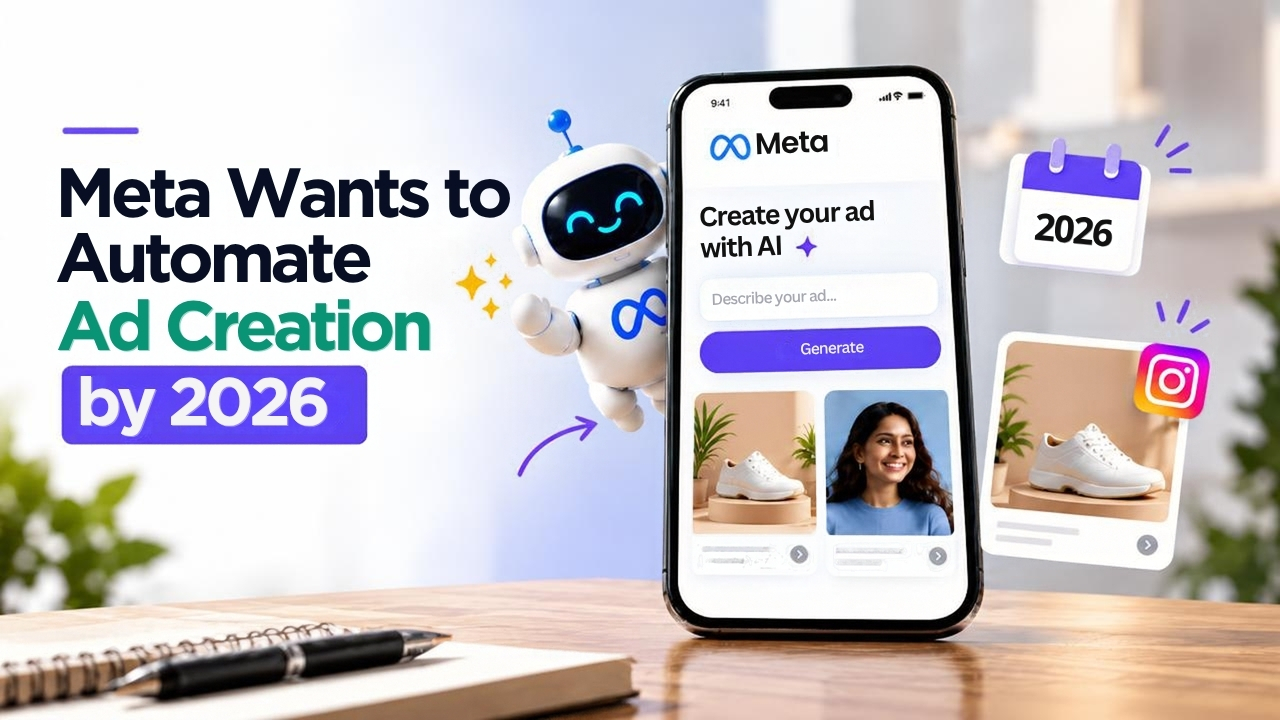
Anyone who has spent time inside Ads Manager over the last five years knows the platform has been stripping away manual levers one by one. First came automatic placements, then broad targeting expansions, and then generative image tools. A report from The Wall Street Journal indicated that Meta wants to take this to its logical conclusion by late 2026: fully automated ad creation and campaign execution from start to finish.
The concept behind meta ai automated advertising sounds straightforward. An advertiser provides a budget, a link to a product page, and maybe a raw product photo. The system takes over from there, writing copy, building visual assets, selecting the audience, and managing the bidding.
While this shift removes much of the tedious setup work, it also introduces real commercial risks for brands that rely on the platform to stand out.
The reported plan points to a system where advertisers no longer build distinct ad sets, select detailed interest tags, or manually test five headlines against three thumbnail images.
Instead, machine learning models will ingest a company's product catalogue, review historical conversion data, and generate tailored visual and text assets for individual users in real time. One shopper might see a fast-paced video highlighting price, while another user looking at the same product sees a clean, minimal image focusing on materials.
This is different from what exists today. Meta's current Advantage+ suite helps with discrete tasks, such as expanding image backgrounds to fit different aspect ratios or swapping headlines from an advertiser-provided list. The proposed 2026 model turns the platform from a campaign assistant into the primary creative director and media planner.
Computers are far better than humans at multivariate testing and real-time bid adjustments. If Meta's algorithms want to test hundreds of subtle text variations across millions of people to see which converts best on a Sunday afternoon, no media buyer can match that speed.
Creative generation is where pure automation runs into trouble.
Algorithms generate assets based on statistical probability. They look at what has already worked across millions of ads and produce something that resembles the average. The result is often technically competent but completely forgettable. When every brand in a category lets the same platform build their creative, every ad starts using the same generic phrasing, the same stock aesthetics, and the same promotional hooks.
Handing campaign mechanics over to an algorithm makes practical sense. Letting it determine your brand strategy does not.
There are fundamental decisions that require deliberate human judgement:
The days of charging fees simply to duplicate ad sets, manage lookalike audiences, and manually toggle budget switches are ending. That kind of manual account management is being swallowed by platform automation.
Instead, the focus of social media advertising is moving towards upstream strategy.
The valuable work now lies in three specific areas:
For smaller businesses with limited marketing staff, deeper automation sounds like an easy fix. You drop in a URL, set a modest daily budget, and let the platform find customers.
It will make launching basic campaigns easier. But it also creates a trap. If an SMB relies entirely on auto-generated copy and images, their brand becomes indistinguishable from hundreds of competitors doing the exact same thing.
Smaller businesses should treat automation as an operational shortcut, not a replacement for creative effort. Providing your own crisp photography, authentic customer stories, and distinct value propositions will be the only way to avoid disappearing into algorithmic noise.
Businesses do not need to wait until late 2026 to adjust their approach. The transition is already visible across Meta's current ad manager.
Meta's move towards full automation confirms what has been clear for years: manual campaign tinkering is no longer a competitive advantage. The algorithm will handle the distribution, the bidding math, and the mechanical variations.
The brands that succeed in this environment will not be the ones that fight automation, nor will they be the ones that hand over their entire marketing brain to an algorithm. Success comes from combining platform automation with deliberate human strategy, distinctive creative assets, and clear commercial priorities.
At GBIM, we help businesses navigate shifts in meta ai automated advertising by building data-led paid social strategies backed by over 21 years of digital marketing experience. We focus on the strategic positioning, creative direction, and performance tracking that automated systems cannot replicate on their own.
When will Meta roll out fully automated ad creation?
Reports indicate Meta is working towards fully automated campaign generation by late 2026, though specific automated creative and targeting tools are rolling out gradually across its advertising manager.
Will automated advertising replace human marketing teams?
Automation takes over routine campaign setup, audience selection, and basic asset resizing, but human teams are still required to direct brand positioning, set commercial margins, write messaging guidelines, and verify compliance.
What is the difference between Advantage+ and fully automated ads?
Advantage+ automates specific parts of a campaign, like audience expansion and image formatting. Full automation aims to generate the entire ad, from copy to visual assets, using minimal business inputs.
How can small businesses stand out if all ads are automated?
Small businesses can stand out by supplying original photography, distinct brand messaging, and clear value propositions rather than relying solely on generic, auto-generated templates.
Why does human oversight matter for AI ad copy?
Automated copy tools can generate inaccurate claims, violate category regulations, or dilute brand tone by defaulting to generic marketing buzzwords.
309, Rupa Solitaire,
Sector-1, Millennium Business Park,
Mahape, Navi Mumbai,
Maharashtra (400 710), INDIA.
Write to us at
hr@gbim.com