
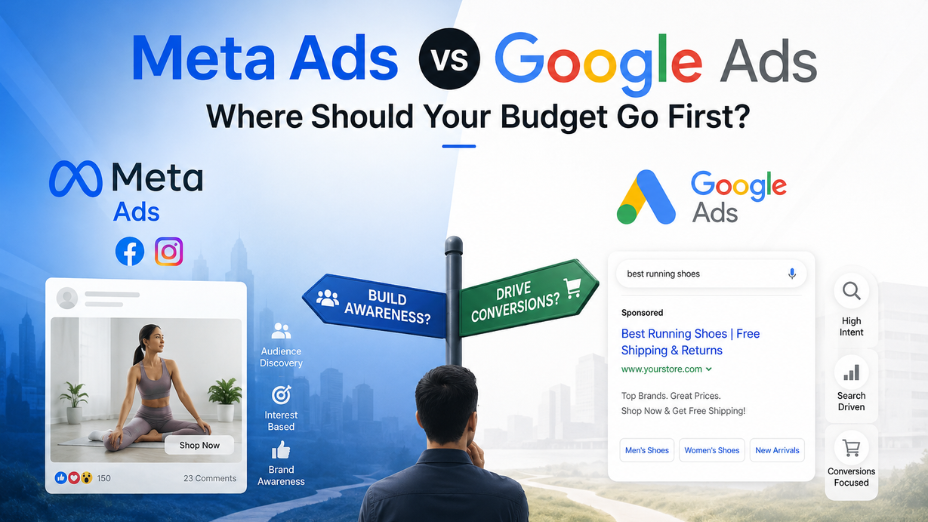
Deciding where to allocate your initial ad spend between Facebook ads vs Google ads is one of the most critical growth decisions your business will make. For founders, e-commerce brands, and marketing leaders, choosing the right primary channel directly impacts your initial acquisition costs and overall profitability. While both platforms offer massive reach, they solve two fundamentally different marketing problems: capturing active search demand versus generating new interest. This guide breaks down how both paid channels operate, compares their strengths, and gives you a clear framework to fund the right platform first for maximum ROI.
Before comparing platform features, you need to understand how user mindsets differ across each ecosystem.
When someone uses Google, they are actively looking for a solution. They open a tab, type a query, and expect an immediate answer or supplier. This is intent-based search. When you bid on Google Ads, you pay to place your business right in front of a user who is already standing at the cash register with their wallet out.
When someone opens Instagram or Facebook, they are looking to be entertained or informed. They are scrolling through feeds, watching reels, and catching up with friends. Bidding on Meta Ads relies on pattern interruption. You are stepping into their personal feed with visual storytelling to capture attention and spark a demand that did not exist five seconds ago.
Put simply: Google Ads captures existing demand. Meta Ads creates new demand.
Google Ads remains the gold standard for reaching customers who know what they want and need it right now. The platform spans multiple formats, including Google Search Ads, Google Shopping, Performance Max, and YouTube.
Meta Ads (encompassing Facebook and Instagram) gives advertisers access to unmatched user demographic data and visual placement options.
When evaluating Facebook ads vs Google ads, evaluating key performance metrics side-by-side helps clarify which channel fits your current growth stage.
|
Metric / Dimension |
Google Ads |
Meta Ads (Facebook & Instagram) |
|
Primary User Mindset |
Active intent (Searching for a solution) |
Passive discovery (Scrolling for entertainment) |
|
Best Used For |
Capturing ready-to-buy traffic |
Building brand awareness & creating new demand |
|
Targeting Mechanism |
Keywords, search phrases, user context |
Demographic data, user behavior, interest clusters |
|
Average CPC |
Moderate to High |
Low to Moderate |
|
Creative Requirements |
Minimal (Text-heavy Search ads) |
Heavy (High-quality video, lifestyle graphics) |
|
Retargeting Effectiveness |
Strong across Google Display & YouTube |
Exceptional across Facebook & Instagram feeds |
|
Scalability Limit |
Restricted by keyword search volume |
Broad audience size with creative iterations |
To avoid burning capital, choose your initial paid acquisition channel based on your specific business model and current market awareness.
You should prioritize Google Ads if your business falls into any of these categories:
You should prioritize Meta Ads if your business meets these criteria:
Treating Facebook ads vs Google ads as a rivalry misses the bigger growth picture. The most profitable performance marketing campaigns do not choose between them permanently; they integrate both into an omnichannel acquisition engine.
Here is how a balanced growth funnel operates:
Building this cross-platform funnel requires structured tracking and creative alignment. You can discover more about our unified approach through our social media marketing services and integrated search acquisition strategies.
Choosing between paid search and paid social requires balancing data, creative assets, and unit economics. We at GBIM take a performance-first approach to paid media management, ensuring every marketing dollar spent works toward clear financial goals.
Our team helps businesses build scalable acquisition engines by:
If you are looking to scale your organic search authority alongside your paid campaigns, explore our full suite of performance-driven SEO and digital marketing solutions or visit GBIM to see how we help brands turn paid media spend into predictable revenue.
Meta Ads generally offer lower cost-per-click rates than Google Ads, but Google Ads often yield higher immediate conversion rates due to active user search intent.
A focused starting budget allows you to gather statistically significant data on a single platform within 30 days before scaling spending.
Yes, combining Meta Ads for top-of-funnel brand discovery with Google Ads to capture search demand creates a highly effective cross-channel funnel.
Google Ads is usually better for immediate B2B search demand, while Meta Ads works well for retargeting and distributing long-form content to decision-makers.
Unlike organic search optimization, paid campaigns generate immediate traffic upon approval, though campaign optimization usually takes 2 to 4 weeks of testing.
Partnering with an experienced performance marketing team prevents budget waste on wrong targeting, ineffective landing pages, and poor ad structure.
309, Rupa Solitaire,
Sector-1, Millennium Business Park,
Mahape, Navi Mumbai,
Maharashtra (400 710), INDIA.
Write to us at
hr@gbim.com