
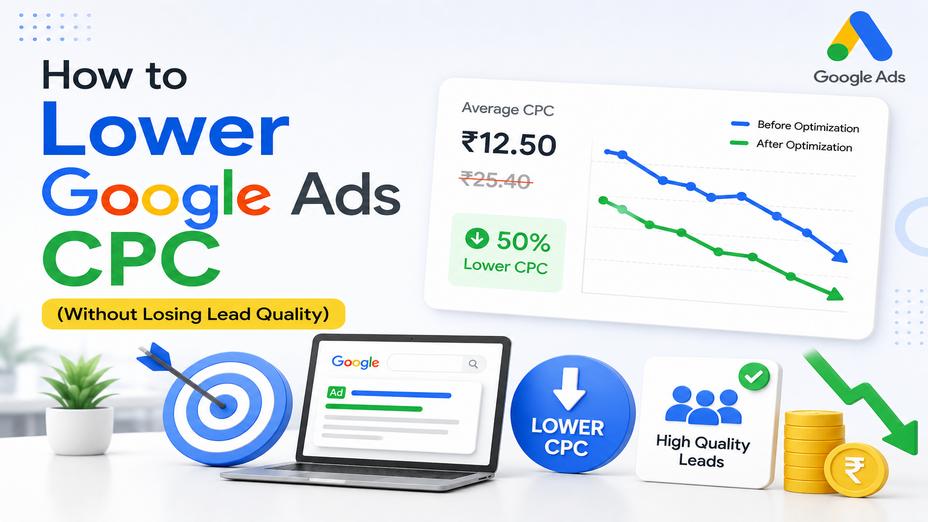
Learning how to reduce Google Ads cost without sacrificing lead quality is critical for business owners, growth marketers, and campaign managers struggling with rising CPCs. Google Ads optimization is the practice of refining your keywords, ad relevance, bidding strategies, and landing pages to lower your cost per click while attracting high-intent buyers. By eliminating wasted ad spend on irrelevant search terms and improving your Quality Score, you can stretch your marketing budget further and acquire qualified leads for less. You are in the right place to discover proven, actionable strategies that cut acquisition costs without compromising campaign revenue.
When cost per click (CPC) steadily rises, the knee-jerk reaction for many advertisers is to reduce daily budgets or pause high-performing campaigns altogether. Unfortunately, slashing budgets without addressing underlying inefficiencies simply cuts off your pipeline of qualified leads.
Lowering your ad spend effectively is not about doing less. It is about removing the friction and wasted budget that inflate your cost per acquisition (CPA).
Google operates on an auction system, but bid amount is only half the equation. If your campaign costs are climbing faster than your conversions, one of three common issues is usually at play:
When you fix these structural flaws, you can achieve better ad placements while actually paying less per click than your competitors.
Google assigns every keyword a Quality Score from 1 to 10 based on expected click-through rate (CTR), ad relevance, and landing page experience. Higher Quality Scores earn higher ad positions at significantly lower prices.
To raise your scores quickly:
A jump in Quality Score from 5 to 8 can reduce your actual cost per click by up to 30% without changing your targeting.
The single fastest way to stop wasting money in Google Ads is by applying robust negative keywords. Every time your ad shows for an irrelevant query, you risk paying for a click that will never convert.
Review your search terms report weekly. Add the following query types to your negative list:
Broad keywords like "digital marketing" or "plumbing services" carry heavy competition and high prices. Switching a portion of your budget to long-tail keywords lowers competition while capturing users who are ready to take action.
For instance, replacing a generic phrase with a high-intent variation like "B2B PPC management agency in Mumbai" drastically cuts irrelevant clicks. Readers searching specific phrases are further down the purchase funnel and convert at much higher rates.
Not all locations or devices deliver equal value. Running blanket campaigns across all regions often burns budget in areas where your conversion rates are weak.
Analyze your historical campaign data:
Many advertisers focus solely on reducing CPC, but the real end goal is lowering your cost per acquisition (CPA). If your landing page converts 4% of visitors instead of 2%, you effectively halve your lead cost even if your CPC stays identical.
Focus your conversion rate optimization (CRO) on these fundamentals:
Combining strong landing page design with advanced strategies outlined in our guide on Performance Max campaign optimization helps keep total marketing overhead low.
Even when using phrase match or exact match, Google's "close variants" system can introduce unwanted search queries into your account.
Set aside time each week to review your active search terms. If you notice Google matching your exact keywords to distant synonyms, add those specific misalignments as exact-match negatives. This keeps your ad spend focused strictly on profitable search intent.
Automated bidding strategies like Target CPA or Target ROAS can dramatically streamline management, but only when supplied with accurate conversion data.
If you use Smart Bidding:
|
Strategy Focus |
Primary Action |
Impact on Account |
|
Quality Score Boost |
Align ad headlines directly with keyword intent |
Lower CPC up to 30% for same positions |
|
Negative Keyword Audits |
Eliminate non-converting and generic search terms |
Prevents 15% to 30% of wasted monthly ad spend |
|
Long-Tail Keyword Shift |
Target multi-word commercial intent queries |
Increases conversion rate while reducing bid competition |
|
Geo & Device Adjustments |
Trim bids on poorly performing locations and devices |
Reallocates budget to highest-converting segments |
Managing Google Ads efficiently requires constant vigilance, technical expertise, and deep analytics tracking. Without active governance, ad platforms tend to expand broad match reach and inflate daily spend.
We at GBIM bring over eighteen years of performance marketing expertise to help businesses scale sustainably. As a trusted Google Ads agency, we specialize in restructuring underperforming accounts, removing wasted spend, and building reliable lead generation engines.
Our team helps clients:
Our services support businesses across industries in achieving lower acquisition costs while expanding their market share through strategic PPC management.
Quality Score improvements and negative keyword additions can begin lowering your average CPC within 1 to 2 weeks of implementation.
Not if you focus on eliminating wasted spend first. Removing irrelevant clicks allows you to reallocate budget toward high-converting search queries.
A Quality Score of 7 to 10 is considered strong and earns bid discounts, while scores below 5 result in financial penalties and higher CPCs.
CPC spikes are usually caused by new market competitors, dropped Quality Scores, or budget leaking into unmonitored broad match keywords.
Manual bidding gives you tighter control during initial cleanup, while Target CPA or Target ROAS works best once you have established 30+ monthly conversions.
High-spend accounts should review search terms every 2 to 3 days, while lower-volume campaigns should audit reports weekly to add negative keywords.
309, Rupa Solitaire,
Sector-1, Millennium Business Park,
Mahape, Navi Mumbai,
Maharashtra (400 710), INDIA.
Write to us at
hr@gbim.com