
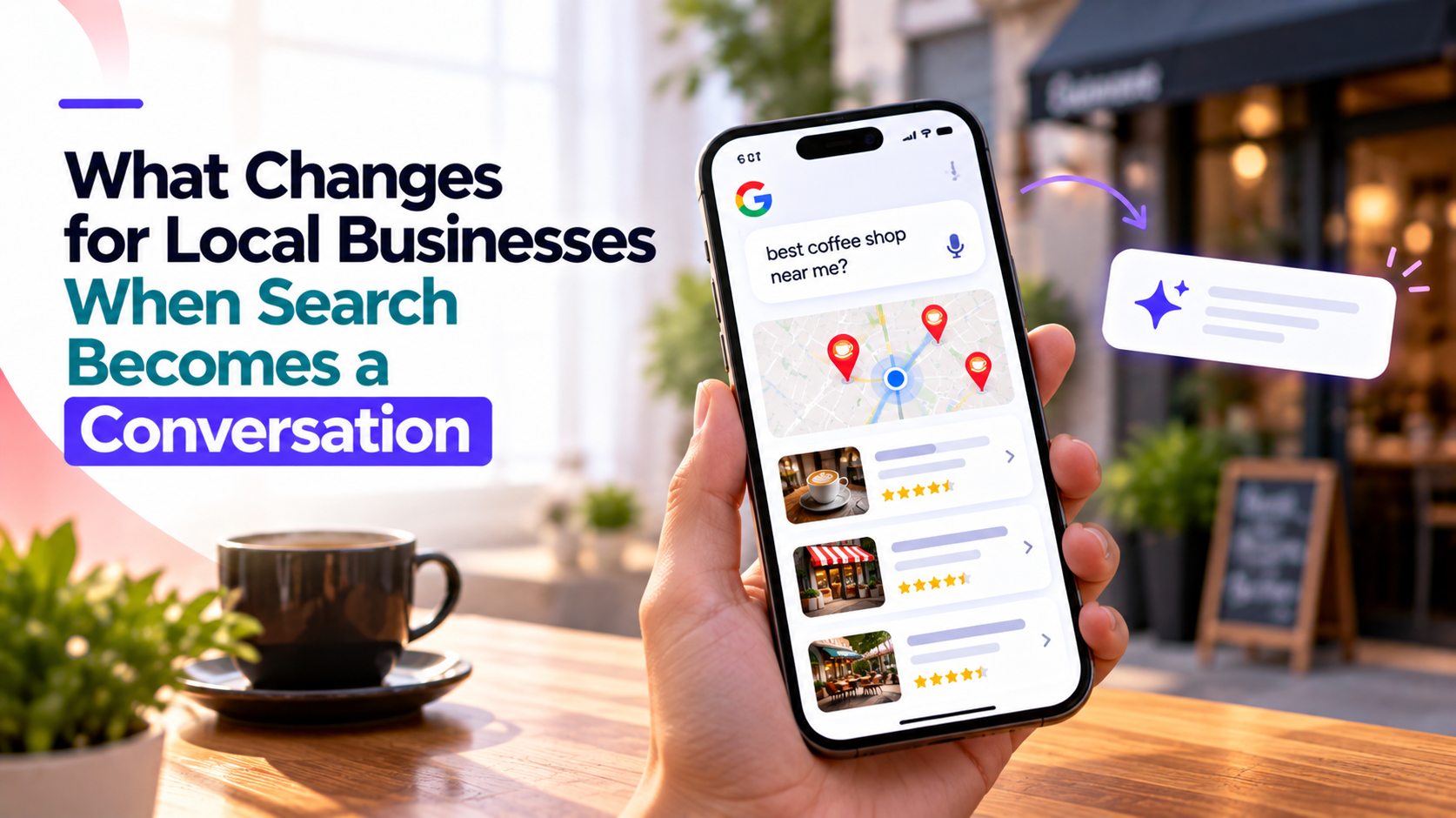
A customer needs a plumber. The search phrase several years ago may have been solely “best plumber near me.”
Now they might ask, "Who is a good plumbing company in my area that will fix a leaky kitchen pipe today and has positive reviews from their customers?"
The difference may seem like a trivial one, but for the search engine, it means something else. This is no longer a match against a short term and a list of links. It must infer the situation, location, need and purpose all at once.
This is why local seo ai search 2026 is crucial for companies that have a physical address or a specific service area. Local search isn't gone. It's slowly getting more natural.
Traditional local search trained businesses to think in short queries:
A user performed a search, read Maps or local results, opened some profiles, read reviews, and may have even visited a website before contacting you.
That journey still exists.
What is changing is what can happen before the customer clicks.
Google's AI Mode works best for longer and more complex questions, such as local recommendations. Google is also adding Ask Maps, which will allow users to ask conversational questions on places, rather than repeatedly navigating through the filters and conducting separate searches.
The search engine is increasingly helping with the comparison itself.
Consider these two searches:
Traditional query:
“coffee shop near me”
Conversational query:
“Find a quiet coffee shop nearby that would work for a client meeting, has good reviews, and is open this afternoon.”
The second query contains several conditions.
The system may need to understand:
For a local business, that creates a different visibility challenge.
Simply being associated with a broad keyword may not communicate enough.
A traditional local SEO page might make the core service and location perfectly clear. That remains important.
But conversational discovery creates more context.
A person looking to find a restaurant might want to consider outdoor tables. A customer looking for a salon may specify a particular service. A person looking for an accountant might need a specific sort of business.
This translates to making vital data easy to locate and comprehend on websites and business profiles in this context.
Think beyond:
What do we do?
Also make clear:
This does not mean writing hundreds of pages for every imaginable conversational query. It means reducing ambiguity.
AI search might seem new, but many of the elements that enable a search engine to understand a local business are common.
Accurate business details still matter.
Google's local business documentation illustrates how information like business hours or any other business information can be shared with Google.
For business owners, the practical checklist is surprisingly ordinary:
That is, local SEO ai search 2026 doesn't need to discard the local SEO playbook. It requires making that playbook work for richer questions.
For businesses looking to audit their foundations, a good place to begin is with our local SEO services and approach, which includes the optimization of Google Business Profile, local keyword strategy, location pages and structured local information.
Reviews have always been important because they are used by customers to rate a business.
They can be more useful in conversational discovery.
Suppose there are two restaurants with same location, ratings and hours of operation. One is often mentioned as good for family dinners, and another is often stated to be good for fast lunches.
Those details are a lot more context than a simple star rating can give.
When answering questions about places, Google says that Ask Maps uses information about hundreds of millions of places and reviews contributed by users.
The lesson here is not to censor or influence reviews, or ask customers to write a certain way. It is meant to encourage true feedback and to continue to engage in good feedback.
Using real customer language can bring to light details of the business which a standard description does not include.
There is an easy mistake businesses can make here.
If searches are getting more specific, should they all be 3,000 words long for every local landing page?
No.
The more words the more meaning is not.
A local page should be helpful to a visitor in determining if the business is right for them.
|
Weak local content |
More useful local content |
|
Repeats the city name constantly |
Explains the actual service area |
|
Lists broad services |
Clarifies individual services |
|
Uses generic marketing claims |
Provides specific business information |
|
Creates near-identical city pages |
Adds genuinely location-relevant details |
|
Writes only for keywords |
Answers likely customer questions |
The objective is clarity rather than volume.
This also explains why traditional SEO remains part of the picture. A technically accessible website with clear pages gives search systems better material to interpret. Businesses competing in dense markets can see how these fundamentals connect through our SEO services in Mumbai.
Location remains critical.
What changes is everything surrounding the location.
Instead of:
“dentist near me”
someone can describe what they need, when they need it, what matters to them, and then continue the conversation with follow-up questions.
That shifts the focus of local optimization from keyword to information quality.
For businesses thinking about local seo ai search 2026, a useful test is simple:
If a search system had to explain your business to someone without relying on your homepage headline, would it have enough clear information to do so?
If the answer is uncertain, there is probably work to do.
Start with the basics before chasing new AI optimization tactics.
Review your business as though the search engine knows nothing about it.
Can it clearly determine your location? Are your services separated and explained? Are business hours current? Does the website answer practical customer questions? Are important details consistent across your online presence? Are location pages useful content or just a city name replacement?
Google has also been introducing guidelines for businesses to appear in its AI search, and it's saying that there's nothing complicated in terms of special coding or AI tricks.
That's a helpful viewpoint.
The technology around search is changing quickly. The need to provide accurate, accessible, trustworthy information is much less exotic.
The local customer has not stopped wanting the closest useful answer. They simply have better ways to explain what “useful” means.
This drives companies to make themselves more customer and machine friendly.
We’re here to support businesses in building local search foundations that drive that visibility at GBIM, ranging from location strategy and local content to Google Business Profile and all things local search optimization. As conversational search evolves, we continue to prioritize maintaining those core elements that align with how customers are finding and assessing local businesses.
No. AI-powered search changes how people can ask questions and how information may be presented, but businesses still need accurate location, service, website, and business-profile information.
Google's current guidance says businesses do not need special AI-only technical tricks simply to participate in AI Search. Standard SEO practices, accessible content, and accurate business information remain important.
No. Location intent remains highly relevant. The difference is that users can now combine location with much more context, such as opening times, requirements, preferences, and follow-up questions.
They should answer genuine customer questions clearly, but they do not need a separate page for every possible query. Useful service pages, location information, FAQs, and accurate business details can cover many real customer needs.
Yes. Business information continues to support discovery across Google Search and Maps. Keeping details accurate and current remains an important local-search foundation.
Start with clarity. Check your business information, services, location or service areas, opening hours, website structure, local pages, and customer-facing information before looking for more advanced AI-search tactics.
309, Rupa Solitaire,
Sector-1, Millennium Business Park,
Mahape, Navi Mumbai,
Maharashtra (400 710), INDIA.
Write to us at
hr@gbim.com