
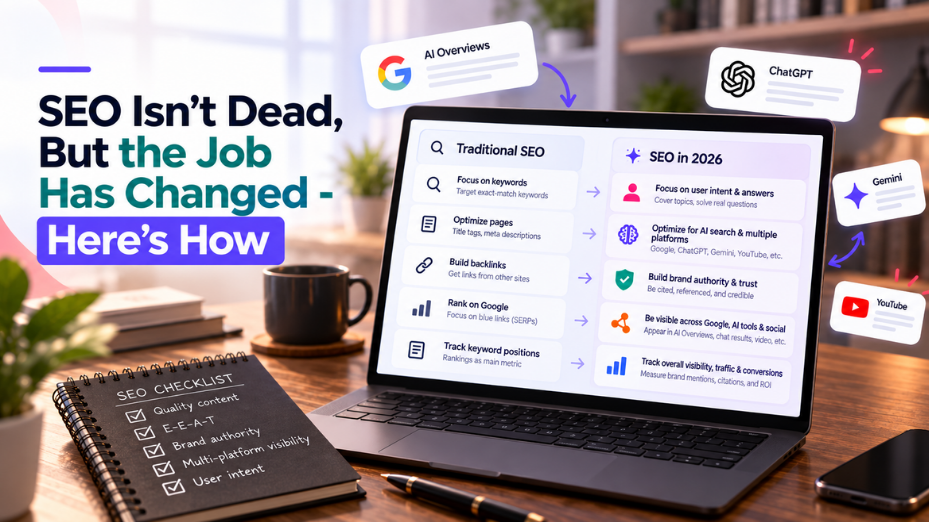
Every few years, something arrives that is supposed to kill SEO. Social media was going to do it. Voice search was next. Then came zero-click results. Now, AI Overviews and conversational search have produced perhaps the strongest version of the argument yet.
So, is SEO still relevant 2026? Yes, but not because there is no change. Quite a lot has.
Users are now able to get a summary upfront on a search results page, follow a search query as an ongoing conversation; and research complex questions without having to click on ten different links. Google's AI Overviews has surpassed two and a half billion MAUs and AI Mode has reached one billion, the company reports.
The error is to think that this indicates that there is a decline in the need for search optimization.
It means the job has changed.
The line between a search engine and an AI assistant is getting harder to see.
Google has incorporated AI Overviews, AI Mode, follow-up questions, more conversational queries, and increasingly agentic features into Search. In 2026, Google also described AI-powered Search as its biggest upgrade in more than 25 years.
That changes how someone might research a topic.
A user once searching:
“best CRM for small business”
might now ask:
“What should a 20-person B2B company look for in a CRM if the sales team is remote and we need simple reporting?”
That is still a discovery problem. It is simply a much richer one.
For businesses, the question therefore moves beyond, “Can this page rank for a keyword?”
It becomes:
The fundamentals behind SEO have not vanished. The environment around them has expanded.
This part of the “SEO is dead” argument should not simply be dismissed.
Zero-click behavior is real, and AI-generated answers can make it unnecessary to visit a website for certain questions.
A 2026 study using browsing data from a representative panel of 900 U.S. adults found that searches displaying AI Overviews were associated with fewer clicks and a greater likelihood of the browsing session ending on the search page. It also found clicks on sources cited directly within AI Overviews were rare in the observed data.
That matters.
If a user requires a short fact, a conversion or a date to be added to the website, the search interface might be able to meet the requirement immediately.
Not all searches have a solution, however.
There's still a need for original research, clear explanations, products, professional services, tools, demonstrations, comparisons, first-hand experiences, and actual businesses which can help solve the problem.
In 2026, Google itself kept rolling out various in-line links, article recommendations, website views, Preferred Sources, and more to link AI-search users with websites.
The challenge now isn't getting all the clicks you can.
It is becoming worth clicking when the user needs to go further.
Keywords remain useful because they reveal the language people use when looking for information.
What has weakened is the idea that a page succeeds simply because one exact phrase appears enough times.
Search systems have become much better at interpreting context and increasingly complicated questions. AI Mode, for example, is specifically designed to handle longer and more nuanced queries and follow-up questions.
That pushes content toward a more useful standard.
Businesses should not create a page around a single keyword and regurgitate it, but they must grasp the underlying issues of a query.
A strong page may need to answer:
This is one reason asking is SEO still relevant 2026 misses part of the bigger change. Search optimization is becoming less about optimizing isolated phrases and more about making genuinely useful information discoverable and understandable.
Not every old SEO habit deserves to survive.
Some approaches are increasingly difficult to justify:
|
Losing relevance |
Becoming more important |
|
Writing pages primarily around exact-match keywords |
Covering the actual search intent |
|
Publishing generic summaries |
Adding original experience and useful detail |
|
Measuring success only through rankings |
Looking at visibility, qualified traffic, leads, and conversions |
|
Creating near-identical pages at scale |
Building distinctive, useful resources |
|
Treating SEO as only blue-link optimization |
Considering traditional and AI-powered discovery |
|
Chasing every algorithm rumor |
Building technically sound, genuinely useful websites |
This doesn't mean that all traditional SEO techniques are outmoded.
Technical accessibility remains important. Internal linking is still important. The structure of pages is important, even when they are helpful. Webpages have to be found, indexed, and comprehended by search engines.
Google's own explanation of how Search works remains unchanged, stating that crawling, indexing and serving search results are the basics of Search.
The interface is changing faster than those underlying needs.
In the past, on a few occasions, SEO could be seen as a fairly contained channel: keywords, pages, links, rankings, traffic.
That boundary is becoming less useful.
The scope of modern search visibility is becoming more and more intertwined with content strategy, brand authority, the quality of technical websites, structured information, digital PR, user experience, and AI discoverability.
One good mental note to take for the transition is:
Old question:
“How do we rank this page?”
Better question now:
“How do we make this business discoverable and credible wherever search systems help customers research this problem?”
That can still involve a conventional organic result.
It might also mean appearing as a source within an AI-generated response, being discovered during a much longer research journey, or earning the click when a user decides that an AI summary is not enough.
Businesses therefore need to watch actual search changes rather than react to dramatic headlines. Instead of pronouncing any channel "dead" after major Google algorithm updates, it is much better to assess the impact of the changes for specific channels.
Keep the basics that remain the same and then adjust the amount of measurement and content.
Build content around real decisions.
Answer the questions customers ask before they contact, compare, buy, or shortlist.
Give search systems something worth referencing.
It's more difficult to replace other generic summaries with original examples, clear explanations, first-hand expertise, useful data, and specific insights.
Strengthen technical foundations.
If search systems don't find or understand a valuable page, then it can't perform well.
Measure beyond rankings.
Qualified enquiries, conversions, branded search, visibility and visitor quality towards important pages are also helpful areas to consider in terms of what is considered to be useful for organic sessions.
Expect search behavior to keep changing.
The current AI-search interface will not necessarily be the final one. Google was still changing link presentation and publisher controls throughout 2026.
For organizations unsure where those changes leave their existing strategy, working with an experienced SEO consultant can also help separate meaningful shifts from temporary noise.
The better answer to is SEO still relevant 2026 is not “SEO is exactly the same as before.”
It clearly isn't.
Some searches can be met with AI-generated answers without visiting the website. Queries are getting longer and more naturalistic. Traditional rankings now compete for attention with summaries, recommendations, follow-up questions, and other search features.
But businesses still need to be discovered when people investigate problems, evaluate options, and decide whom to trust.
That makes search visibility different, not irrelevant.
At GBIM, we take a holistic perspective to SEO, keeping that larger search journey in mind. We work with businesses to fortify the fundamentals that remain relevant and keep up with how people discover and assess information these days. If your organic strategy is about the search you had yesterday, we can help you determine what the real changes need to be.
Yes. Search behavior has changed significantly, but people still use search systems to research questions, products, services, and businesses. The focus is increasingly on useful content, technical quality, authority, and visibility across both conventional and AI-powered search experiences.
They can reduce clicks for some searches, particularly when users can obtain the information they need directly from the results page. Independent 2026 research found lower click behavior associated with searches displaying AI Overviews. However, the effect can vary depending on the query and what the user needs to accomplish.
Google is increasingly combining the two rather than treating them as completely separate experiences. AI Overviews, AI Mode, conversational follow-ups, web links, and conventional results are becoming parts of a broader search experience.
Yes, but keyword repetition alone is not an SEO strategy. Keywords remain useful for understanding demand and the language searchers use, while the page itself should satisfy the broader intent behind those searches.
Rankings and organic traffic remain useful, but they should be considered alongside qualified enquiries, conversions, branded searches, engagement with important pages, and overall search visibility. The right metrics depend on what the website is expected to achieve.
The biggest strategic change is moving from optimizing solely for traditional search-result clicks toward optimizing for broader discovery. Businesses need content and websites that remain understandable, credible, and useful whether the customer encounters them through a standard result or an AI-assisted research journey.
309, Rupa Solitaire,
Sector-1, Millennium Business Park,
Mahape, Navi Mumbai,
Maharashtra (400 710), INDIA.
Write to us at
hr@gbim.com