
Sixty-five percent is the kind of number that can change a media plan before anyone asks what it actually measures.
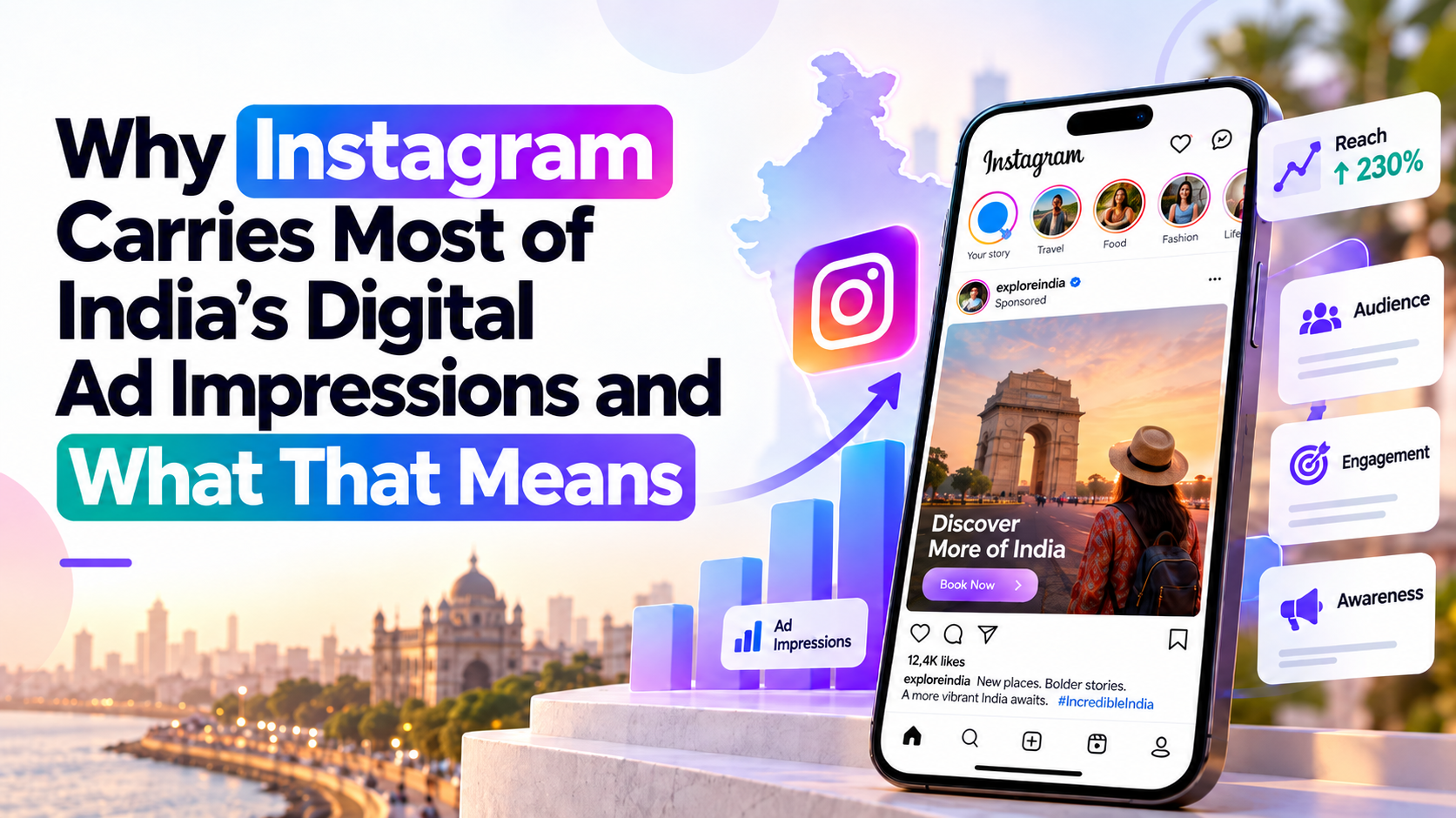
According to TAM AdEx data for 2025, Instagram accounted for 65% of digital ad impressions among the web publishers covered in the report. Facebook followed at 14%, while YouTube accounted for 8%. For marketers tracking instagram ad share india, the headline is hard to ignore. But “Instagram is huge” is not the most useful takeaway. The more important question is what such heavy concentration means for brands deciding where their next customer will come from.
The answer is more complicated than simply moving more advertising onto Instagram.
The TAM AdEx findings show just how heavily digital advertising impressions have shifted toward Instagram. Digital ad impressions overall also increased sharply in 2025, reaching more than 2.5 times their 2024 level, according to reporting on the study.
Another eye-catching figure was programmatic buying made up 95.8% of digital ad impressions in the data set. Around 83% of the impressions were displayed as single images, only 10% were video ads.
Put together, the picture looks something like this:
|
2025 indicator |
Reported figure |
|
Instagram share of impressions |
65% |
|
|
14% |
|
YouTube |
8% |
|
Programmatic share |
95.8% |
|
Single-image creative |
83% |
|
Video creative |
10% |
These numbers describe impression volume, not business outcomes. An impression is an opportunity for an ad to be seen. It does not automatically represent attention, engagement, a lead, or a sale.
That distinction matters.
There is no single explanation, but audience scale is part of it.
Meta's advertising tools indicated that Instagram had around 481 million users in India in late 2025. Its potential advertising reach was equivalent to roughly 46.8% of India's internet user base, according to DataReportal's Digital 2026 India analysis.
Scale, however, is only one part of Instagram's appeal.
The platform combines several things advertisers want in one environment:
A fashion brand can launch a product on a Reel and drive the recognition with a second ad and follow the product journey with more social touch points.
This makes Instagram simple for marketers to put in the center of a more extensive social media marketing strategy.
But easy to use is not the same as safe to depend on.
This is where the instagram ad share india discussion becomes more strategically useful.
When a platform has the ability to deliver huge reach, the adverts naturally gravitate towards them. Over time, however, the same strength can create concentration risk.
Imagine that 70% of a company's social leads come from one platform.
The results may look excellent today. But what happens when audience behavior changes? What if creative fatigue appears? What if the brand needs to reach people in a different context?
The issue is not that Instagram is somehow a bad channel.
The issue is dependency.
A strong advertising strategy should distinguish between:
Channel performance: Is Instagram currently producing the outcome we want?
and
Channel resilience: Would our marketing strategy still be successful if Instagram didn't work for our target users?
They are very lot of different questions.
This is probably the most important interpretation of the data.
Market share is not a media-planning instruction.
A platform with a large number of impressions on its own, does not necessarily deserve the right to the same amount of resources from every company.
Consider three businesses:
All three can advertise digitally. Their ideal channel mix, however, could look completely different.
The right question is not:
“Which platform has the most impressions?”
It is:
“Where is their attention when they are listening to our message?”
That is where paid social advertising must go beyond platform popularity and focus on users' actions, goals, and outcomes.
Instagram's scale should not make the rest of the digital landscape invisible.
Facebook still made up 14% and YouTube 8% of impressions in the TAM AdEx findings. There was a smaller, but more dispersed, group of other publishers.
Raw impression share doesn't capture all of the motivations that a marketer might have for selecting a channel.
Youtube may serve a different purpose once people are actively consuming demonstrations, reviews or educational material. When it comes to B2B targeting and professional context, LinkedIn can come in handy. Search advertising can connect with people who are already looking for something via a search query.
Audiences are not the same on every social media platform, even within the social media sphere.
This is why “be everywhere” and “put everything into Instagram” are both weak strategies.
The better approach is selective diversification.
There is no obligation for marketers to add additional platforms. They must be able to grasp the functionality of the current platforms.
Start with four questions:
Identify the channels that introduce new people to the brand.
Look at where users research, compare, watch, read or return before acting.
Separate reach and engagement from enquiries, qualified leads, purchases or other relevant actions.
This is the stress test.
If losing one channel would remove most of your customer acquisition pipeline, diversification deserves attention even when that channel is currently performing well.
The instagram ad share india figure tells marketers something important about where enormous advertising exposure is currently being generated. It does not provide any specific guidance to a single business on what the optimum media mix should be.
Instagram should be taken seriously due to its reach and the many ways there are to connect content, creators and advertising for brands. But even when there's a big audience reach, it's important to consider how that audience will fit with the campaign and what results it will actually drive for the business.
The strongest media plans are not built by following the largest number on a market report. They are built by understanding what that number means for a particular audience.
At GBIM, we consider social advertising as a component of a bigger customer journey and see one platform as only one of many options. We educate brands on where they're being seen, what each channel is delivering and where a more even balance in the digital realm can yield best returns in terms of sustainable, stronger growth.
TAM AdEx reported that Instagram accounted for 65% of digital ad impressions among the web publishers measured for 2025. The figure should be understood within the scope of that dataset rather than interpreted as 65% of every form of advertising in India.
Instagram combines large audience reach with visual content, short-form video, creators and paid advertising. Meta's advertising tools indicated around 481 million Instagram users in India in late 2025, helping explain the platform's potential scale for advertisers.
Not based on market share alone. The appropriate channel mix depends on the target audience, customer journey, campaign objective and measurable performance of each channel.
Yes. In the same TAM AdEx data, Facebook represented 14% of digital ad impressions. Whether it is valuable to a particular brand depends on its audience and campaign goals.
Channel concentration happens when a business relies heavily on one source for reach, leads or sales. It can make customer acquisition more vulnerable if performance, audience behavior or platform conditions change.
Diversification should be purposeful rather than simply adding more platforms. Brands can identify where discovery, consideration and conversion happen, measure the role of each channel, and then build a mix that reduces unnecessary dependence without spreading resources too thin.
309, Rupa Solitaire,
Sector-1, Millennium Business Park,
Mahape, Navi Mumbai,
Maharashtra (400 710), INDIA.
Write to us at
hr@gbim.com