
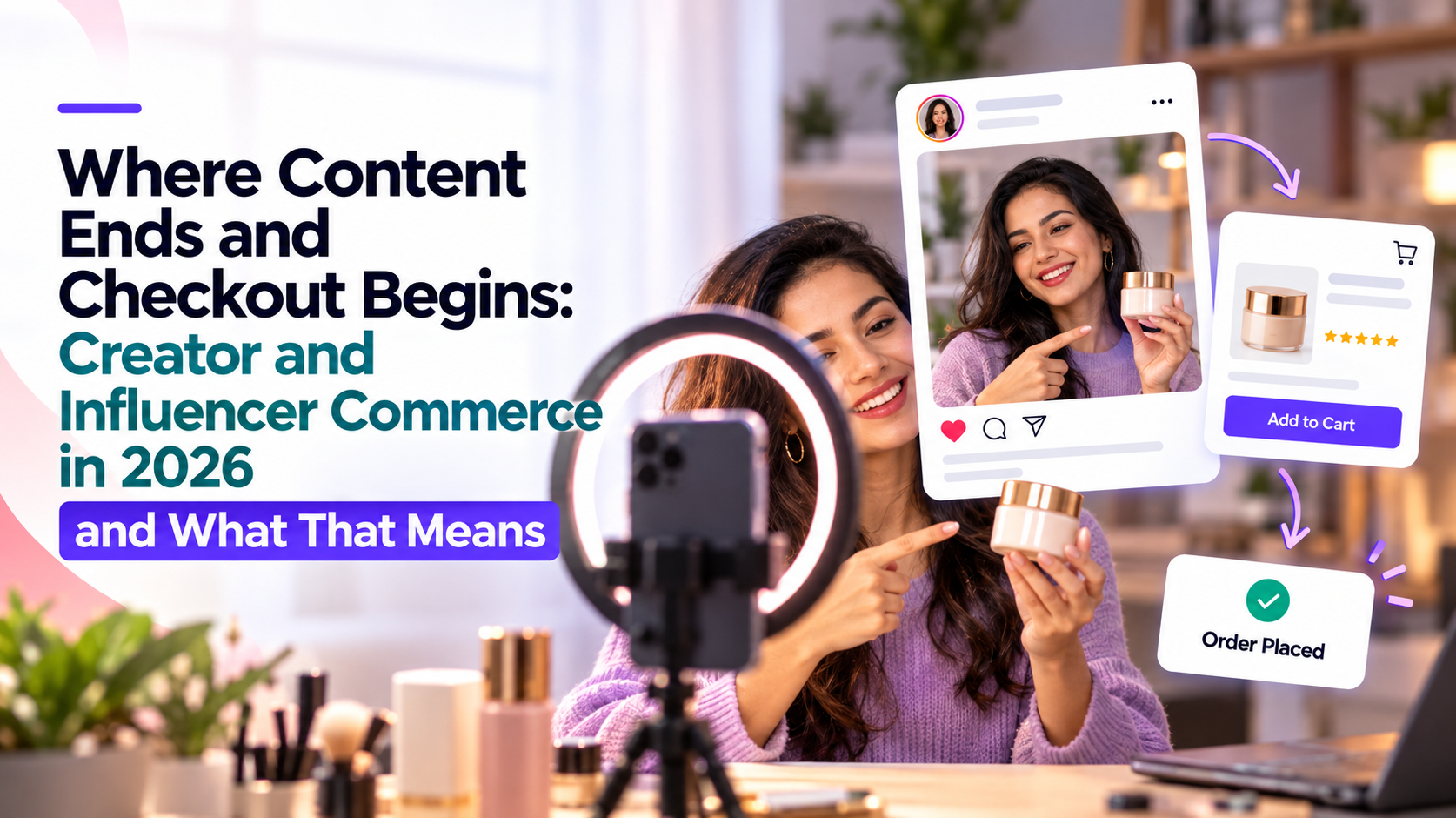
A creator creates a video that lasts 30 seconds showing a product that they actually use. You watch it, check the comments, tap the product, look at a few details and move closer to buying it. There may be no separate Google search, no visit to the brand’s social profile and no obvious moment when “content” turns into “shopping.”
That blurred line is one of the defining influencer commerce trends of 2026.
Creator marketing is no longer limited to awareness at the top of the funnel. Short-form video, product tagging, affiliate tools, live shopping and conversational commerce are pulling discovery and purchase much closer together. In India, Meta describes the shift as moving from a traditional search-and-transaction journey toward a scroll-led discovery ecosystem influenced by creators, video, AI and messaging.
For brands, that changes a fairly basic question: Where does marketing stop and commerce begin?
Increasingly, there isn't a clean answer.
For years, digital marketing could be mapped into relatively neat stages.
|
Earlier journey |
Emerging creator-led journey |
|
See an advertisement |
Discover a product naturally in content |
|
Search for the brand |
Watch the creator explain or demonstrate it |
|
Visit the website |
Check comments, reviews or tagged products |
|
Compare products |
Move between social, search and the store |
|
Decide to purchase |
Buy through the most convenient available route |
The older journey has not disappeared. Users continue to compare, search and read reviews, as well as visit the ecommerce website.
The distance between those activities has changed.
Now, a shopper can see a product as they are watching entertainment, learn how it works by a creator demonstration and begin the journey to purchase without having to go through the actions as discrete steps.
That makes creator commerce more than influencer marketing with a "Buy" button added.
This is where it all usually starts in traditional ecommerce.
A person comes to the realization they require running shoes, skin care, kitchen storage, or a new phone. They look for alternatives and begin to make comparisons.
Creator-led commerce can reverse that sequence.
The product is available before the shopper actively looks for it.
This will be very effective if the content provides context for the product. Instead of seeing a polished product image, someone may see:
That context can make creators valuable not simply because they have audiences, but because they can demonstrate products in situations that feel closer to everyday use.
Recent Indian retail research also suggests the increasing linkage between social discovery and shopping. Short-form video and creators are becoming an integrated part of the product discovery and purchase journey, but brands need to note that the numbers come from a study linked to Meta.
For businesses building an influencer marketing strategy, the question is now: "How many people did this creator reach through this content?".
It becomes: What happened after people paid attention?
Consider what normally happens when someone likes a product in a video.
They remember the name. Search for it. Find the correct product. Visit the store. Locate the same variation. Then decide whether they still want it.
Each additional task provides another chance to drop out on the journey.
The shoppable content aims to speed up that process.
Product tags and links can be related to the item being discussed directly with the product information or a location to buy it. Meta, for instance, made announcements of tools for creators that will enable them to create shoppable discovery moments using catalog products or product links in Reels in 2026.
Not all content needs to be a sales post.
If all recommendations sound 'salesy', the creator may risk losing the integrity that made the partnership useful.
When there is a real commerce opportunity with low friction, then there is a next step that is easy to find.
The concept goes further with live shopping as the content and buying dialog can take place concurrently.
Let's say someone is thinking about a bag in a live stream.
They are interested to see if a laptop will fit into it.
They may be able to inquire from the creator directly, rather than leaving it up to them to seek out the specifications and solve the problem. The creator may display the compartment, provide the answer to the question and proceed to demonstrate the product.
This gives live commerce an unusual mix of:
It will not suit every business or every audience. But it illustrates why creator commerce deserves to be considered separately from ordinary social posting.
This is where some of the excitement around influencer commerce trends needs a reality check.
A persuasive video cannot repair a weak buying experience.
A creator might generate interest, but shoppers can still disappear when they encounter:
That means creator commerce cannot operate in isolation.
The content may start the journey, but the ecommerce environment still has to finish it.
This is also where ecommerce SEO remains relevant. Creator discovery does not eliminate search. A customer that initially encounters a product through creator content might subsequently look into the brand, make comparisons, look for reviews, or return via Google before making a decision.
Discovery channels are not merely replacing each other but are in fact increasing in number.
Sometimes it was easy to speak about the creator campaigns, with traditional social metrics: followers, comments, likes, views and reach.
Commerce creates harder questions.
Did viewers explore the product? Did the content generate qualified traffic? Did certain creators repeatedly introduce customers who later converted? Did people discover through social but complete the journey through search or another channel?
A simple framework can help brands separate the signals:
Not every useful creator interaction will receive perfect attribution. Somebody may view today, look for the brand the following week and buy it later.
That makes it harder to measure but if you pretend the creator has only added the last click then it isn't as accurate as it is.
The most significant modification might be conceptual.
Brands used to be content makers with the purpose of capturing attention and driving people to go somewhere else.
Creator commerce allows some of the evaluation process to happen inside the content itself.
The video can demonstrate.
The creator can explain.
The comments can provide additional questions and reactions.
The product link can provide the next step.
The website can validate the decision.
Search can support further research.
Messaging can be used to follow up on the conversation.
Instead of questioning who 'owns' the customer, businesses must grasp the interplay of those touchpoints.
The bottom line here is that the current influencer commerce trends are not a call to action for every company to adopt live shopping or hundreds of creators.
Rather it's the fact that the distance between marketing content and shopping behaviour is closing.
Brands should start by asking:
Those questions are more useful than chasing for the latest fad in social-commerce.
At GBIM, we consider creator activity not as a standalone social initiative, but rather an integral component of our digital journey. We work to bridge the gap between the amount of visibility a business gains and their content and ecommerce plan, ensuring that the attention that's produced is put to good use.
Influencer commerce is the use of creator or influencer content to support product discovery, evaluation and purchasing. It can involve product links, affiliate content, tagged products, livestreams and other formats that connect creator content with a shopping journey.
Influencer marketing can have many objectives, including awareness, reach and brand engagement. Creator commerce focuses more directly on how creator content contributes to product discovery and movement toward a transaction.
Not exactly. Social commerce is the broader use of social platforms as part of shopping and selling. Live commerce is one format within that ecosystem, where products are demonstrated or discussed during a livestream while viewers can interact in real time.
No. Creator content may introduce someone to a product, but that person can still use search to investigate the brand, compare products, read more information or return later. Social discovery and search can influence different stages of the same purchase journey.
Brands can examine content reach and engagement alongside product interactions, qualified website visits, inquiries, assisted conversions and other actions relevant to the buying journey. The useful metrics depend on what role the creator is expected to play.
Not necessarily. The fit depends on the product, audience, platform and way customers normally make decisions. Brands should first understand where creators genuinely influence their customers rather than adding shopping features simply because they are available.
309, Rupa Solitaire,
Sector-1, Millennium Business Park,
Mahape, Navi Mumbai,
Maharashtra (400 710), INDIA.
Write to us at
hr@gbim.com