
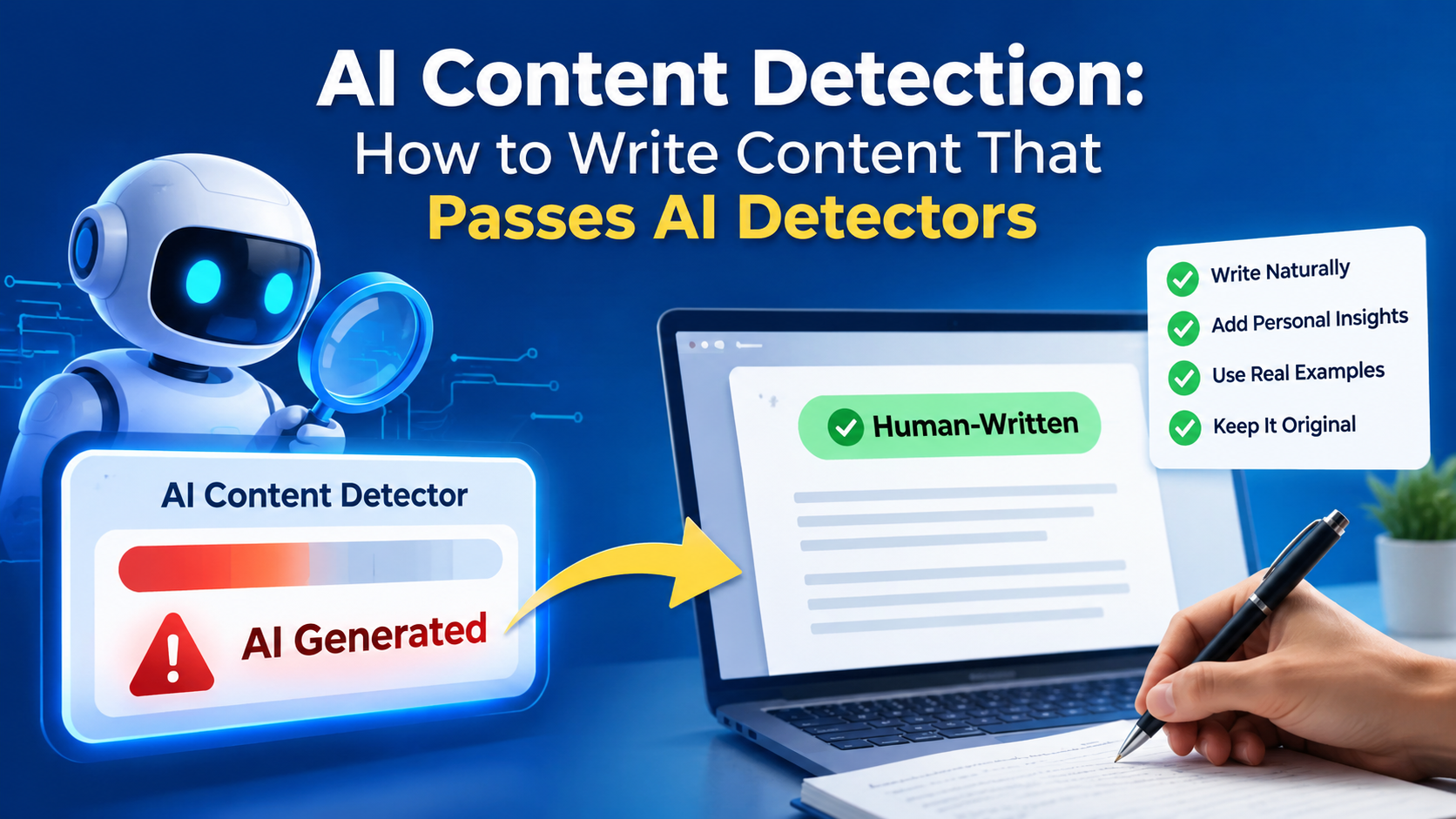
If you're searching for how to make AI content sound human, you're probably facing a common problem. AI tools can produce content quickly, but the output often feels repetitive, predictable, or overly polished. Readers notice it. Search engines are getting better at recognising it. AI detectors often flag it.
The solution isn't to "trick" AI detectors. It's to create content that genuinely reflects human expertise, experience, and intent. Whether you're a business owner, marketer, publisher, or SEO professional, this guide explains how to create content that feels natural, builds trust, and performs well in both traditional search and AI-powered search experiences.
Most AI-generated content shares similar characteristics because language models are trained on predictable writing patterns.
Common signs include:
None of these necessarily make the information incorrect. The issue is that the writing lacks personality, depth, and real-world context.
Modern AI detection tools analyse patterns rather than looking for specific words. The more predictable your writing becomes, the easier it is to identify.
Many people assume human content simply means adding contractions or changing a few words.
It goes much deeper than that.
Content written by experienced professionals usually includes:
This is exactly what search engines increasingly reward.
As AI search continues evolving, authority comes from demonstrating experience rather than simply publishing more words.
There isn't a single trick that works.
Instead, focus on improving the writing itself.
AI should support research, not replace it.
Before writing, ask:
Adding original insights immediately separates your content from thousands of AI-generated pages.
Human writers rarely write in perfectly balanced paragraphs.
Instead they naturally:
For example:
Instead of writing:
Content optimisation is important for businesses.
Write:
A page can rank well and still generate very few enquiries. In many cases, the issue isn't visibility. It's that the content answers search engines better than it answers real people.
Notice the difference.
The second version sounds like someone who's actually worked on websites.
AI often explains what something is.
Humans usually explain:
This additional context creates authority.
One of the easiest ways to improve AI-generated writing is by changing its rhythm.
Instead of repeating:
Mix the format naturally.
Use:
Short paragraphs.
Questions.
Examples.
Longer explanations where needed.
It feels much more natural to readers.
Examples immediately increase credibility.
For instance:
Instead of saying:
Businesses should optimise their content.
Say:
A local dental clinic may need pages answering treatment questions, while a SaaS company benefits from comparison guides and implementation tutorials. The strategy changes because search intent changes.
Specific examples make content feel authentic.
Many businesses copy AI-generated content into another AI tool hoping it will become "human."
Unfortunately, this usually creates:
Detection tools analyse writing patterns, not just vocabulary.
Human editing requires judgement.
That includes:
That's where genuine value is created.
Search engines do not automatically penalise AI-generated content.
What matters is quality.
Helpful content generally demonstrates:
Low-quality AI content usually struggles because it offers nothing beyond what already exists online.
As AI-powered search becomes more common, answer engines increasingly favour content that demonstrates topical authority, clear structure, and trustworthy information.
At GBIM, AI is part of the workflow, not the writer.
Every project follows a structured content process.
We begin by understanding:
Instead of creating generic outlines, we develop content around:
This is where the biggest difference happens.
Every draft is reviewed for:
Sections are rewritten where necessary instead of simply paraphrased.
Our content supports visibility across:
Because the future isn't just about rankings.
It's about becoming the source AI systems choose to reference.
Businesses that invest in genuinely useful content often experience:
The goal isn't simply to pass AI detectors.
The goal is to create content people actually want to read.
Avoid these shortcuts if you want your content to feel genuinely human.
AI creates a starting point.
It should never be the final version.
No detector is perfectly accurate.
Improving writing quality is far more valuable than trying to achieve an arbitrary percentage.
Search engines increasingly understand topics rather than exact keyword repetition.
Focus on answering complete user questions.
Content without real expertise becomes interchangeable.
Experience is difficult for competitors and AI tools to replicate.
This approach is valuable for:
Any organisation that relies on trust can benefit from improving content quality.
Businesses work with GBIM because we combine AI efficiency with experienced human strategy.
Rather than producing high volumes of generic articles, we focus on content that:
Our approach fits naturally with today's evolving search landscape, where credibility matters as much as visibility.
Learning how to make AI content sound human is no longer just about passing detection tools. It's about producing content that earns attention, answers real questions, and reflects genuine expertise.
We at GBIM help businesses develop content strategies that combine AI-assisted efficiency with human judgement, SEO expertise, and AI Search optimisation. Our team focuses on creating helpful, authoritative content that supports long-term visibility across both traditional search engines and emerging AI platforms.
No. Google evaluates content based on quality, usefulness, and value rather than whether AI assisted in creating it.
Add original insights, practical examples, varied sentence structures, and expert editing rather than relying on automated rewriting.
Not always. Most detectors estimate writing patterns and can produce false positives or false negatives.
Yes. Human editing improves clarity, accuracy, originality, and trustworthiness while removing repetitive AI patterns.
High-quality, experience-driven content generally performs better because it better satisfies user intent and demonstrates expertise.
No. AI is valuable for research and drafting, but human expertise should shape the final content.
AI-powered search systems increasingly prioritise authoritative, well-structured, trustworthy content when generating answers and citations.
309, Rupa Solitaire,
Sector-1, Millennium Business Park,
Mahape, Navi Mumbai,
Maharashtra (400 710), INDIA.
Write to us at
hr@gbim.com