
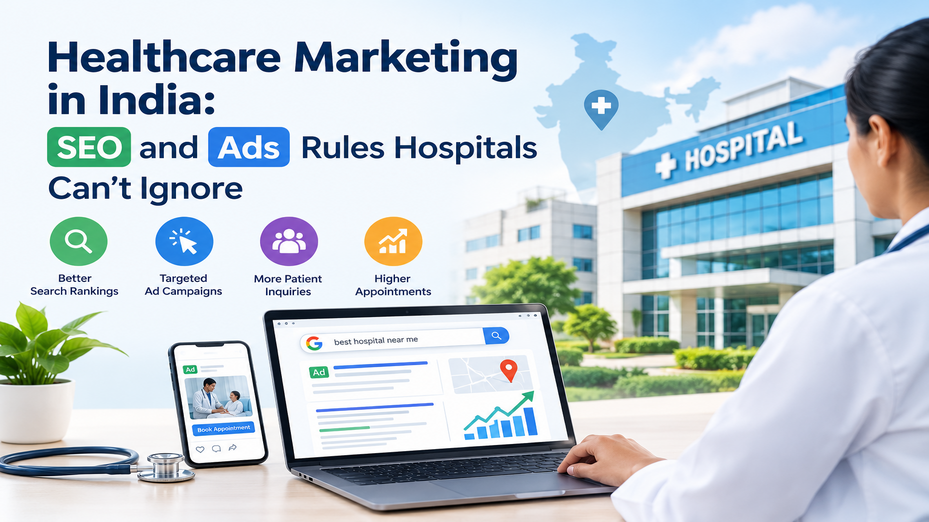
For a hospital, digital marketing is not simply about getting more traffic or filling appointment forms. A patient may search for a specialist, compare hospitals, read reviews, check credentials and only then decide where to call.
That makes digital marketing for hospitals different from marketing an ordinary consumer service.
There is another complication: healthcare advertising has less room for careless claims. Medical information needs to be accurate, advertising needs to respect applicable rules, and Google applies its own restrictions to healthcare and medicines advertising. A campaign that works perfectly for real estate or ecommerce can create serious problems when copied into healthcare.
Here is what hospital marketing teams need to get right in 2026.
Hospital digital marketing covers the online activity used to help patients discover, evaluate and contact a healthcare provider.
It can include:
But the objective should not be reduced to "more leads."
For a hospital, the more useful question is:
Are we helping the right patient find the right service at the right point in their decision?
At GBIM, we approach healthcare marketing around that journey. Our broader digital marketing framework looks at visibility, trust, search intent, conversion and data before deciding where marketing activity needs to improve. See our digital marketing services.
This sounds obvious. It still gets overlooked.
Healthcare content should not promise outcomes that cannot be substantiated. Be particularly careful with phrases such as:
The problem isn't only credibility. Indian law restricts certain misleading advertisements relating to drugs and prohibits false or misleading claims about drugs under the Drugs and Magic Remedies (Objectionable Advertisements) Act, 1954.
The Consumer Affairs Department also publishes the Guidelines for Prevention of Misleading Advertisements and Endorsements for Misleading Advertisements, 2022.
For a hospital marketing team, the practical rule is simple:
If a medical claim cannot be verified and approved internally, don't put it into an ad or landing page.
Marketing teams should also establish an internal medical review process. Doctors or qualified subject matter experts should review clinical content before publication where appropriate.
Healthcare SEO needs a different editorial standard.
A page targeting "cardiologist in Mumbai" should help a patient understand the service, the doctor, the hospital, the location and the next step.
A page created simply to repeat "best cardiologist in Mumbai" twenty times is unlikely to create much trust.
Build useful pages around actual patient intent:
Service searches
"cardiology hospital in Mumbai"
"orthopaedic treatment near me"
Doctor searches
"cardiologist in Navi Mumbai"
"oncologist consultation"
Condition searches
"signs of heart disease"
"when should I see an orthopaedic doctor?"
Location searches
"multispeciality hospital near me"
"emergency hospital in [location]"
At GBIM, our SEO services include website and SEO audits, keyword strategy, industry analysis, strategy development and implementation. For healthcare, the aim is to connect search demand with accurate, genuinely useful information.
A large hospital may offer dozens of departments and hundreds of procedures.
Putting everything on one page creates a poor experience for both patients and search engines.
Create dedicated pages for important services and specialties.
A strong department page should explain:
The same principle applies to doctor profiles.
A doctor page should clearly communicate qualifications, specialty, areas of practice, experience and the hospital connection without turning the profile into exaggerated promotional copy.
For hospitals and clinics, location can be as important as medical specialty.
Someone searching for "emergency hospital near me" is not researching healthcare in the abstract. They need a nearby option.
Your local presence therefore needs attention.
Keep your Google Business Profile accurate. Check:
For multi-location hospitals, each location needs its own accurate local information.
GBIM's recent healthcare work also reflects the importance of local search. Our local SEO services can be used to improve local visibility, location relevance and search journeys for healthcare businesses.
This is where hospital marketing teams need to slow down before launching campaigns.
Google has specific policies for healthcare and medicines. Some healthcare-related content is restricted, some requires certification, and some categories cannot be advertised. Google also expects ads and landing pages to follow applicable laws and industry standards.
For India specifically, Google's current policy allows certain healthcare advertising with restrictions. Prescription drug services have additional requirements, and advertisers promoting such services in India must meet Google's certification requirements. Google states that prescription drugs cannot be promoted in ads or landing pages in India.
That means the campaign review should cover more than the ad headline.
Check the:
Ad → keyword → landing page → website content → targeting → healthcare category
A compliant headline can still lead to a problematic destination.
Healthcare advertising sits close to people's anxiety.
That makes fear-based messaging tempting. It also makes it risky.
Avoid copy that unnecessarily frightens people into booking an appointment.
Instead of:
"Ignoring this symptom could put your life at risk."
A more responsible approach might be:
"Persistent symptoms can have different causes. Speak with a qualified specialist if you're concerned."
The second statement gives the reader a next step without pretending to diagnose them through an advertisement.
Good healthcare marketing should reduce uncertainty, not manufacture it.
Patients look at reviews before choosing healthcare providers.
But review management needs care.
Don't manufacture reviews. Don't alter patient feedback to make it sound better. Don't pressure patients into providing a particular type of testimonial.
Build a process for requesting genuine feedback and responding professionally.
A negative review doesn't always need a defensive response. A simple acknowledgement and an appropriate invitation to resolve the issue privately can be more useful.
Healthcare content is one area where publishing quickly can backfire.
A blog about diabetes, fertility, cancer treatment or cardiac symptoms should not be treated like a generic marketing article.
The content team can handle research, structure, SEO and editing. But clinical accuracy needs qualified review.
Useful healthcare content can include:
The best content answers a real patient question without pretending to replace medical advice.
GBIM already works across healthcare categories. Our published case studies include NYUCC, Genext Genomics, Vasudha Life Science, Medicare Vacation and Revital Trichology. See our healthcare case studies.
For example, GBIM's current case study page reports a 40% increase in patient inquiries for NYUCC, a 67% increase in organic users for Genext Genomics and a 22% conversion uplift for Revital Trichology. These are project-specific results, not promises of what every healthcare campaign will achieve.
An agency cannot build an accurate healthcare campaign from a logo and a list of services.
The hospital should provide:
That last point matters.
Healthcare content often requires multiple stakeholders. If medical, legal and marketing approvals aren't defined early, campaigns can become slow and inconsistent.
At GBIM, we bring SEO, paid advertising, content, social media, website development and performance marketing into one strategy rather than running each channel separately.
For a hospital, that can mean identifying why a service page isn't getting visibility, improving the search journey, building location-focused pages, creating educational content, developing compliant campaign messaging and tracking what happens after a patient enquiry.
Our approach starts with understanding the business, audience and goals before developing the strategy. That fits healthcare particularly well because the marketing problem isn't always "we need more traffic."
Sometimes the hospital already has traffic but poor appointment conversion.
Sometimes a high-value department has almost no organic visibility.
Sometimes paid campaigns generate enquiries that the sales or appointment team cannot use.
Sometimes the website has good clinical information but makes booking unnecessarily difficult.
The solution depends on the gap.
Traffic alone isn't enough.
Track the metrics that connect marketing with patient journeys:
|
Metric |
What it tells you |
|
Organic visibility |
Whether patients can find services |
|
Qualified enquiries |
Whether targeting is relevant |
|
Appointment requests |
Whether intent is turning into action |
|
Cost per enquiry |
Paid acquisition efficiency |
|
Department-wise leads |
Which services attract demand |
|
Call conversions |
Offline response to online activity |
|
Location performance |
Which areas generate demand |
|
Landing page conversion |
Whether the website supports action |
This is where analytics becomes useful. A hospital shouldn't simply ask which campaign generated the most leads. It should ask which campaigns generated the right patient enquiries for the services being promoted.
Digital marketing for hospitals can improve visibility, patient education and appointment journeys, but healthcare cannot be marketed with the same shortcuts used in less sensitive industries.
Claims need evidence. Content needs clinical oversight. Ads need policy checks. Local information needs to be accurate. Patient trust has to come before aggressive conversion tactics.
At GBIM, we build healthcare marketing around those realities. Our work combines SEO, paid media, content, local visibility and conversion strategy, while our healthcare case studies give us experience across different medical categories.
The objective isn't simply to make a hospital appear everywhere online.
It is to make the right service easier to find, easier to understand and easier to trust.
Hospitals can use digital marketing, but healthcare advertising must comply with applicable Indian laws, professional requirements and platform policies. Specific services and claims may have additional restrictions.
Yes, but Google applies healthcare and medicines policies. Certain healthcare categories require certification or have additional restrictions. Prescription drug advertising has specific India requirements.
Any result claim should be accurate, supportable and appropriate for the service being promoted. Avoid guaranteed outcomes or claims that cannot be substantiated.
SEO can help patients discover hospital departments, doctors, treatments and location-specific services when they are actively searching. It works best when pages genuinely answer those searches.
Useful content includes treatment explainers, procedure guides, doctor interviews, patient preparation information, FAQs and educational resources that have been reviewed for medical accuracy.
The agency needs accurate service information, doctor details, locations, approved creative assets, target audiences, campaign objectives, previous performance data and an internal process for medical and compliance review.
At GBIM, we combine SEO, Google Ads, content marketing, social media, local search, website and conversion work based on the hospital's specific growth gap. We also have published healthcare case studies across areas including fertility, genomics, pharma, medical tourism and trichology.
309, Rupa Solitaire,
Sector-1, Millennium Business Park,
Mahape, Navi Mumbai,
Maharashtra (400 710), INDIA.
Write to us at
hr@gbim.com