
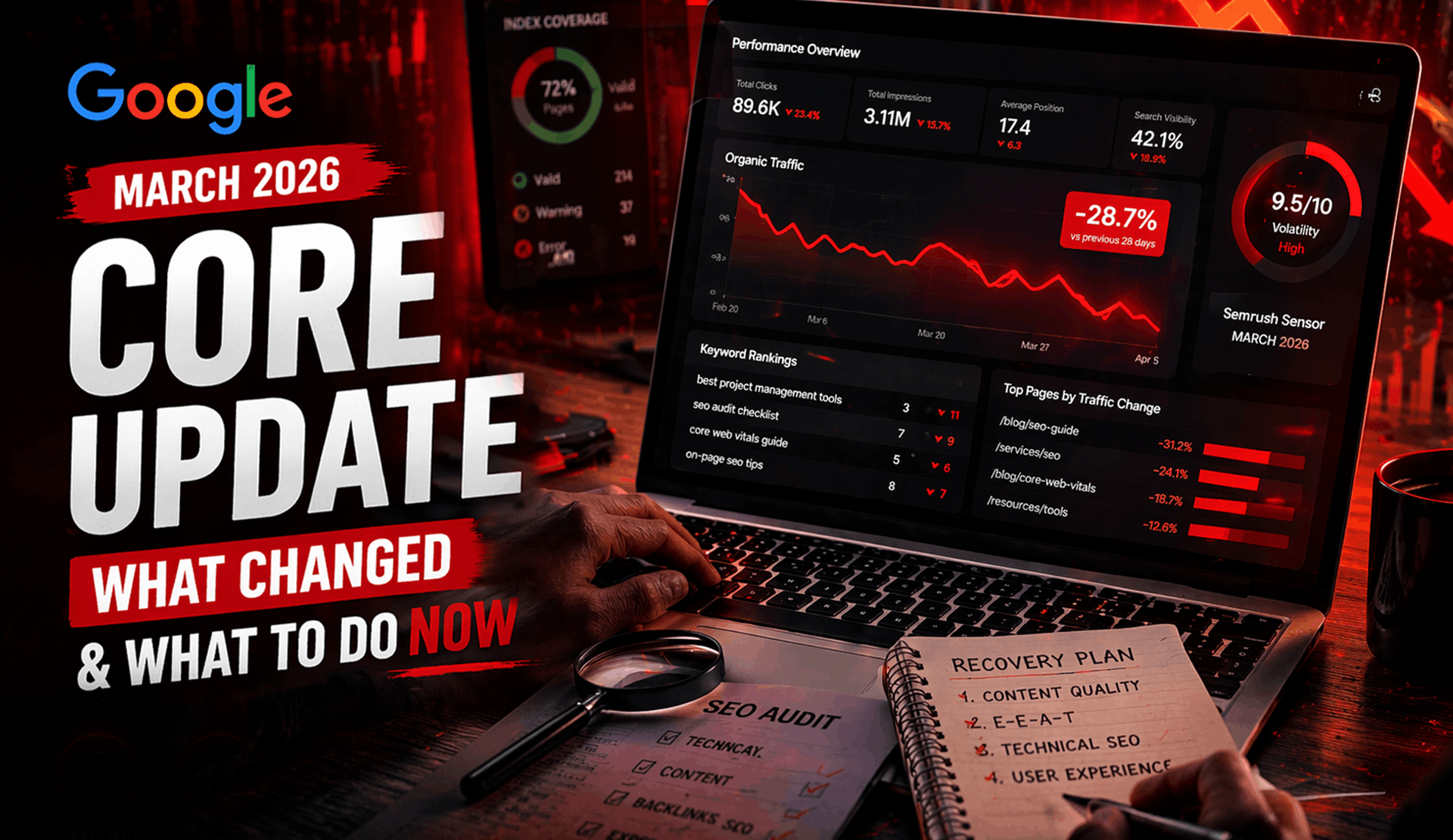
You checked your analytics this week and something felt off. Traffic dipping. Rankings sliding on pages that had been holding steady for months.
Here is the uncomfortable truth: most site owners will spend the next two weeks fixing the wrong things. This blog tells you exactly what the Google March 2026 core update actually changed, why your site may have dropped, and what to do about it in plain, practical terms.

Google dropped three algorithm changes in under a month. All three are overlapping in your data right now, which is why diagnosis matters before action.
Google's first-ever Discover-only update. It targeted clickbait headlines and syndicated filler content. Major publishers reported 40% plus drops in Discover traffic if their headlines did not match their actual content.
Completed in under 20 hours, the fastest spam update on record. It cleared out mass-produced AI content, manipulative link schemes, and what Google calls "parasite SEO," which is low-quality content piggybacking on high-authority domains.
The big one, still propagating as of today. Semrush Sensor hit 9.5 out of 10 volatility. Over 55% of monitored websites saw ranking changes within the first two weeks. Some sites lost 20 to 35% of organic traffic in the first week alone.
You can track the official rollout status on Google's Search Status Dashboard. Do not make large-scale changes until rankings stabilize around mid-April. Acting mid-rollout makes it impossible to know what is working.
Google does not publish a changelog for core updates. But the ranking patterns across thousands of sites tell a consistent story.
For years, the SEO playbook said write something more comprehensive than the top ten results. Google has now identified this approach as "regurgitated content" and is actively demoting it.
The new standard is originality, not length. Your page must contribute something that genuinely cannot be found elsewhere: proprietary data, first-hand case studies, original research, or a specific expert perspective. Pages that simply reorganise existing information with better formatting are losing ground fast.
This update deploys Google's most advanced AI model to determine whether a page was created to help a real person or to manipulate a search ranking. It looks for a genuine "human footprint": nuance, personal specificity, and formatting that serves the reader rather than the crawler.
Unedited bulk AI content is being demoted at an unprecedented rate. AI used as a writing tool with genuine human expertise layered on top is performing fine. The line Google draws is about intent and substance, not the production method.
E-E-A-T (Experience, Expertise, Authoritativeness, Trustworthiness) has always mattered. This update enforces it at the individual page level, not just across the domain.
Author bios are no longer optional metadata. They are active ranking infrastructure. Google is cross-referencing author bylines with external professional signals. Pages attributed to "Admin" or "Staff Writer" on YMYL topics (health, finance, real estate, legal) are among the hardest hit. First-person language and specific professional examples are now meaningful signals, not just stylistic choices.
When content quality is equal, technical performance determines who wins. INP measures how quickly your page responds when a user clicks or taps. Google's threshold is under 200ms. Currently 43% of sites fail this standard. If your site feels slightly laggy on mobile, this matters alongside your content work.

Before rewriting a single page, open Google Search Console and go to Performance > Search Results. Compare March 27 onwards against the previous four weeks. If clicks and impressions dropped specifically around March 27 to 28, this update is your cause.
The three most common reasons sites dropped:
The content is long but says the same things as every other article on the topic. There is zero Information Gain. Google has seen it before and is choosing pages that add something genuinely new.
Publishing YMYL content without a named, credentialed author is now a direct ranking liability. If neither readers nor Google can verify who wrote something and why they are qualified, that page is vulnerable.
Sites covering too many unrelated topics are losing topical authority. A business blog that writes about digital marketing, kitchen appliances, and travel cannot be seen as an expert in any of them. Niche depth now outranks broad volume.

Recovery from a Google core update is not about patching a bug. It is about demonstrating that your site is a genuinely useful and trustworthy resource. Follow this in sequence.
Identify your top 20 pages with the steepest drops. For each one, ask: could an AI have written this entire piece without real-world experience? If yes, it needs work.
Add at least one proprietary asset to each priority page. An original chart, a specific client example, a team insight, a direct quote from an industry professional. Ensure the primary question is answered in the first 100 words. Google's own helpful content guidance emphasises answering the user's question directly and completely.
Create dedicated author bio pages for every contributor. Link them to LinkedIn profiles, professional certifications, and any external publications where the author has appeared. Implement Author and Organisation Schema using JSON-LD structured data so Google's Knowledge Graph can formally associate expertise with your content. Ensure your About and Contact pages contain verifiable details, not just a generic form.
More pages is not more authority. If your site has 400 blog posts but only 60 get meaningful traffic, the remaining 340 thin posts are likely pulling down your overall quality signal.
Merge smaller related articles into comprehensive, well-structured guides with a proper redirect. Remove outdated content that no longer serves a real reader in 2026. Raising the minimum quality floor across your entire site consistently outperforms improving only your top pages.
Run your site through Google PageSpeed Insights and target these three numbers:
You can also check your Core Web Vitals directly inside Google Search Console under the Experience section. Technical fixes can show results in 4 to 8 weeks, faster than content improvements which are typically recognised at the next core update.

The Google algorithm update India impact has been particularly significant in B2B, real estate, healthcare, and finance sectors where volume-based content strategies were common.
Hyper-local expertise is currently one of the strongest defences against core updates. A real estate firm that publishes Mumbai neighbourhood price data, RERA updates, and area-specific market analysis is far harder to displace than one writing about national real estate trends that any generic site could cover.
Niche depth beats topic breadth. Every time.

Technical improvements can show progress in 4 to 8 weeks. Content quality improvements are typically recognised at the next major core update, expected around June to July 2026. Full recovery generally takes 2 to 6 months of consistent, substantive work.
Google itself states this clearly in its core update recovery guidance: improvements may not be seen until after the next broad core update. Start the work now so your site is in a stronger position when Google reassesses it.
At GBIM, we have been navigating Google algorithm updates with clients for over 20 years. What this update confirms is what we have always held to: there are no lasting shortcuts.
Sites built on original content marketing and genuine topical authority hold steady when updates land. Sites built on volume alone feel the impact first. Our SEO services are structured around the exact signals this update rewards, and if your rankings shifted this week, we are happy to take a diagnostic look at what happened.
Early technical improvements can show in 4 to 8 weeks. Full content-level recovery typically aligns with the next core update, expected around June to July 2026.
Not inherently. Bulk AI content with no human expertise or original value is the problem. AI used as a drafting tool with genuine expert input on top is not penalised. Google's position on this is clearly stated on its Search Central blog.
No. Focus on value density. A 600-word page with original data and a named expert outperforms a 2,500-word page that restates what already exists.
Interaction to Next Paint measures how fast your page responds when a user interacts with it. Under 200ms is Google's target. It is now a meaningful tiebreaker when content quality is equal between competing pages.
Not necessarily. The rollout completes around mid-April. Early stability does not guarantee the update will not affect you as it continues propagating. Monitor your Search Console daily until then.
Stay updated on every major algorithm shift via our Google Algorithm Update page, or explore our SEO and content marketing services to build a foundation that holds through every update.
309, Rupa Solitaire,
Sector-1, Millennium Business Park,
Mahape, Navi Mumbai,
Maharashtra (400 710), INDIA.
Write to us at
hr@gbim.com