
Hundreds of people visit your website. Some will download a guide, others will subscribe to your newsletter and a few will leave you enquiries. Your sales team records customer interactions and results of your marketing effort are recorded by your marketing team.
However, can your business relate these interactions to know what customers are truly looking for?
There are a lot of companies that have information everywhere. This means that it is hard to tailor campaigns, track leads and analyze customer actions.
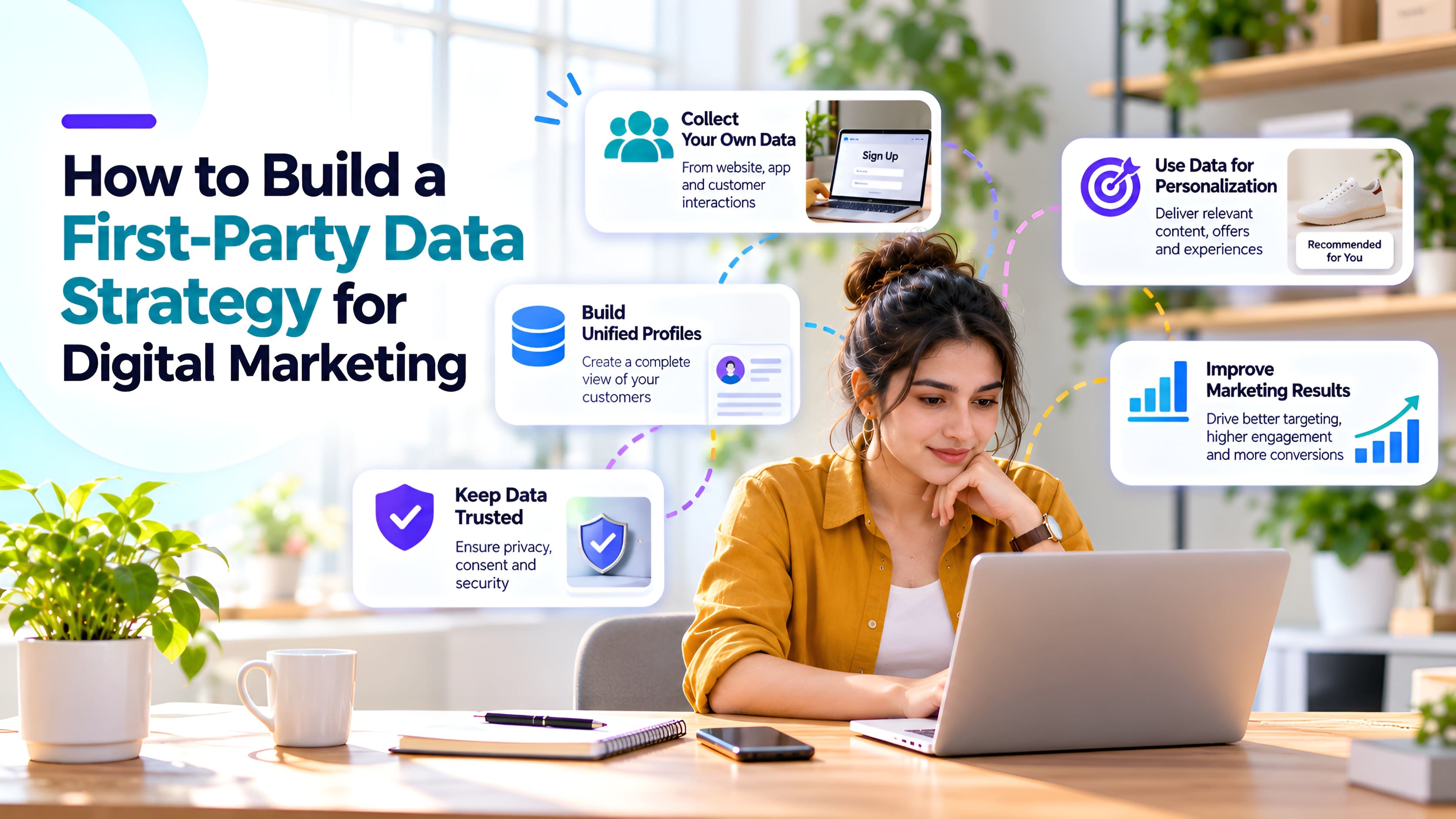
A first party data strategy for marketing helps businesses organise and use information collected directly from its customers, to improve decision making.
The focus is not about collecting all the information that you can. It is about gathering relevant information responsibly and opening it up into meaningful customer experiences.
Digital Marketing is about understanding the consumers' behaviour. But with evolving privacy expectations and the advance of browser technologies and data protection needs, responsible collection of information has never been more vital.
The first-party data can give businesses insights into customers, but not just from external sources.
It can support:
But gathering information through direct means doesn't necessarily mean that it is accurate or legally ready to be used in all marketing activities.
Customer consent, data quality and the intent of the data collection should be taken into account.
Knowing the differences allows businesses to determine what information they have and what they don't.
|
Data type |
Meaning |
Example |
|
First-party |
Information collected directly through customer interactions |
Website enquiries, purchase records |
|
Second-party |
Another organisation's first-party data shared through an arrangement |
Data shared through an authorised partnership |
|
Third-party |
Information supplied or aggregated by external providers |
Audience segments from data vendors |
|
Zero-party |
Information customers intentionally share about their preferences |
Survey answers, preferred product categories |
Zero-party data is information customers intentionally share about their preferences.
For example, shoppers may select their preferred clothing categories when registering.
The information can be utilized by businesses for pertinent reasons with proper disclosures and permissions.
Imagine a retail business in the ecommerce industry experiences a decreasing number of repeat customers.
It could be taken up by its marketing department to get more information from customers. However, there may be existing patterns that can be useful in the purchase history.
The issue may be that customers are not linked to email marketing.
Similarly, if your B2B company is receiving leads that are never relevant to them, you might need more lead qualification than lead tracking.
When developing a strategy, think about:
The following questions help to prevent unnecessary collection of data and tie the strategy in with the business objective.
The first party data strategy for marketing should be aligned to business objectives, customer information, managing and measuring the impact.
It's best to look at the channels your business is currently talking to customers through.
This can be via website enquiries, ecommerce, CRM data, newsletter sign-up, loyalty programs or customer feedback.
Make a simple inventory, listing the place where information is stored and why it was collected and who has access to it.
This way, duplicate data, missing data and missing systems can be detected.
The customer should be given reasons for asking for his/her information.
A newsletter registration, for instance, will usually ask for less details as compared to a comprehensive business consultation.
Businesses should inform and ask for consent if necessary, regarding purposes.
Organisations need to consider the Digital Personal Data Protection Act, 2023 and the DPDP Rules, 2025 and the phased implementation.
Privacy policies should be in line with the obligations, not the assumption, that data that is collected directly can be used for any marketing purpose.
Incomplete, duplicate and obsolete records are less useful to customers.
A CRM or well integrated data management system can help to maintain uniform information.
Pay attention to 5 priorities:
Businesses should also have good retention and deletion policies.
The purpose is to gain reliable information, and not a complex technology system.
Once it's structured it can be broken down into groups of people that have similar attributes and behaviours, which can then be used by businesses.
|
Customer segment |
Possible marketing activity |
|
New subscribers |
Share introductory educational content |
|
Returning shoppers |
Recommend relevant product categories |
|
Previous service enquirers |
Provide information matching expressed interests |
|
Engaged B2B prospects |
Share useful service guides or case studies |
|
Inactive customers |
Offer appropriate re-engagement communication |
The segmentation should be based on actual needs of customers.
A reader of a product article might be looking for information for a purchase, but not intending to buy right away.
Customer insights are useful when they help to make better marketing decisions.
The data gathered through relevant and appropriate means can be used by businesses to create targeted email campaigns, enhance user experience on their websites, and comprehend customer retention.
Eligible first-party audience information is also supported by some advertising platforms, in compliance with platform policies and consent requirements.
Track to ensure that these activities are not simply measuring the number of messages, but that they are achieving some useful outcome.
Different businesses have different objectives, and a multitude of different measures of each of those goals.
|
Business objective |
Useful metric |
|
Improve lead quality |
Qualified lead rate |
|
Increase customer retention |
Repeat purchase rate |
|
Improve campaign relevance |
Engagement and conversion rates |
|
Strengthen sales performance |
Lead-to-customer conversion rate |
|
Improve customer relationships |
Retention rate and feedback |
Don't assume that every improvement is due to customer data initiatives; analyse results regularly.
Other performance factors have to do with campaign quality, product relevance, customer experience.
Collecting unnecessary information: Long forms can cause customers to not complete enquiries. Ask for only specific information with a definite purpose.
Keeping disconnected customer records: Lost opportunity for sales, missed reports and inaccurate reporting because of lost customer records.
Ignoring changing customer preferences: Consent and communication options need to be taken into account at all times. Companies should honor any requesting withdrawal and make the needed changes if there is a valid request to withdraw.
To make the information more useful, it's important to solve these problems before introducing any additional marketing tools.
First-party data is worth its value because it can guide businesses to comprehend their customers' requirements, boost interaction, and make smarter marketing choices.
Best practices are a blend of clear goals, intentional information gathering, good documentation and ongoing performance monitoring.
At GBIM, we help businesses to align digital marketing efforts with tangible growth goals. Insightful digital marketing with SEO and performance marketing will create more meaningful experiences to the customer and we are committed to planning campaigns with the customer in mind to create better customer relationships.
A major component of better marketing is knowing your audience, and knowing how to market responsibly to your audience.
First-party data is information businesses collect directly through interactions with customers and prospects. Examples include website enquiries, purchase records, newsletter subscriptions and customer feedback. Its use must follow applicable privacy requirements.
First-party data comes directly from a business's own customer interactions. Third-party data is supplied by external providers that collect or aggregate information from other sources. Their collection methods, permissions and reliability may differ.
Yes. Small businesses can begin by organising existing customer records, website enquiries and newsletter subscriptions. Accurate information, clear collection purposes and relevant audience segmentation matter more than implementing sophisticated technology immediately.
It can help businesses understand customer segments, refine campaign messaging and evaluate outcomes. Certain advertising platforms support eligible customer-list audiences, provided businesses meet relevant consent, privacy and platform requirements.
No. Direct collection does not automatically make every use lawful. Businesses must consider applicable requirements concerning notices, consent or other lawful grounds, security, retention and individual rights.
Businesses should review their strategy regularly and whenever they introduce new platforms, change collection practices or expand into new markets. These reviews help maintain data accuracy, respect customer preferences and identify opportunities for improvement.
309, Rupa Solitaire,
Sector-1, Millennium Business Park,
Mahape, Navi Mumbai,
Maharashtra (400 710), INDIA.
Write to us at
hr@gbim.com