
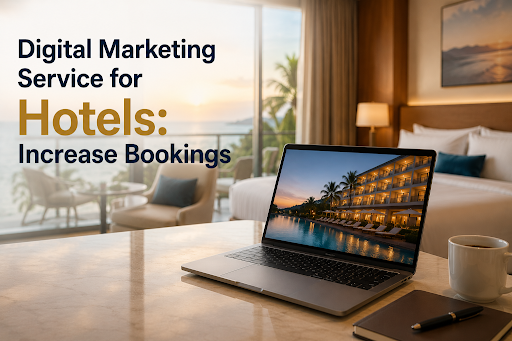
In recent years, the hospitality industry is even more competitive than ever before. Nowadays, people conduct extensive research online before booking their hotel stays, looking at all kinds of options available to them, such as booking hotels online, reading reviews, looking at pictures, and even analyzing social media accounts of hotels before making their final decision. For a hotel trying to draw more customers and make direct bookings, it is very helpful to implement an efficient digital marketing service.
The modern traveler expects convenience at every stage of the journey. Right from searching for different accommodation choices to making bookings, everything is done through an online platform. For those hotels that have a robust online presence, it becomes easier to connect with guests at the appropriate time.
An effective online marketing approach does not just revolve around the concept of having an online website. Instead, it encompasses elements such as search presence, content marketing, reputation management, paid search marketing, and social media interaction.
Today, travelers tend to research their destination places, compare hotel choices, and make reservations using their mobile phones. If the website of a hotel is slow, complicated to use, or it’s not mobile-friendly, the visitors will leave the site and won’t make any bookings. The mobile-friendly interface includes fast loading, easily readable room descriptions, ease of navigation, and the booking process. It will allow hotels to satisfy customers even during the first contact with the website and make reservations for their visitors.
Travelers usually research several accommodations before booking a particular one. If the property in question has a weak web presence or does not provide engaging content, it is unlikely to attract its target audience.
Here are some benefits of having a digital presence:
Hotels that make sure to focus on growing their online presence have a much higher chance of maintaining their occupancy rate during all periods of the year.
Search Engine Optimization (SEO) continues to be one of the most powerful methods of attracting people who search for accommodations to stay. When a hotel has an outstanding placement in search engines, it receives highly targeted traffic.
Main SEO tasks for hotels are:
Companies that manage to utilize professional SEO techniques are likely to benefit from a continuous increase in traffic and booking opportunities. For this reason, hotels incorporate SEO in their overall marketing strategy.
Content plays a key role in making travel decisions. Guests like to see what they will get in case they book the property.
A hotel can generate valuable content using:
High-quality content will allow travelers to know why the property is unique. It will also make the property more visible when people try to search for it. High-quality content can help visitors spend more time at the website, making it more likely that conversions will happen.
Hotels depend on OTAs quite often. Although such sites create opportunities for exposure, they involve commission charges, which are not good for the bottom line.
The use of an extensive digital marketing service allows hotels to make more reservations directly from their website. This way, hotels keep more control over their customer relationships and become less dependent on third parties.
The strategies for getting more direct bookings include:
These efforts work together to attract travelers and guide them toward booking directly with the hotel.
Social Media's Role in Hotel Marketing
Today, social media has become an influential tool to influence the travel decisions of travelers. Travelers tend to learn about new destinations and hotels through social media before researching any further.
Social media can be used by hotels to:
Visuals have become an important part of the hospitality marketing effort because quality visuals are capable of creating strong emotions that would motivate potential guests to book rooms at the hotel.
Reviews influence the booking decision process. Positive reviews increase the trust of potential customers, while negative reviews drive away potential guests.
The online reputation of hotels needs to be managed by responding to:
A proactive approach to reputation management conveys dedication to the satisfaction of guests and is essential for building credibility in the market environment.
Among the biggest benefits that digital marketing offers is the accuracy of performance tracking. It is possible to monitor visitor activity, sources of bookings, the effectiveness of campaigns, and ROI.
The key metrics are:
Data-based decision-making helps hotels constantly improve their approach and increase marketing effectiveness.
The hotel industry is still developing, and travelers' needs are constantly changing. It is much easier for innovative and visible hotels that focus on developing a digital experience for their guests to develop in the long-term perspective. Having a professional digital marketing service will help hotels attract quality travelers, get more direct bookings, and become stronger in the market.
GBIM provides professional services to hotels that seek qualified assistance in digital marketing. Experience of GBIM in providing results-driven solutions, including SEO, Social Media Marketing, Content Marketing, Google Ads, Video Production, Online Reputation Management, Web Development, Lead Generation, and Marketing Consulting, will help your hotel business build a strategy for sustainable growth and increased bookings.
309, Rupa Solitaire,
Sector-1, Millennium Business Park,
Mahape, Navi Mumbai,
Maharashtra (400 710), INDIA.
Write to us at
hr@gbim.com