
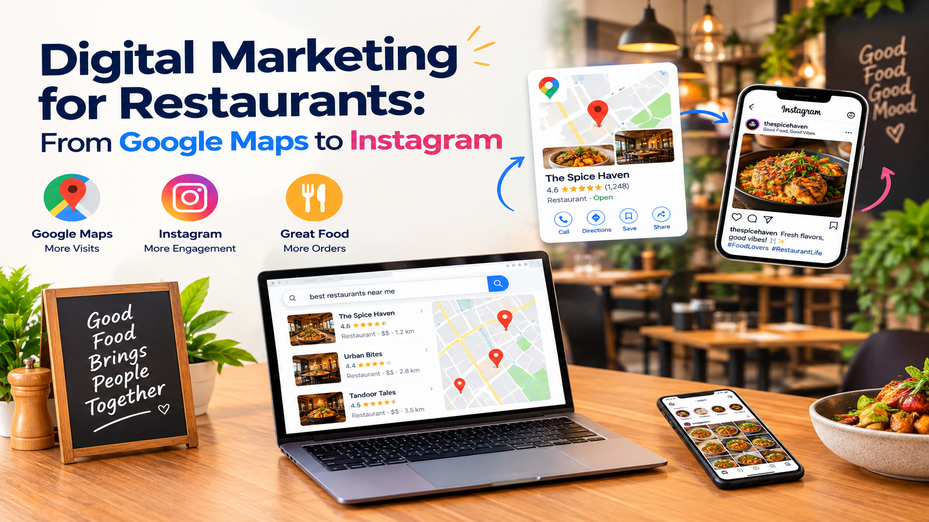
If you're wondering how to market a restaurant online, start where hungry customers actually look.
For most restaurants, that means Google Search and Maps when someone wants a place to eat, and Instagram when they want to see the food, atmosphere, menu, and experience before deciding.
The best restaurant marketing strategy connects both. Search captures existing intent. Social creates desire. Your website, reviews, menu, and booking or ordering experience turn that attention into a visit or order.
Here is what that looks like in practice.
For a local restaurant, Google Maps can be one of the most important digital touchpoints.
Your Google Business Profile should give customers accurate information before they visit:
Keep these details updated. A customer who sees the wrong closing time or an outdated menu may simply choose another restaurant.
Google recommends claiming and verifying your Business Profile so you can manage how your business appears across Google Search and Maps. Google's guide to establishing business details
Restaurant SEO should focus on searches that indicate genuine intent.
Think about what someone near your restaurant might search:
Don't create separate pages for every tiny keyword variation. Build useful location and cuisine pages where they genuinely help customers.
Your website should clearly mention the restaurant's location, cuisine, menu, opening hours, contact details, and other information diners need.
GBIM's restaurant SEO guide also focuses on local search, Google Business Profile optimisation, restaurant websites, and high intent queries.
A restaurant website doesn't need to be complicated.
It needs to answer the questions a customer has before deciding.
Put these details where they're easy to find:
Menu: Make it readable on mobile. If possible, don't hide the entire menu inside an image or difficult PDF.
Location: Show the complete address and an easy route to the restaurant.
Hours: Keep them current, including holiday or special timings.
Reservations: Make booking straightforward.
Ordering: If you offer online ordering, make the route obvious.
Photos: Show actual dishes, interiors, and the dining experience.
A customer shouldn't have to search through Instagram just to find your menu or phone number.
Google captures intent. Instagram can create it.
Restaurant social content works best when it gives people a reason to imagine themselves eating there.
Instead of posting the same food photograph repeatedly, show different parts of the experience:
Short videos can demonstrate texture, preparation, portion size, presentation, and atmosphere far better than a static promotional post.
The content should still have a purpose. A beautiful Reel that attracts views but gives customers no reason to visit isn't doing much for the restaurant.
GBIM's social media marketing services focus on connecting creative content and campaigns with brand strategy and audience engagement.
Reviews influence restaurant decisions because diners want reassurance before spending their time and money.
Encourage genuine customers to leave reviews, then pay attention to what they actually say.
If customers repeatedly praise:
those patterns can inform future content and website copy.
Don't manufacture reviews or offer misleading incentives. Your goal is to make it easy for real customers to share their experience.
Google also uses business information and customer facing signals to help present local businesses in Search and Maps. Google's Local Business guidance explains how structured data can help Google understand details such as business hours and other local business information.
If you have a restaurant website, structured data can help Google understand the business information on your pages.
Google recommends using the most specific LocalBusiness subtype possible, including Restaurant for restaurants. Google's LocalBusiness structured data documentation
But don't treat schema as a shortcut to rankings.
The information in structured data should match what customers can actually see on the page. Google explicitly says structured data can make a page eligible for certain search features, but it does not guarantee that those features will appear. Google's structured data guidelines
Organic search takes time. Paid advertising can help restaurants reach people more quickly.
Google Ads can target people actively searching for relevant restaurants, cuisines, locations, or dining occasions.
Social advertising can work differently. You can use it to reach people based on location, interests, behaviour, or previous interaction with the restaurant.
For example, a restaurant launching a weekend brunch could run:
The message should remain consistent across channels.
GBIM's digital advertising services include Google Ads, social advertising, geographic targeting, contextual targeting, and retargeting.
Followers are useful, but they aren't the whole picture.
For a restaurant, track actions closer to revenue:
If Instagram engagement increases but reservations don't, investigate the journey.
Maybe the content is attracting the wrong audience. Maybe the booking page is slow. Maybe the offer isn't clear.
Good restaurant marketing looks at the entire path from discovery to visit.
At GBIM, we start with the business problem rather than automatically choosing a channel.
Our digital marketing approach looks at growth gaps across visibility, trust, intent, conversion, and intelligence before deciding what needs attention.
For restaurants, that can mean connecting local SEO, content, social media, paid advertising, website experience, and performance tracking.
Our content marketing work also covers content strategy, creation, optimisation, promotion, and reporting. You can see the approach through our content marketing services.
The right mix depends on the restaurant. A new neighbourhood café may need local visibility first. An established restaurant with strong reviews may benefit more from social content and targeted campaigns for specific occasions.
Before building a marketing plan, we need the basics:
Good marketing starts with accurate business information. If the menu, hours, offers, or booking process are unclear, marketing cannot fix the underlying customer experience.
How to market a restaurant online isn't about being present on every platform.
Start with Google Maps and local search so nearby customers can find you. Make your website useful. Use Instagram to show the food and experience. Build genuine reviews, run paid campaigns where they make commercial sense, and measure actions that lead to visits and orders.
At GBIM, we connect these channels around the restaurant's actual growth objective rather than treating SEO, social media, and advertising as separate activities.
Start with Google Business Profile, local SEO, a useful website, Instagram content, reviews, and targeted advertising where appropriate.
Yes. Food, ambience, preparation, and customer experiences are highly visual, making Instagram useful for building interest and giving potential diners a preview of the experience.
Claim and verify your Google Business Profile, keep your business information accurate, and maintain a complete local presence. Google recommends using your Business Profile to manage how your business appears on Search and Maps.
It can help restaurants capture searches from people actively looking for nearby dining options, specific cuisines, dishes, or restaurant experiences.
Paid search can be useful when you want to reach customers actively searching for relevant restaurants or dining options. Budget and targeting should be based on the restaurant's goals.
Show food, preparation, ambience, staff, new dishes, events, customer experiences, and offers. Prioritise content that helps someone decide whether they want to visit.
Track calls, direction requests, website visits, reservations, online orders, offer redemptions, and advertising conversions rather than relying only on followers or likes.
309, Rupa Solitaire,
Sector-1, Millennium Business Park,
Mahape, Navi Mumbai,
Maharashtra (400 710), INDIA.
Write to us at
hr@gbim.com